Cloud-Based ERP Software: Benefits for SMBs
Cloud-based Enterprise Resource Planning (ERP) software is an online business management tool that connects core functions like finance, inventory, and sales into a single system hosted on remote servers
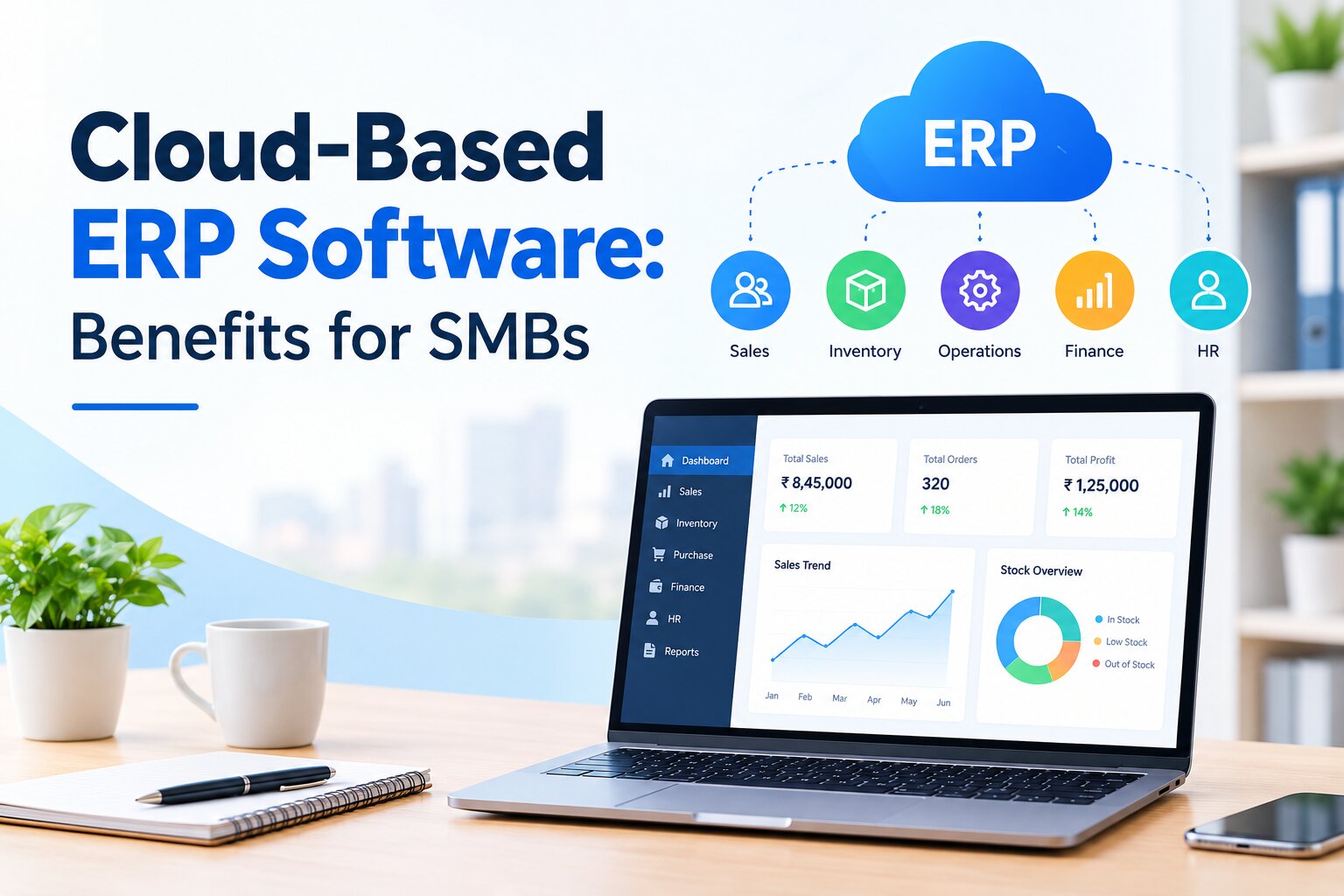
Cloud-Based ERP Software:
Benefits for SMBs
A decade ago, choosing an ERP system meant choosing servers, IT staff, and a significant upfront capital investment before a business ever saw the software actually running. Cloud-based ERP changed that calculation fundamentally, and it's now the default starting point for the overwhelming majority of Indian SMBs evaluating new systems. But "it's what everyone's doing" isn't a reason on its own understanding exactly what cloud ERP delivers, and where it genuinely outperforms the alternative, matters before committing your business's core operations to it for what will likely be a multi-year relationship with whichever vendor you choose.
This guide covers what cloud-based ERP actually means in practical terms, the specific benefits that matter most for growing Indian businesses, honest answers to the security and connectivity concerns that hold some owners back, and how the costs genuinely compare against on-premise alternatives.
This is a genuinely important decision to get right, not because switching later is impossible, but because the deployment model you choose shapes your IT budget, staffing needs, and operational flexibility for years afterward. Understanding the real trade-offs upfront, rather than defaulting to cloud simply because it's currently the popular choice, leads to a more confident and durable decision.
What "Cloud-Based" Actually Means
Cloud-based ERP runs on the vendor's servers, accessed through a web browser or app rather than installed on computers within your office. Your data, application logic, and processing all happen on infrastructure the vendor manages and maintains, while you simply log in and use the system from wherever you have an internet connection.
This is a fundamentally different ownership model than traditional on-premise software, where a business purchases hardware, installs the software directly on it, and takes on responsibility for maintenance, security patches, and backups internally or through a hired IT team.
It's worth noting that "cloud" itself isn't a single uniform category some vendors offer true multi-tenant cloud software shared across many customers on common infrastructure, while others offer single-tenant cloud hosting, where your instance runs on dedicated, isolated infrastructure that happens to be hosted remotely rather than in your own office. The practical benefits described in this guide apply to both variants, though single-tenant options sometimes carry a higher price point in exchange for additional isolation and customization flexibility.
Key Benefits for Growing SMBs
Lower Upfront Investment
Cloud ERP typically operates on a subscription model rather than requiring a large capital purchase of servers and licenses upfront. This makes the initial financial commitment considerably smaller, spreading cost over time rather than requiring a significant lump sum before the system delivers any value a meaningful advantage for SMBs managing tight working capital.
This shift also changes how ERP adoption gets budgeted internally. A subscription fits naturally into a predictable monthly operating expense, which is often easier for a growing business to plan around than a large, one-time capital outlay that competes directly with other growth investments the business might want to make at the same time inventory expansion, a new hire, or a marketing push, for example.
Access From Anywhere, on Any Device
A cloud ERP system works from a laptop at the office, a phone at a client site, or a tablet at a warehouse anywhere with internet access. For businesses with field sales teams, multiple locations, or owners who travel frequently, this accessibility isn't a minor convenience; it fundamentally changes how quickly information moves and decisions get made.
This matters especially for Indian SMBs with a founder or key decision-maker who splits time between multiple sites or travels for business development. Being able to approve a purchase order, check cash position, or review a sales report from anywhere removes a bottleneck that on-premise systems, tied to specific office terminals, simply can't match.
Automatic Updates and Maintenance
The vendor handles software updates, security patches, and infrastructure maintenance, meaning your business always runs on a current, supported version without needing internal IT staff dedicated to this ongoing task. This removes a genuine operational burden that on-premise systems place on businesses, many of which lack the in-house technical capacity to manage it well.
For most SMBs, this translates to real, measurable savings not just in direct IT salary costs, but in the management attention that would otherwise go toward overseeing server maintenance, patch schedules, and the inevitable troubleshooting that comes with running infrastructure internally.
Easier Scalability
Adding users, storage, or additional modules on a cloud ERP typically means adjusting your subscription rather than purchasing and installing new hardware. This flexibility matters enormously for a growing business, where predicting exact future capacity needs years in advance is genuinely difficult.
This scalability works in both directions, which is sometimes overlooked. A business going through a slower season or a temporary team reduction can typically scale a cloud subscription down as well, whereas on-premise infrastructure purchased for peak capacity sits underutilized, and its cost, during quieter periods.
Built-In Disaster Recovery
Reputable cloud ERP vendors maintain redundant infrastructure and regular backups as a core part of their service, offering a level of disaster recovery preparedness that most individual SMBs would struggle to replicate on their own on-premise setup, both in terms of cost and technical expertise required.
This matters more than it might seem in daily operations. A fire, flood, theft, or simple hardware failure that would represent a genuine business continuity crisis for an on-premise system is typically a non-event for cloud ERP users, since the data and application were never dependent on a single physical location in the first place.
Faster Initial Deployment
Without the need to procure, install, and configure physical servers, cloud ERP implementations generally move from kickoff to a working system faster than equivalent on-premise projects, letting a business start realizing value sooner.
This speed advantage compounds with the earlier point about lower upfront cost a business isn't just spending less to get started, it's also waiting less time before that investment starts delivering operational value, shortening the payback period considerably compared to a longer, hardware-dependent on-premise rollout.
Addressing Common Concerns
Despite these benefits, some business owners remain hesitant about cloud ERP, usually for a few specific, legitimate reasons worth addressing directly rather than dismissing.
"Is Our Data Actually Secure in the Cloud?"
Reputable cloud ERP vendors typically invest considerably more in security infrastructure encryption, access controls, regular security audits than most individual SMBs could afford to implement on their own on-premise systems. The relevant question isn't "cloud versus not cloud" in the abstract, but evaluating a specific vendor's actual security practices and certifications before committing.
It's worth flipping the usual framing here: for most SMBs, an on-premise server sitting in a back office, maintained without dedicated security expertise, is often meaningfully less secure than a properly configured cloud platform backed by a vendor whose entire business depends on maintaining strong security practices at scale. The intuition that "our own server in our own building" feels inherently safer doesn't hold up once you account for the gap between a dedicated security team and an SMB's typically limited internal IT capacity.
"What Happens If Our Internet Goes Down?"
This is a legitimate concern in areas with less reliable connectivity, though it's become less significant as internet infrastructure across India has improved substantially in recent years. Many cloud ERP platforms also offer limited offline functionality for critical tasks, syncing automatically once connectivity returns worth confirming specifically with any vendor if this is a genuine operational concern for your business's location.
For businesses in areas with genuinely unreliable connectivity, a practical mitigation is a backup internet connection through a different provider or a mobile hotspot as failover a considerably cheaper safeguard than maintaining an entire on-premise server infrastructure purely to avoid this risk. Most businesses that seriously evaluate this trade-off find that a modest backup connectivity plan costs far less than the ongoing burden of self-managed infrastructure, while still providing adequate protection against occasional outages.
"Do We Lose Control Over Our Own Data?"
A well-structured vendor agreement should guarantee your ownership of your data and a clear, straightforward process for exporting it if you ever choose to switch providers. This is a contractual question worth confirming explicitly before signing, rather than an inherent limitation of cloud ERP as a category.
Reading the data ownership and export terms in a vendor's contract before signing is a simple, often-skipped step that protects against genuine lock-in risk. A vendor unwilling to clearly commit to your data ownership and portability in writing is a red flag worth taking seriously, regardless of how strong the rest of their platform appears on the surface during a sales demonstration.
Cloud ERP vs. On-Premise: A Realistic Cost Comparison
|
Cost Factor |
Cloud ERP |
On-Premise ERP |
|
Upfront Investment |
Low subscription-based |
High hardware, licenses, setup |
|
Ongoing Costs |
Predictable monthly/annual subscription |
Maintenance, IT staff, periodic hardware refresh |
|
IT Staffing Needs |
Minimal vendor handles infrastructure |
Requires internal or contracted IT support |
|
Scalability Cost |
Incremental, tied to usage growth |
Often requires new hardware investment |
|
Disaster Recovery |
Typically included by the vendor |
Business must build and maintain its own |
Over a multi-year period, cloud ERP's total cost frequently comes out lower for SMBs specifically because it avoids the large upfront capital expense and ongoing internal IT staffing that on-premise systems require though very large, established enterprises with existing IT infrastructure sometimes find on-premise economics more favorable at their scale.
It's worth running this comparison with real numbers specific to your business rather than relying on general assumptions. Factor in not just the software licensing difference, but the fully loaded cost of IT staff time, hardware refresh cycles typically needed every three to five years for on-premise setups, and the genuine cost of downtime if an on-premise system fails without the redundancy a cloud vendor typically builds in as standard.
|
The SMB Sweet Spot Cloud ERP's advantages are strongest precisely for the SMB segment businesses too small to justify a dedicated IT department, but growing fast enough to need real scalability without repeated hardware investment. This is exactly why cloud has become the default recommendation for Indian SMBs evaluating ERP in 2026. |
When On-Premise Still Makes Sense
Despite cloud's clear advantages for most SMBs, a small number of specific situations still favor on-premise deployment, and it's worth being honest about them rather than presenting cloud as universally superior.
• Businesses in highly regulated industries with strict data residency requirements that specifically mandate on-site data storage
• Businesses with substantial existing IT infrastructure and staff already in place, where the marginal cost of maintaining on-premise systems is genuinely low
• Operations in areas with persistently unreliable internet connectivity, where cloud dependency would create real, frequent operational risk
• Very large enterprises where the economics of scale shift in favor of owning infrastructure outright rather than paying ongoing subscription costs
For the substantial majority of Indian SMBs, none of these conditions apply strongly enough to outweigh cloud's advantages in cost, accessibility, and reduced IT burden which is why cloud has become the default recommendation rather than merely one option among equals.
What to Look for in a Cloud ERP Provider
Beyond the general benefits described above, choosing the right specific vendor matters just as much as choosing cloud deployment in the first place. A few practical evaluation points help separate a genuinely reliable partner from one whose marketing outpaces their actual service quality.
• Clear data ownership and export terms, confirmed in writing before signing any agreement
• Transparent uptime guarantees and a track record of actually meeting them, not just marketing claims
• Security certifications and a willingness to explain their specific practices in detail, not just reassurance in general terms
• Responsive support with a clear escalation path for urgent issues, not a generic ticket queue with no visibility into response time
• Pricing transparency, including what happens to cost as you add users, storage, or modules over time
What This Looks Like in Practice
A building materials distributor in Dehradun, supplying to construction contractors across the region, had been putting off ERP adoption for years, assuming the upfront cost of servers and IT staff was simply beyond what their business could justify at their current size.
The owner had actually researched ERP options twice before, both times several years apart, and both times concluded the investment wasn't justified based on cost estimates that were, in hindsight, based on outdated assumptions about on-premise infrastructure requirements that no longer reflected how modern cloud ERP is actually priced and deployed.
InfoTechBrains implemented a cloud-based ERP tailored to their distribution workflow, eliminating the need for any on-premise infrastructure investment. The business's field sales team, previously reliant on phone calls back to the office to check stock, gained direct mobile access to real-time inventory from client sites.
The rollout was phased across their two locations, starting with the main warehouse before extending to a smaller satellite location, allowing the team to build confidence and work through any early issues on a smaller scale before the full multi-location rollout.
|
₹0 Spent on servers or on-premise hardware |
3 weeks From decision to go-live |
40% Faster stock-check response time for field sales |
The owner's own reflection was direct: he'd assumed ERP meant a significant capital investment his business wasn't ready for, and hadn't realized the cloud model had fundamentally changed that assumption years before he finally looked into it seriously. The broader lesson for hesitant SMB owners: the barriers that once made ERP feel like an enterprise-only investment have largely dissolved with cloud deployment, and businesses delaying adoption on outdated cost assumptions are often missing genuinely accessible options already suited to their exact size and budget. Revisiting a decision made even a few years ago with current cloud pricing and deployment realities in mind is often worth the time, given how much the underlying economics have shifted in the SMB's favor.
|
Considering Cloud ERP for Your Business? InfoTechBrains helps Indian SMBs evaluate and implement cloud ERP systems including custom-built options when off-the-shelf cloud platforms don't quite fit. Call / WhatsApp: +91 84594 18970 Visit: https://infotechbrains.com/ |
About the author
InfoTechBrains Team
Technology expert focused on software architecture, automation, and digital transformation.
View profile & all posts →