Types of ERP Systems: Which One Fits Your Business
Enterprise Resource Planning (ERP) systems are software platforms that connect business processes into one unified database. The main types of ERP deployment include cloud, on-premises, and hybrid systems. Choosing the right fit depends on your company size, industry, and budget.
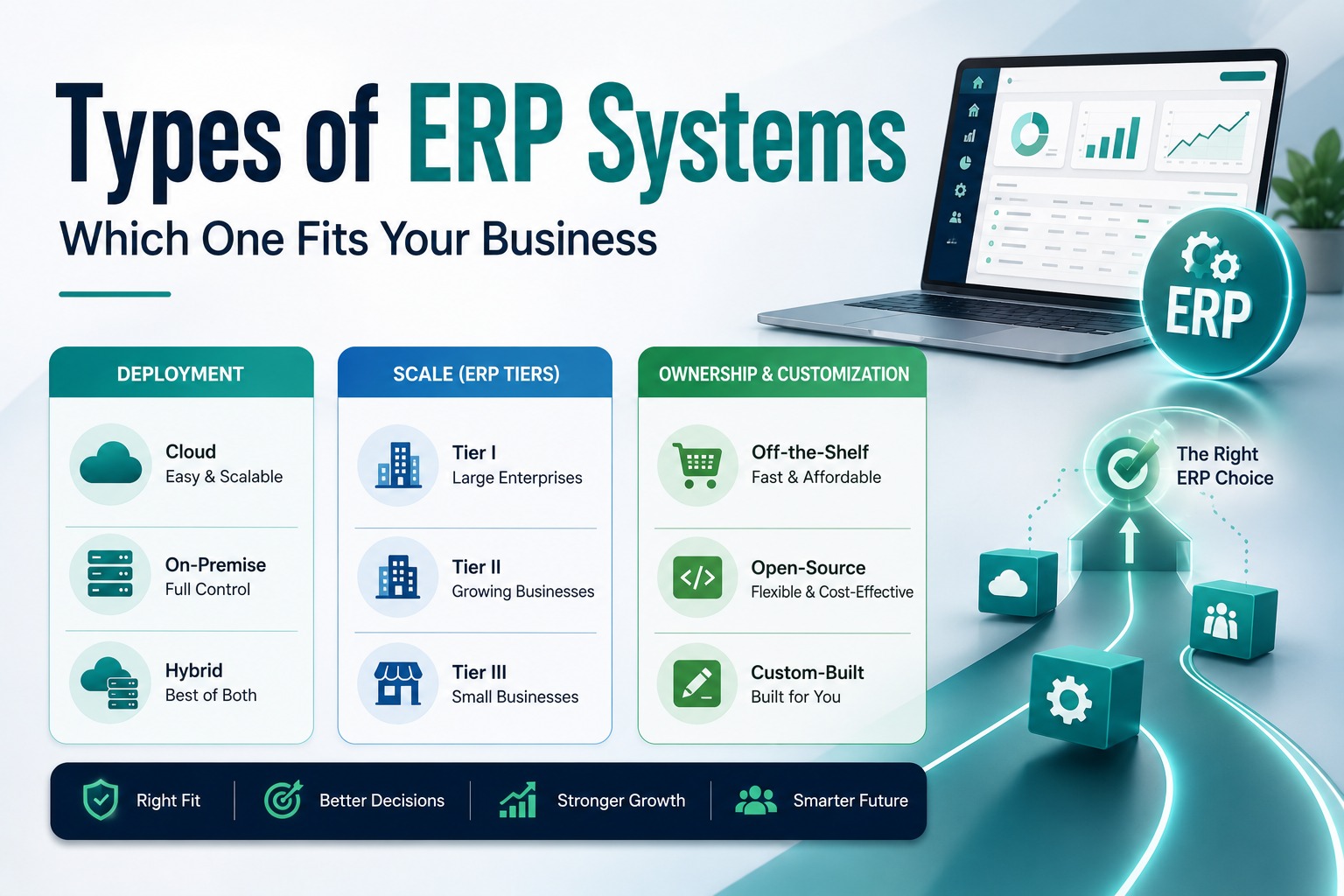
Types of ERP Systems:
Which One Fits Your Business
Search for "ERP systems" and you'll quickly run into a wall of overlapping categories cloud ERP, on-premise ERP, Tier I versus Tier III, open-source versus proprietary each described as if the listener already understands the underlying framework. For a business owner simply trying to figure out what actually applies to them, this alphabet soup of classifications is more confusing than helpful, and most vendor websites don't help matters by using these terms interchangeably rather than explaining what each one actually implies for a buyer.
The reality is that ERP systems are typically categorized along three separate dimensions, not one and understanding all three, rather than picking a system based on brand recognition alone, is what actually leads to a good decision. This guide breaks each dimension down clearly.
Think of it less like choosing a single product off a shelf and more like specifying a custom order across three independent menus how it's hosted, what scale it's built for, and how much of it is standard versus tailored to you. A business that only considers one of these menus, usually deployment model because it's the most heavily marketed distinction, often ends up with a system that's technically "cloud-based" and modern-sounding but completely wrong for their actual scale or workflow complexity.
Dimension 1: Deployment Model
The first, and most commonly discussed, way ERP systems differ is in how they're hosted and accessed.
Cloud-Based ERP
Hosted on the vendor's servers and accessed through a browser or app, cloud ERP has become the default choice for most SMBs due to lower upfront cost, faster deployment, and automatic updates handled by the vendor. The trade-off is ongoing subscription cost and a degree of dependency on internet connectivity and the vendor's infrastructure.
For most growing Indian businesses without a dedicated IT team, cloud ERP has become the practical default someone else handles the servers, the backups, and the security patching, which matters enormously for a business whose core competency is manufacturing, distribution, or services, not IT infrastructure management.
On-Premise ERP
Installed and run on a business's own servers, on-premise ERP offers greater control over data and customization, historically favored by businesses with strict data residency requirements or highly specific infrastructure needs. It typically requires a larger upfront investment and an internal or contracted IT team to maintain.
On-premise remains relevant for a shrinking but real segment of businesses — those in regulated industries with specific data-residency mandates, or those with existing infrastructure investment that makes a cloud migration less attractive in the near term. For most SMBs starting fresh in 2026, though, it's increasingly the exception rather than the default choice.
Hybrid ERP
A hybrid approach keeps certain sensitive or performance-critical functions on-premise while running other modules in the cloud, offering a middle ground for businesses that need specific control without forgoing cloud convenience entirely. This is less common among SMBs but appears more often as businesses scale toward mid-market complexity.
Dimension 2: Business Scale (ERP Tiers)
The second dimension categorizes ERP by the scale of business it's built to serve often referred to informally as Tier I, Tier II, and Tier III.
|
Tier |
Typical Business Size |
Example Platforms |
|
Tier I (Enterprise) |
Large enterprises, multi-national operations |
SAP S/4HANA, Oracle NetSuite (enterprise tier) |
|
Tier II (Mid-Market) |
Growing mid-sized businesses, multi-location SMEs |
SAP Business One, Microsoft Dynamics 365 Business Central |
|
Tier III (Small Business) |
Small businesses, single-location SMEs |
TallyPrime, Zoho, Odoo, custom-built ERP |
Most Indian SMBs fall naturally into Tier III territory, though the boundaries blur as a business grows a company in the middle of a strong growth phase might start on a Tier III platform and outgrow it within a few years, which is worth factoring into the decision rather than optimizing purely for today's size. It's generally more cost-effective to plan one tier ahead of your current scale than to repeat a full ERP evaluation and migration every eighteen months as the business grows past each platform's ceiling.
Dimension 3: Ownership and Customization Model
The third, and often least discussed, dimension is how much of the system is standard versus built specifically for your business.
Off-the-Shelf ERP
A pre-built platform used by many businesses with minimal modification, offering the fastest deployment and lowest upfront cost, at the expense of flexibility for genuinely unique workflows.
This is the right starting point for most standard businesses a trading company, a straightforward retailer, a services firm without unusual compliance needs. The moment a business's core operations diverge meaningfully from the norm, though, off-the-shelf systems begin requiring the same workarounds that made spreadsheets unsustainable in the first place.
Open-Source ERP
Platforms like ERPNext or the Odoo Community edition offer the underlying code free to use and modify, appealing to businesses with in-house technical capability or access to a skilled implementation partner, though the total cost of a fully functioning deployment is rarely as low as "free" suggests.
The appeal of open-source is real ownership and no per-user licensing fees over the long run, but it shifts significant responsibility onto the business or its implementation partner — hosting, security, updates, and support all become internal responsibilities rather than something a vendor handles automatically.
Custom-Built ERP
Designed and built specifically around a business's actual workflows, custom ERP carries the highest upfront investment but eliminates the ongoing workarounds and forced compromises that come with fitting a unique business into generic software.
This doesn't have to mean building everything from scratch. In practice, the most cost-effective custom ERP builds start from a proven financial and inventory core, then apply custom development only to the specific modules where a business's workflow genuinely diverges from the standard pattern keeping cost proportional to actual uniqueness rather than rebuilding solved problems unnecessarily.
|
Why All Three Dimensions Matter Together A business evaluating ERP often picks a platform based on just one dimension usually deployment model or brand recognition without considering scale-fit or ownership trade-offs. The right choice sits at the intersection of all three, not any single one in isolation. |
Which Type Actually Fits Your Business
• Small, single-location business with standard processes: cloud-based, Tier III, off-the-shelf platform fastest and cheapest path to a working system
• Growing mid-market business with some unique workflows: cloud or hybrid, Tier II or upper Tier III, with selective customization on the modules that matter most
• Business with highly specific processes generic platforms can't represent well: custom-built ERP, typically cloud-hosted, regardless of current sizethe ownership dimension matters more here than the scale tier
• Technically capable team wanting maximum control and no licensing fees: open-source ERP, on-premise or self-hosted cloud, provided the internal or partner technical capacity genuinely exists
What This Looks Like in Practice
A mid-sized pharmaceutical distributor in Bhopal had spent months evaluating ERP options by comparing brand names alone TallyPrime versus Zoho versus SAP without a clear framework for what actually mattered to their specific situation: multi-location inventory, batch expiry tracking, and strict documentation for regulatory compliance across all three of their warehouses.
InfoTechBrains helped the business work through the decision along all three dimensions: cloud deployment for accessibility across their three warehouse locations, positioned between Tier II and Tier III given their growth trajectory, and a hybrid ownership model a standard financial and inventory core with custom-built batch expiry and compliance tracking layered on top. This approach avoided both the six-figure cost of jumping straight to a Tier II enterprise platform and the compliance gaps a pure off-the-shelf Tier III system would have left unaddressed.
|
3 Warehouse locations unified on one system |
100% Batch expiry tracking accuracy post-rollout |
6 weeks From framework decision to go-live |
The owner's reflection was direct: once the decision was broken into these three separate questions instead of one overwhelming "which ERP should we buy," the choice became considerably clearer, and considerably faster to make with genuine confidence. That structured approach deployment, scale, ownership, evaluated as three distinct decisions tends to serve any growing Indian business better than comparing platforms by reputation alone, precisely because it forces each trade-off into the open instead of letting a single flashy feature or a familiar brand name make the decision by default.
|
Not Sure Which Type of ERP Fits Your Business? InfoTechBrains helps Indian SMBs evaluate deployment models, scale tiers, and ownership options and builds custom ERP when off-the-shelf doesn't fit. Call / WhatsApp: +91 84594 18970 Visit: https://infotechbrains.com/ |
About the author
InfoTechBrains Team
Technology expert focused on software architecture, automation, and digital transformation.
View profile & all posts →