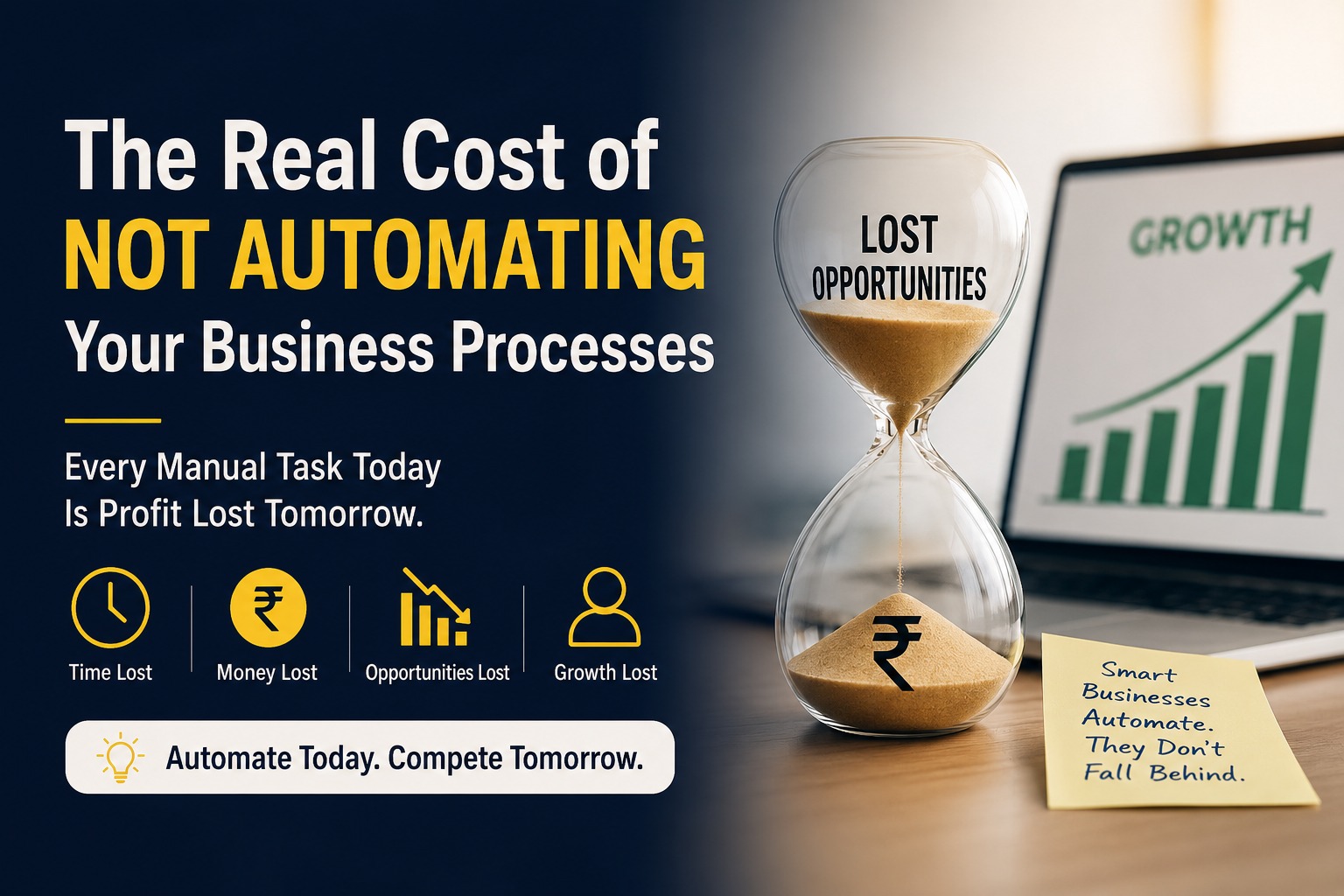
The Real Cost of NOT Automating Your Business Processes
Discover the hidden costs Indian SMBs face by not automating business processes, including lost revenue, time, and talent. This guide provides real numbers, case studies, and benchmarks to highlight the urgent need for AI automation. Understand how manual workflows drain resources and impede growth, and learn the strategic advantages of automation. Make informed decisions to reduce costs, increase efficiency, and stay competitive in a rapidly evolving market.
|
AI AUTOMATION & INTEGRATION | SERIES ARTICLE 4 The Real Cost of NOT Automating Your Business Processes A Loss-Aversion Guide for Indian SMBs — With Real Numbers InfoTechBrains | infotechbrains.in | ISO 9001:2015 Certified |
|
Meta Description: Still running your Indian SMB on spreadsheets and manual workflows? Discover the real financial, competitive, and operational cost of delaying AI automation — with benchmarks, case studies, and an actionable path forward. |
The Business You're Losing Right Now — Without Even Knowing It
Most business owners think about automation as an expense: something to buy, implement, and manage. But that framing misses the more important question — what is the absence of automation already costing you?
Manual processes don't announce their cost. There's no invoice that says 'you lost 18 leads this month to slow follow-up' or 'your team wasted 600 hours on data entry that generated zero revenue.' The cost is invisible, distributed, and compounding — and for most Indian SMBs, it runs into lakhs of rupees per year.
This article makes the invisible visible. We'll break down the real cost of not automating — across time, money, growth, and competitive position — and show you the numbers that should make this decision urgent.
|
₹6.2L Average annual revenue lost per SMB due to manual process delays ASSOCHAM India Report, 2025 |
47% of Indian SMBs say they lost a client to a faster-responding competitor Zoho Business Survey, 2025 |
22 hrs per employee per week spent on tasks with no strategic value NASSCOM Digital SMB Study, 2025 |
Part 1: The Hidden Costs of Manual Work
When founders add up automation costs, they include software fees and implementation time. Almost no one adds up what manual work actually costs. Here are the five hidden cost categories that will surprise you.
|
₹ |
Hidden Cost #1: Salary Spent on Zero-Value Work Your highest cost resource — human attention — deployed on tasks machines do better |
Let's do the math. A mid-level operations or sales executive in an Indian SMB earns approximately ₹30,000–₹50,000 per month. Research shows that 40–60% of their working hours go toward repetitive, rule-based tasks: data entry, status updates, report generation, follow-up emails, manual reconciliation.
At 50% utilization on automatable tasks, you are effectively paying ₹15,000–₹25,000 per employee per month for work a system could handle for a fraction of that cost.
For a 10-person team, that's ₹1.8L to ₹3L per month — ₹21.6L to ₹36L per year — in salary allocated to work that creates no strategic value.
|
⏱ |
Hidden Cost #2: The Cost of Human Error Mistakes that seem small individually create compounding operational damage |
Manual processes have an inherent error rate. Data entry errors, missed follow-ups, incorrect invoice amounts, double-bookings, wrong dispatch quantities — individually, each seems minor. Collectively, they erode customer trust, create rework cycles, and in some cases directly reduce revenue.
• A missed lead follow-up in a ₹5L deal pipeline could cost you the entire deal
• An invoice error requiring correction and re-approval adds 3–5 days to payment cycles
• A stock entry mistake can trigger an incorrect procurement order costing lakhs
• Customer data entered incorrectly means your marketing segments are unreliable from day one
|
The Rework Tax Studies show that correcting a data entry error costs 10x more than preventing it. For SMBs running primarily manual workflows, rework consumes an estimated 15–20% of total operational capacity — work that doesn't produce output, only restores what was lost. |
|
📉 |
Hidden Cost #3: Opportunity Cost of Speed Gaps Every hour your competitor responds faster is revenue that left your pipeline |
Speed is a product feature. When a prospect reaches out to three vendors and your competitor responds in 3 minutes via automated WhatsApp while your team responds 4 hours later, you didn't just lose on price or quality — you lost on infrastructure.
Research from the Harvard Business Review shows that leads contacted within the first 5 minutes of inquiry are 21x more likely to convert than those contacted after 30 minutes. At scale, across hundreds of leads per month, this speed gap alone can account for 20–35% of lost potential revenue.
|
👥 |
Hidden Cost #4: Talent Drain and Burnout Your best people quit repetitive jobs — and take institutional knowledge with them |
Here's a cost that never appears on a P&L but is felt acutely by every founder who's replaced a good employee: talent turnover. Smart, capable team members who spend their days on repetitive, low-meaning tasks don't stay. They leave — for competitors, for larger companies, or for businesses that offer more interesting work.
The average cost to replace an employee in India, factoring in recruitment, onboarding, and lost productivity during transition, ranges from ₹50,000 to ₹2,00,000 depending on seniority. For a business experiencing regular turnover driven by process burnout, this is a recurring, underestimated cost.
|
What Gets Lost With the Employee Manual businesses rely on individual people remembering process details, client preferences, and operational know-how. When those people leave, the knowledge leaves with them. Automated businesses encode that knowledge into systems — it stays, regardless of who's on the team. |
|
🔗 |
Hidden Cost #5: Scaling Lock — Growth Requires More Headcount The ceiling that prevents profitable scale is usually a process problem, not a product problem |
The most structurally damaging cost of not automating isn't monthly — it's strategic. Manual businesses hit a ceiling: every new unit of growth requires a proportional increase in headcount. This creates a cost structure that makes profitability harder to achieve at scale.
AI-automated businesses break this link. They can handle 3x the customer volume without adding staff, process 5x the orders without proportional admin overhead, and grow revenue while keeping cost per transaction declining. That structural advantage compounds year over year.
Part 2: Time Lost vs. Time Saved — The Real Numbers
Abstract cost discussions don't change behaviour. Specific numbers do. Here's a realistic time-cost breakdown for a typical 10-person Indian SMB team running primarily manual workflows:
|
Task |
Hrs/Week (Manual) |
Hrs/Week (Automated) |
Annual Hours Saved |
|
Lead capture & CRM entry |
18 hrs |
2 hrs |
832 hrs |
|
Customer follow-up (email/WhatsApp) |
24 hrs |
3 hrs |
1,092 hrs |
|
Report generation & data pull |
12 hrs |
0.5 hrs |
598 hrs |
|
Invoice processing & follow-up |
16 hrs |
2 hrs |
728 hrs |
|
Inventory updates & reconciliation |
20 hrs |
3 hrs |
884 hrs |
|
Internal status updates & handoffs |
14 hrs |
4 hrs |
520 hrs |
|
Customer support ticket routing |
14 hrs |
2 hrs |
624 hrs |
|
HR & attendance manual tracking |
20 hrs |
5 hrs |
754 hrs |
|
TOTAL (10-person team) |
~138 hrs |
~22 hrs |
6,032 hrs/yr |
6,032 hours per year — that's what a 10-person team gets back when manual workflows are replaced by AI automation. At an average fully-loaded cost of ₹350/hour for your team, that's ₹21.1 lakh in recoverable capacity per year. Not theoretical savings. Actual time that gets redirected to revenue-generating work.
Part 3: What Your Automated Competitors Are Already Doing
The gap between AI-automated businesses and manual ones isn't emerging — it's already here. Across every sector that InfoTechBrains serves — retail, manufacturing, solar, and professional services — we're seeing the same pattern: businesses that moved early on automation are creating structural advantages that are increasingly difficult to close.
|
Metric |
AI-Automated Competitor |
Manual Business (You?) |
|
Lead response time |
Under 3 minutes (automated WhatsApp + routing) |
4–24 hours (manual assignment) |
|
Quote turnaround |
Same day — auto-generated from CRM data |
2–5 days — manually created |
|
Follow-up consistency |
100% — system-driven sequences |
60–70% — depends on rep memory |
|
Customer support first reply |
Under 5 minutes — AI chatbot triage |
4–8 hours business hours only |
|
Order processing accuracy |
99%+ — system-to-system sync |
92–95% — human data entry |
|
Monthly reporting time |
Real-time dashboard — zero manual effort |
2–3 days of team time monthly |
|
Sales pipeline visibility |
Full — real-time, CRM-integrated |
Partial — spreadsheet-dependent |
This table isn't hypothetical it represents the measurable operational gap between businesses that have invested in automation and those that haven't, based on actual client engagements across Indian SMB sectors.
The businesses on the left column aren't all large companies with enterprise budgets. Many are SMBs the same size as yours. The difference is infrastructure, not investment scale.
Part 4: Case Study with Numbers What Changing Made Possible
|
CASE STUDY Manufacturing Components Supplier, Faridabad Challenge: A mid-sized B2B manufacturing components company with 35 employees was managing 150–200 weekly inquiries, order tracking, and dispatch coordination entirely through WhatsApp groups, email, and Excel. The sales team was spending 60% of working hours on administrative tasks. Orders were being lost due to slow response times, and month-end reporting took 3 full days of senior management time. Outcome: InfoTechBrains implemented an integrated WhatsApp automation layer, a lightweight CRM with auto-lead capture from web and WhatsApp, automated dispatch notifications, and a real-time dashboard replacing manual reporting. The entire implementation took 8 weeks. • Lead response time: from avg. 9.5 hours to under 4 minutes • Sales admin time reduction: 60% of day down to 22% — over 3 hrs/day freed per rep • Order error rate: reduced from 8% to under 1.5% within 90 days • Month-end reporting time: from 3 days to 2 hours (dashboard + auto-pull) • Revenue impact: 28% increase in lead-to-order conversion within 4 months • Annual recoverable capacity estimated at ₹18.4 lakhs (salary reallocated to productive work) |
|
The Key Insight from This Case The company didn't grow because they hired more people or launched new products. They grew because they stopped losing what they already had: leads slipping through response gaps, errors creating rework, and management time disappearing into manual reporting. |
Part 5: Side-by-Side The True Cost Comparison
Let's put it all together in a direct comparison. This is based on a representative 10-person Indian SMB with annual revenue of ₹2–5 crore:
|
Business Function |
Without Automation |
With AI Automation |
|
Lead management |
₹3.8L/yr in salary on manual entry + ~30% lead loss |
₹0.8L/yr tool cost + near-zero lead leakage |
|
Customer support |
₹4.2L/yr on repetitive query handling |
₹0.6L/yr AI chatbot + human handling complex issues only |
|
Order & invoice processing |
₹2.9L/yr on admin + error correction cost |
₹0.5L/yr automation + 99%+ accuracy |
|
Reporting & analytics |
₹1.8L/yr of senior time on manual dashboards |
₹0.3L/yr — real-time, self-updating |
|
Talent turnover (burnout) |
₹2.5L–₹5L/yr in replacement & onboarding costs |
Significantly reduced — more meaningful work retained staff |
|
Total estimated cost |
₹15–22L/yr (visible + hidden combined) |
₹2.2–3.5L/yr tools + implementation amortized |
The numbers in this table are estimates your actual numbers will depend on team size, sector, and current tech stack. But the ratio is consistent: manual operations cost 5 to 8 times more than automated ones when all costs are accounted for.
What to Do With This Information
Reading this and recognising your business in these numbers is step one. Step two is deciding what to do about it and the most important thing we can tell you is: don't try to automate everything at once.
The Three Questions to Answer Before You Start
• Question 1: What is our single most expensive manual process in time or errors?
• Question 2: What would it mean for our business if that one process ran automatically, accurately, 24/7?
• Question 3: What's the cost of waiting 6 more months in lost leads, salary, errors, and competitive gap?
If you can answer those three questions clearly, you have the business case for your first automation project. From there, the pattern is consistent: start with one process, measure the result, use the ROI data to justify expanding.
InfoTechBrains has implemented automation solutions for Indian SMBs across retail, manufacturing, solar, and professional services starting from as low as a single WhatsApp automation workflow, scaling up to full ERP and CRM integration. We help you find the right starting point, not the most expensive one.
|
Stop Paying the Manual Tax Get a free Cost of Inaction Assessment from InfoTechBrains. We'll calculate your actual annual cost of manual operations — no obligation. ISO 9001:2015 certified. Serving retail, manufacturing, solar & professional services. Practical automation for Indian SMBs. Real ROI. No enterprise jargon. www.infotechbrains.in | +91-XXXXX-XXXXX | [email protected] |
|
About InfoTechBrains InfoTechBrains (infotechbrains.in) is an ISO 9001:2015 certified technology company helping Indian SMBs across retail, manufacturing, solar, and professional services unlock growth through AI automation, ERP software, WhatsApp Business API, and custom web and mobile solutions. We build practical, affordable systems — not theoretical roadmaps. |
About the author

Aman Gupta
Founder & CEO at InfoTechBrains, helping SMEs scale and reduce manual work with AI, automation and custom software.
View LinkedIn ProfileView profile & all posts →