AI in Customer Support for Indian SMBs: How Predictive Analytics Cuts Response Time
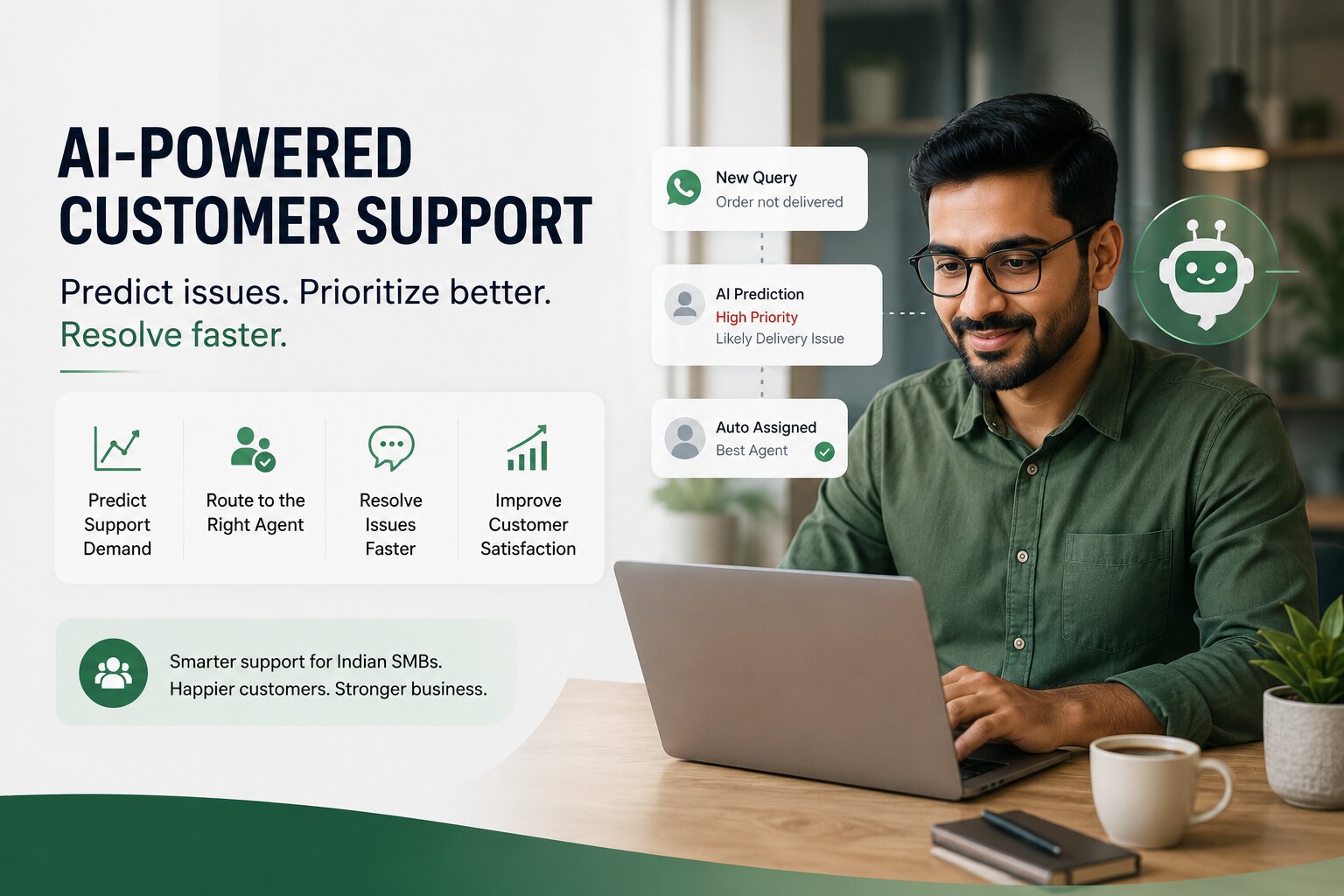
For Indian SMBs, AI-driven predictive analytics slashes support wait times by forecasting customer needs, detecting sentiment, and automating case routing. By resolving routine issues instantly and triaging urgent tickets, businesses reduce operational costs and boost customer satisfaction
AI AUTOMATION & INTEGRATION
AI in Customer Support for Indian SMBs: How Predictive Analytics Cuts Response Time
Indian SMBs from D2C retailers in Mumbai to solar EPC firms in Ahmedabad are discovering that customer support can no longer run on guesswork. A single delayed reply on WhatsApp or email can cost a sale, a renewal, or a referral. Predictive analytics is changing that equation: instead of reacting to complaints after they pile up, growing businesses across India are using AI to anticipate support demand, route the right ticket to the right person, and resolve issues before customers even have to ask twice.
This article breaks down what predictive analytics actually means in a support context, where it delivers the fastest wins for small and mid-sized teams, what a realistic tech stack looks like, and how to measure whether it's working.
|
42% Avg. drop in first response time after predictive routing |
3.2x Faster ticket triage vs. manual assignment |
27% Fewer repeat/escalated tickets |
What Predictive Analytics Actually Means in Customer Support
Predictive analytics is the practice of using historical support data past tickets, response times, product issues, seasonal patterns to forecast what's likely to happen next, and act on it before it becomes a problem. In a support context, this isn't abstract data science; it's a practical layer sitting on top of the tools your team already uses.
For an Indian SMB, this typically looks like three capabilities working together:
• Volume forecasting: predicting when ticket or WhatsApp message volume will spike (festival sales, GST filing deadlines, monsoon-related service disruptions) so staffing can be planned in advance.
• Issue prediction: flagging customers likely to raise a complaint based on early signals a delayed shipment, a failed payment retry, a product nearing its AMC renewal date.
• Smart routing: automatically assigning tickets to the agent or bot best equipped to resolve them, based on urgency, complexity, and past resolution patterns.
|
Why This Matters More for SMBs Than Enterprises Large enterprises can absorb a slow support queue with sheer headcount. SMBs can't. A 15-person team handling 200 tickets a day has no slack predictive analytics gives that same team enterprise-level responsiveness without enterprise-level hiring. |
Use Cases in Support: Where Predictive Analytics Delivers Real Results
1. Proactive Issue Resolution
Rather than waiting for a customer to write in, predictive models flag at-risk situations early. A solar installation business, for example, can use AMC renewal data and past service-call patterns to reach out to a customer before their inverter warranty lapses turning a potential complaint into a retention conversation.
2. Intelligent Ticket Routing
Not every query needs a senior agent. Predictive routing analyzes ticket content, customer history, and urgency signals to send simple queries (order status, GST invoice requests) to a WhatsApp chatbot, while routing complex or high-value complaints straight to a human specialist cutting resolution time without adding headcount.
3. Staffing and Shift Planning
Retail and e-commerce SMBs see predictable spikes around Diwali, EOSS, and festive sale periods. Predictive models trained on 12-18 months of ticket data can forecast these spikes weeks ahead, so managers can plan shifts and temporary support staff instead of scrambling when volume triples overnight.
4. Sentiment and Escalation Prediction
Natural language models can scan incoming messages for frustration signals repeated contact attempts, negative sentiment, all-caps messages and flag them for priority handling before a minor issue turns into a public review or a lost customer.
|
Case Study: Manufacturing SME, Pune A precision components manufacturer serving 40+ B2B clients was averaging an 18-hour first response time on service queries, often losing clients to faster-responding competitors. After deploying predictive ticket routing integrated with their WhatsApp Business API and CRM, first response time dropped to under 5 hours, and repeat-complaint tickets fell by nearly a third within the first quarter. |
Tools & Tech Stack: What a Realistic Setup Looks Like
You don't need a data science team to get started. Most Indian SMBs can build an effective predictive support stack from a handful of connected tools:
|
Layer |
Purpose |
Typical Tools |
|
Data Source |
Capture support history & customer signals |
CRM, helpdesk, WhatsApp Business API |
|
Prediction Engine |
Forecast volume, flag risk, score urgency |
AI/ML overlay integrated with CRM |
|
Routing & Automation |
Send tickets to the right bot or agent |
Workflow automation, chatbot layer |
|
Reporting |
Track response time, resolution, CSAT |
Dashboard/BI reporting tools |
The key isn't buying more software it's making sure your existing CRM, WhatsApp channel, and support inbox actually talk to each other. Most SMBs already have the raw data; what's missing is the integration layer that turns it into predictions and automated action. This is typically where a technology partner adds the most value: connecting systems that were never designed to work together.
Measuring Success: The Metrics
That Actually Matter
Predictive analytics initiatives fail when businesses track vanity metrics instead of outcomes. For an Indian SMB, these are the numbers worth watching month over month:
|
Metric |
What It Tells You |
Good Benchmark for SMBs |
|
First Response Time (FRT) |
How fast a customer gets an initial reply |
Under 1 hour on WhatsApp/chat |
|
Average Resolution Time |
How fast issues are fully closed |
Under 24 hours for standard queries |
|
Ticket Deflection Rate |
% resolved by bot without human handoff |
30-50% for routine queries |
|
Repeat Contact Rate |
Customers contacting again on the same issue |
Below 15% |
|
CSAT / Customer Satisfaction |
Direct customer feedback score |
85%+ |
Track these against a 90-day rolling baseline rather than day-to-day snapshots support metrics for SMBs fluctuate with sales cycles, and short-term noise can mask real progress. Review monthly, and treat any predictive model as a living system that needs retraining as your business and customer base evolve.
Common Challenges (and How to Avoid Them)
• Data too thin to predict well: start with volume forecasting first it needs less historical data than issue-prediction models.
• Over-automating the wrong queries: keep high-value or emotionally sensitive complaints routed to humans, even after automation matures.
• No feedback loop: build in a simple monthly review so the model and your team keep improving together.
|
Ready to Cut Your Support Response Times? InfoTechBrains helps Indian SMBs in retail, manufacturing, solar, and professional services deploy AI-powered predictive support tools that work with your existing team, not against it. Call +91 84594 18970 | Visit infotechbrains.com |
About the author

Aman Gupta
Founder & CEO at InfoTechBrains, helping SMEs scale and reduce manual work with AI, automation and custom software.
View LinkedIn ProfileView profile & all posts →