How ERP Software Improves Decision-Making with Real-Time Data
Discover how ERP software empowers businesses with real-time data to make faster, smarter decisions. From tracking operations and monitoring finances to improving inventory and customer insights, learn how real-time visibility helps organizations increase efficiency, reduce risks, and stay ahead in a competitive market.
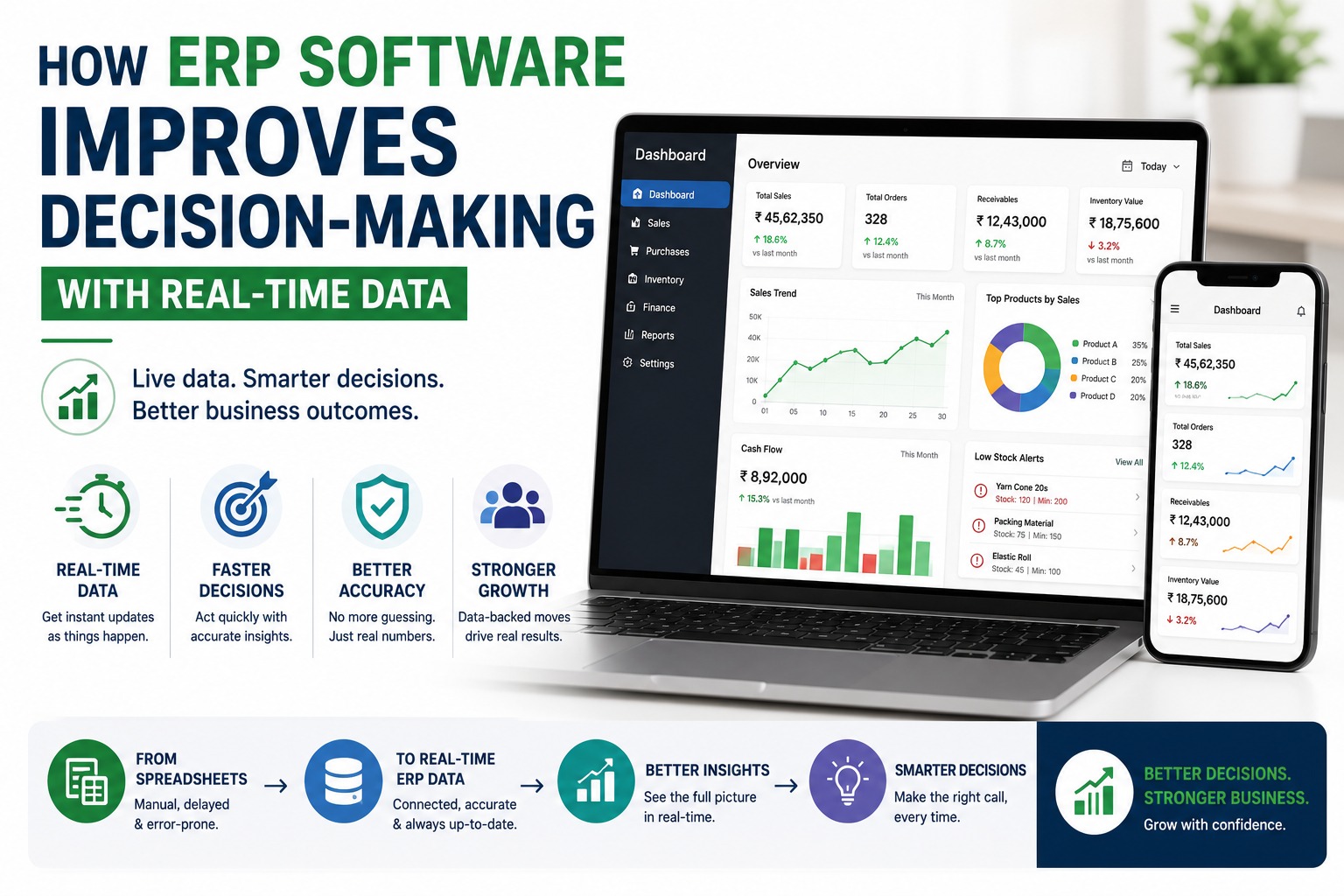
How ERP Software Improves Decision-Making with Real-Time Data
Every business owner has lived some version of this moment: a decision needs to be made today whether to reorder stock, approve a discount, chase a slow-paying customer and the honest answer is "I don't actually know, let me check." What follows is a round of phone calls, a hunt through spreadsheets, and a decision that finally gets made hours or days later, often based on information that was already out of date by the time it was gathered.
This delay isn't a leadership failing. It's a data problem. When information lives in scattered spreadsheets, disconnected tools, and people's memories, "real-time" simply isn't possible, no matter how sharp the decision-maker is. ERP systems fix this at the source not by making owners better decision-makers, but by giving them accurate, current information the moment they need it.
This article looks at what changes when reporting moves from delayed to real-time, what that actually looks like on a dashboard, and a real example of how it reshaped decision-making for one growing Indian business.
Real-Time vs. Delayed Reporting
The difference between real-time and delayed reporting isn't just speed it changes the entire nature of the decisions a business can make.
How Delayed Reporting Actually Works
In a spreadsheet-driven business, a "report" typically means someone manually pulling numbers from two or three sources, reconciling them, and presenting a summary a process that takes hours or days. By the time leadership sees it, the underlying situation has often already moved on. A stock report from three days ago doesn't tell you what's on the shelf today; it tells you what was on the shelf three days ago, with an unknown amount of change in between.
How Real-Time Reporting Works Instead
In an ERP system, every transaction a sale, a stock movement, a payment received updates the underlying data the moment it happens. A dashboard isn't a static document generated periodically; it's a live view that reflects the current state of the business at the exact moment someone looks at it.
| Factor |
Delayed Reporting |
Real-Time Reporting |
| Data Freshness |
Hours to days old by the time
it's reviewed |
Reflects the current moment |
| Decision Speed |
Decisions wait for the next
report cycle |
Decisions happen as situations
arise |
| Accuracy of Action |
Based on a situation that may
have already changed |
Based on what's actually true
right now |
| Staff Effort |
Manual compilation required
each time |
Automatically maintained, no
manual pull needed |
| Trust in Numbers |
Frequently questioned or
double-checked |
Single, consistent source
everyone relies on |
The practical impact compounds daily. A sales manager deciding whether to promise a delivery date, a purchase manager deciding whether to place a reorder, an owner deciding whether cash flow supports a new hire each of these decisions is only as good as the data behind it. Real-time reporting doesn't just make reports faster; it makes the decisions built on them meaningfully better.
|
The Hidden Cost of Delay Every hour spent waiting for accurate numbers is an hour where the business is effectively flying blind on that decision often defaulting to gut feel or the safest, most conservative choice simply because the real picture isn't available yet. |
Dashboard Examples
Real-time data is only useful if it's presented in a way people can act on quickly. Well-designed ERP dashboards translate live data into clear, role-specific views. Here's what that looks like across different functions.
Owner / Leadership Dashboard
A single view combining cash position, sales performance against targets, outstanding receivables, and top-level inventory health giving an owner a genuine "pulse check" on the business in under a minute, without waiting for anyone to compile anything.
Sales Dashboard
Live order status, current stock availability by product, and customer payment history so a salesperson can confidently confirm delivery timelines and credit terms during a live conversation with a customer, rather than promising something and checking later.
Inventory / Warehouse Dashboard
Real-time stock levels across locations, incoming purchase orders, and items approaching reorder thresholds flagged automatically rather than discovered only when a shelf actually runs empty.
Finance Dashboard
Live cash flow position, outstanding payables and receivables, and expense tracking against budget replacing the month-end scramble with a picture that's accurate on any given day, not just at closing time.
|
Designed for the Role, Not Just the Data The value of a dashboard isn't just showing data it's showing the right data to the right person, without noise. A well-built ERP dashboard surfaces what each role actually needs to act on, rather than dumping every available metric onto a single crowded screen. |
Case Study: Faster Decisions in Practice
A hosiery and textile manufacturing business in Ludhiana, supplying both domestic retailers and export clients, came to InfoTechBrains with a specific frustration: by the time their weekly "stock and sales" report was compiled from three different spreadsheets, it was already outdated and yet the business had no faster way to know its real position.
The owner described making purchasing decisions almost a week behind reality reordering yarn based on stock counts that no longer reflected what had actually shipped, been produced, or been consumed since the last report was compiled. On more than one occasion, this led to both overstocking certain materials and unexpectedly running short on others in the same month.
InfoTechBrains implemented an ERP system with role-specific real-time dashboards a leadership view showing overall cash and stock health, a production view showing raw material consumption as it happened, and a sales view showing order status and finished goods availability instantly.
| Same-day
Purchasing decisions vs. previous week-long lag |
27%
Reduction in emergency yarn orders |
5 hrs/week
Manager time reclaimed from manual reporting |
Within two months, the owner described the shift simply: purchasing decisions that used to wait for Friday's report were now being made the same day something changed on the shop floor. The business hadn't gotten smarter it had simply stopped making decisions on stale information, and the results followed naturally from that single change.
This is the real promise of real-time ERP data: not more information, but more current information, delivered to the person who needs it, at the moment the decision actually has to be made. For growing Indian SMBs competing against businesses that have already made this shift, that gap in decision speed can matter more than almost any other operational advantage.
Beyond Speed: How Real-Time Data Changes Decision-Making Culture
The most significant shift often isn't just faster individual decisions it's a change in how a business approaches decision-making altogether. When accurate data is a click away rather than a multi-day request, managers stop defaulting to caution simply because verification felt too slow to bother with. Smaller, more frequent adjustments become possible a purchasing quantity tweaked slightly based on this week's actual sell-through, a delivery promise confirmed with genuine certainty rather than an educated guess.
Over time, this builds a different kind of organizational habit. Teams start asking "what does the dashboard show right now" instead of "what do we remember from last week," and that shift alone tends to reduce the kind of costly, delayed corrections that come from acting on outdated assumptions.
Getting the Most Out of Real-Time Dashboards
Real-time data only delivers value if people actually look at it and trust it enough to act on it. A few practices make the difference between a dashboard that becomes part of daily decision-making and one that gets ignored after the initial excitement wears off.
• Keep each role's dashboard focused on the handful of metrics that actually drive their daily decisions, rather than every number the system can technically display
• Review dashboard accuracy in the first few weeks after go-live, since trust erodes quickly if numbers appear even slightly inconsistent with reality
• Build dashboard-checking into existing routines, like a morning stand-up or weekly planning meeting, rather than treating it as an optional extra step
• Revisit and refine what each dashboard shows every few months, since the metrics that matter most often shift as the business grows
|
Ready to Make Decisions on Today's Data, Not Last Month's? InfoTechBrains builds ERP systems with real-time dashboards that give you a live view of your business so every decision is based on what's actually happening now. Call / WhatsApp: +91 84594 18970 Visit: https://infotechbrains.com/ |
About the author

Aman Gupta
Founder & CEO at InfoTechBrains, helping SMEs scale and reduce manual work with AI, automation and custom software.
View LinkedIn ProfileView profile & all posts →