Top 7 Manufacturing ERPs for Indian SMEs: Features, Pricing & Comparison
The top manufacturing ERPs for Indian small and medium enterprises include TallyPrime, ERPNext, and Odoo ERP, delivering integrated production, inventory, and local tax compliance.
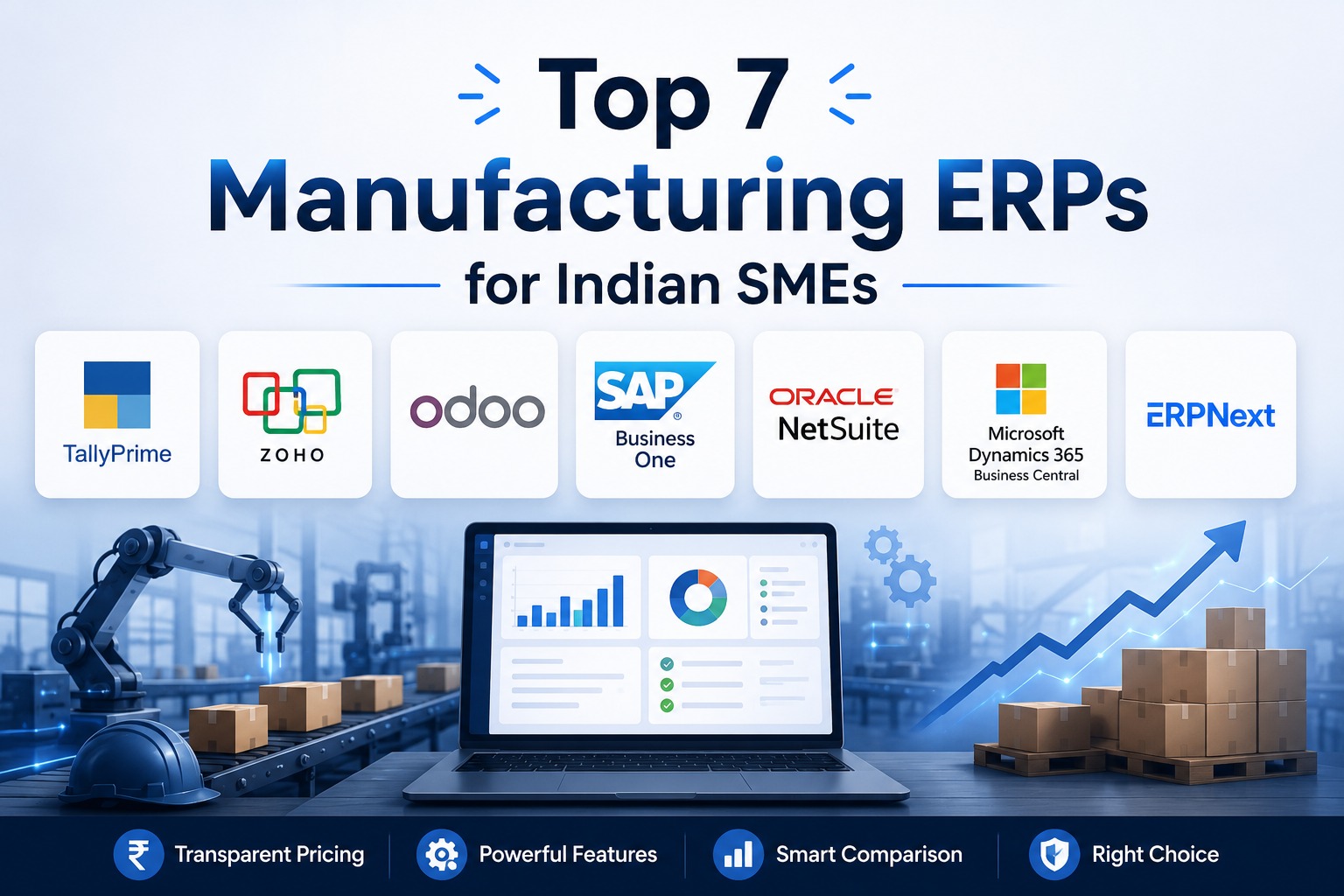
Top 7 Manufacturing ERPs for Indian SMEs:
Features, Pricing & Comparison
Every ERP comparison eventually runs into the same wall: vague pricing. Vendors list a starting price, then quietly reveal that implementation, customization, and support push the real cost several times higher once you're actually in a sales conversation. This guide focuses specifically on giving Indian manufacturing SMEs a transparent, side-by-side view of both features and realistic all-in cost, so you can shortlist based on numbers rather than a sales pitch.
Pricing for enterprise software shifts often and varies by negotiation, business size, and implementation partner, so treat the figures below as directional ranges based on current 2026 market positioning rather than exact quotes but they should get you meaningfully closer to an honest budget conversation than most vendor websites will.
This list deliberately goes deeper on pricing than most manufacturer-facing ERP guides, because cost is consistently the factor Indian SMEs get wrong first. A platform that looks affordable on a pricing page can require five to ten times its license cost in implementation and customization once a manufacturer's actual production complexity meets the software's real limits.
The Top 7, Side by Side
|
Platform |
Approx. Pricing |
Best For |
|
TallyPrime |
₹18,000-₹54,000/year (license/subscription) |
GST-heavy accounting; not a full manufacturing ERP |
|
Zoho ERP Suite |
~₹2,000-3,000 per user/month |
Trading, services, and light manufacturing with cloud simplicity |
|
Odoo |
Free (Community) to ~₹1,200-2,000/user/month (Enterprise), plus ₹2-5 lakh implementation |
Budget-conscious SMEs wanting broad, modular functionality |
|
SAP Business One |
₹15-50 lakh+ upfront, plus ongoing maintenance |
Mid-to-large manufacturers with complex, multi-location needs |
|
Oracle NetSuite |
Premium tier, pricing on request (typically high for SMEs) |
Multi-location manufacturers needing deep financial consolidation |
|
Microsoft Dynamics 365 Business Central |
Per-user subscription, mid-to-high range |
Manufacturers already invested in the Microsoft ecosystem |
|
ERPNext |
Free (self-hosted) or hosted plans; partner fees apply |
Technically capable teams wanting open-source flexibility |
What Each Platform Actually Offers
1. TallyPrime
TallyPrime remains India's most widely used business software, and for good reason its GST compliance, invoicing, and accounting depth are effectively unmatched for the price. However, it's genuinely an accounting tool first, not a true manufacturing ERP. It lacks production planning, shop-floor tracking, and multi-stage BOM management, which means manufacturers typically outgrow it once operations move beyond simple buy-sell-invoice cycles.
2. Zoho ERP Suite
Zoho's growing suite of business applications offers a strong, affordable cloud option for trading and lighter manufacturing operations, with solid Indian GST compliance built in. Its manufacturing-specific depth is more limited than dedicated ERP platforms like Odoo or SAP, making it a better fit for businesses without highly complex production processes.
3. Odoo
Odoo has become one of the most talked-about ERP options for Indian SMEs, offering a free Community edition and modular Enterprise pricing that scales with usage. Its manufacturing modules cover routing, job work, quality control, and maintenance reasonably well. The catch: Odoo is a platform, not a finished product actually deploying it for Indian manufacturing typically requires a qualified implementation partner, and those partner fees often exceed the software's own license cost.
Odoo's real strength lies in its breadth a single ecosystem covering CRM, inventory, HR, and manufacturing means a business can potentially replace three or four separate subscriptions with one platform. Whether that breadth translates to savings depends heavily on how much of it your business actually uses versus pays for and ignores.
4.SAP Business One
SAP Business One remains the benchmark for manufacturers needing serious operational control across finance, inventory, procurement, and production. Its pricing and implementation timeline often three to twelve months put it out of reach for very small manufacturers, but it's a strong fit once a business has genuinely outgrown lighter platforms.
The long implementation timeline isn't a flaw so much as a reflection of what SAP Business One is actually configuring deep, business-specific workflows across every department. For manufacturers with the budget and patience for a thorough rollout, that depth tends to pay off in fewer post-launch surprises than faster, lighter implementations sometimes produce.
5. Oracle NetSuite
NetSuite's cloud-first architecture suits manufacturers expanding across multiple locations or regions, offering strong financial consolidation and reporting. It's generally positioned and priced for businesses beyond the smallest SME segment, making it less common among single-site Indian manufacturers just starting their ERP journey.
Where NetSuite tends to earn its premium pricing is in businesses that have already outgrown single-location thinking a manufacturer running plants in two states, or one selling into export markets with multi-currency accounting needs, will find capabilities here that most of the other platforms on this list handle less gracefully.
6. Microsoft Dynamics 365 Business Central
For manufacturers already using Microsoft's tools daily, Business Central offers a natural extension with strong workflow automation and supply chain visibility. Its pricing sits in a mid-to-high range depending on modules and user count, and its biggest advantage is integration familiarity for teams already comfortable in the Microsoft ecosystem.
7. ERPNext
ERPNext offers an open-source alternative similar in spirit to Odoo free to self-host, with a growing set of manufacturing features. It appeals to businesses with in-house technical capability or a strong local implementation partner, though its Indian manufacturing-specific localization is generally considered less mature than Odoo's at this point.
|
The Pricing Trap to Watch For The cheapest sticker price is rarely the cheapest three-year cost. Implementation, customization for your specific production process, training, and ongoing support often dwarf the license fee especially on platforms marketed as "low-cost" that actually require significant partner-led configuration to become manufacturing-ready. |
How to Actually Decide
Rather than picking by brand recognition, weigh each option against three practical questions specific to your business.
• What does the realistic three-year cost look like, including implementation and customization not just the license or subscription fee?
• Does your production process fit the platform's standard manufacturing modules, or will you need significant customization to represent your actual workflow?
• Do you have, or can you access, the technical capability these platforms assume particularly for Odoo and ERPNext, which require meaningfully more setup work than TallyPrime or Zoho?
• How much does the platform's implementation timeline matter to you a three-month wait for SAP Business One is a very different commitment than a five-week Odoo or custom-build rollout
It's worth adding a fourth, less obvious question: what happens if your production process changes in two years? A platform that fits perfectly today but can't flex with a new product line, a second facility, or an export compliance requirement will eventually force the exact same evaluation exercise again an outcome worth avoiding if a slightly more flexible choice is available now.
What This Looks Like in Practice
A leather goods manufacturer in Kanpur spent nearly two months evaluating Odoo, Zoho, and SAP Business One before approaching InfoTechBrains, having found each option either too shallow for their multi-stage tanning-to-finished-goods process, or priced well beyond what a business their size could justify once real implementation costs were factored in.
InfoTechBrains built a manufacturing-specific ERP core around their actual production stages, layered onto standard finance and inventory modules similar to what the platforms above offer avoiding both the shallow-fit problem of the lighter cloud options and the six-figure-plus cost of enterprise platforms. The build reused proven, standard modules wherever the business's needs were genuinely typical, reserving custom development only for the tanning-to-finished-goods stages that none of the seven platforms above could represent without heavy workarounds.
|
40% Lower total cost vs. the SAP quote received |
5 weeks From requirement discovery to go-live |
0 Ongoing per-user license fees |
The comparison exercise itself wasn't wasted effort — evaluating the top platforms first gave the business owner a clear, informed baseline for what "reasonable" pricing and functionality actually looked like, which made the eventual custom-build decision a confident one rather than a leap of faith. That's generally the right sequence for any manufacturing SME: understand what the top platforms genuinely offer and cost, then decide whether one of them fits or whether your production process needs something built specifically around it. Skipping this comparison step and jumping straight to a single vendor's pitch is how many manufacturers end up signing contracts they later regret.
|
Still Weighing These Options Against Your Budget? InfoTechBrains helps Indian manufacturers get a transparent, all-in cost picture across these options — including where a custom build actually costs less over time. Call / WhatsApp: +91 84594 18970 Visit: https://infotechbrains.com/ |
About the author
InfoTechBrains Team
Technology expert focused on software architecture, automation, and digital transformation.
View profile & all posts →