The Hidden Cost of Disconnected Systems (And How ERP Fixes It)
Discover how disconnected systems drain your business resources and hinder growth. Learn how ERP solutions unify processes, reduce costs, and streamline operations for a more efficient future.
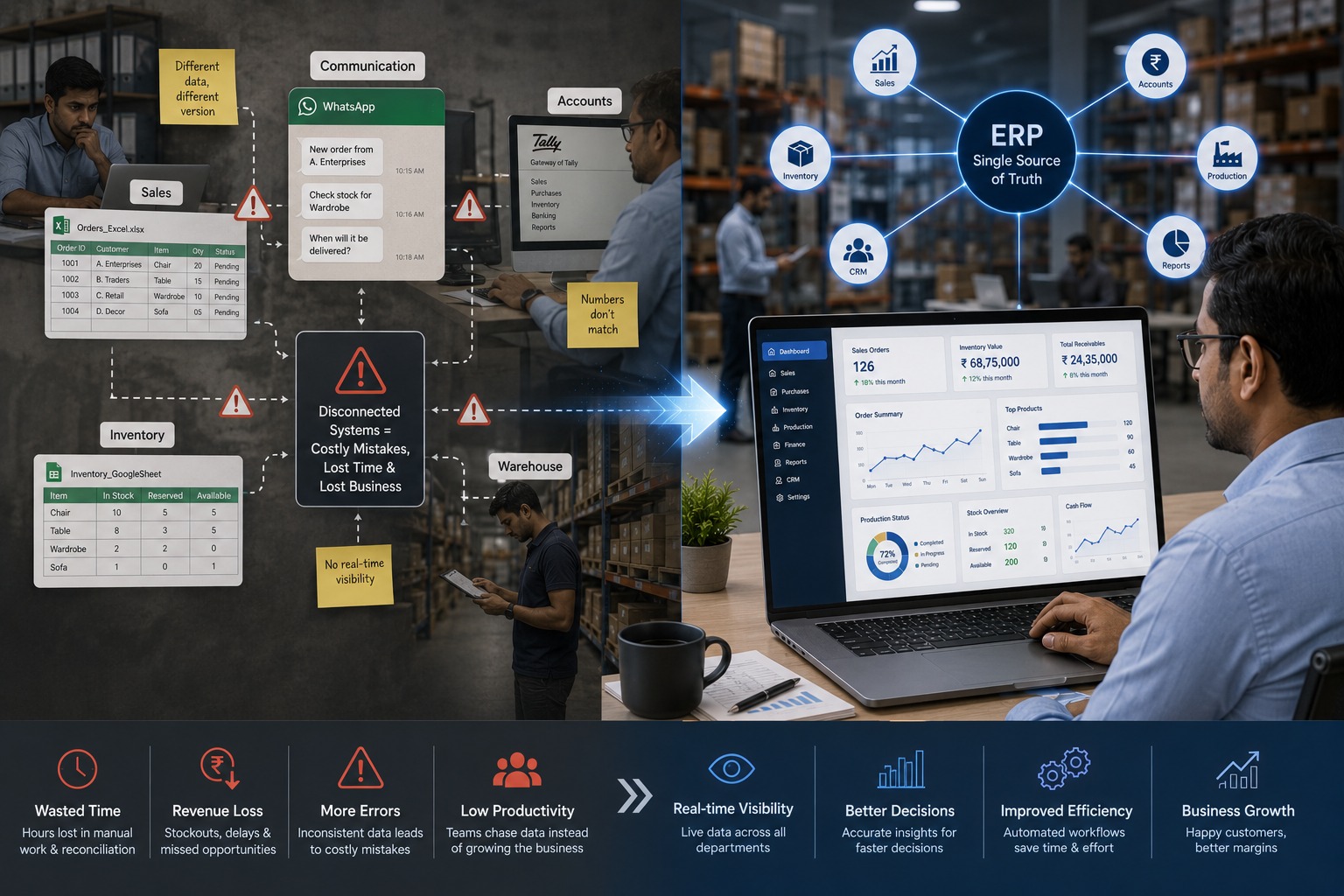
The Hidden Cost of Disconnected Systems
(And How ERP Fixes It)
Ask most Indian SMB owners if their systems are "connected," and they'll usually say yes after all, everyone's using Tally, everyone's got a WhatsApp group for orders, and there's a Google Sheet for inventory that everyone can access. On paper, it all looks joined up.
In practice, none of it is actually connected. Each tool holds its own version of the truth, updated at different times, by different people, with no automatic link between them. This is what's known as a data silo and it's one of the most expensive, least visible problems in growing businesses, precisely because it doesn't show up as a single dramatic failure. It shows up as a thousand small frictions a week.
This article unpacks what disconnected systems actually look like day-to-day, the real business impact they create, what a genuine single source of truth means in practice, and a real-world example of what fixing it looks like.
What Disconnected Data Looks Like
Data silos rarely look dramatic from the outside. They look like ordinary Tuesday-afternoon business which is exactly why they go unaddressed for years. Here's what they typically look like inside an Indian SMB.
The Sales Team Doesn't Know What's in Stock
A salesperson confirms an order with a customer based on what they remember seeing in the warehouse last week. By the time the order reaches fulfillment, the stock has moved, been sold, or was never actually available and now someone has to call the customer back with bad news.
Finance Reconciles Numbers That Don't Match
The accounts team closes the books based on invoices raised in one system, payments tracked in another, and inventory movement recorded in a third. Every month-end becomes a forensic exercise in figuring out why the numbers across three tools don't quite agree.
Customer Information Lives in Someone's Head or Inbox
A customer calls with a query about a past order. The person who handled that order is on leave, and their WhatsApp thread or personal notes are the only record of what was actually promised, negotiated, or agreed.
Reports Require Manual Assembly
Producing a simple monthly performance report means pulling numbers from four different spreadsheets, copy-pasting them into a fifth, and manually checking they line up a process that can eat an entire day of a manager's time every month.
Departments Work From Different "Current" Realities
Procurement thinks stock levels are healthy based on last week's count. Sales is promising delivery dates based on production capacity that changed yesterday. Nobody is wrong, exactly they're just each looking at a different, slightly outdated slice of the truth.
Why This Happens Even With "Good" Tools
It's worth noting that disconnected systems aren't usually the result of bad tools or lazy teams. Tally is a genuinely capable accounting tool. Excel is genuinely flexible. WhatsApp is genuinely fast for quick coordination. The problem isn't any individual tool — it's that none of them were designed to talk to each other, so every handoff between them depends on a human remembering to update the next one manually. Multiply that across dozens of daily transactions, and small gaps compound into significant, ongoing inconsistency.
|
The Silent Symptom Disconnected systems rarely announce themselves with a single big failure. Instead, they show up as constant small firefighting the kind of daily friction that teams eventually accept as "just how things are," long after it's stopped being necessary. |
The Real Business Impact
Data silos don't just create inconvenience — they translate directly into lost revenue, wasted time, and damaged customer trust. Here's where the impact actually lands.
|
Area |
Impact of Disconnected Systems |
|
Revenue |
Missed upsell opportunities, overselling out-of-stock items, delayed invoicing |
|
Working Capital |
Overstocking to compensate for poor visibility, cash tied up unnecessarily |
|
Staff Time |
Hours spent weekly reconciling data between tools instead of serving customers |
|
Customer Trust |
Broken promises on delivery dates, inconsistent information across touchpoints |
|
Decision Speed |
Leadership waits days for a clear picture before making a call |
|
Compliance Risk |
Inconsistent records complicate GST filing, audits, and vendor disputes |
The compounding effect is what makes disconnected systems so costly. A stockout caused by poor visibility doesn't just lose one sale it often loses a customer's confidence, sends them searching for an alternative supplier, and creates a support headache that consumes staff time better spent on new business.
There's also a leadership cost that rarely gets counted. Owners running growing businesses on disconnected systems often find themselves acting as the human integration layer personally cross-checking numbers between departments, settling disputes about whose figures are correct, and approving decisions based on incomplete information because a complete picture simply isn't available fast enough. That's time an owner should be spending on strategy, sales, or new markets, not manual reconciliation.
|
5-8 hrs Weekly manager time lost to manual report assembly |
2-3x More stockouts in silo-affected businesses |
Days Typical delay between an event and its visibility |
Single Source of Truth Explained
The fix for data silos isn't "more communication" or "better spreadsheets" it's structural. A single source of truth means one shared, live dataset that every department reads from and writes to, so there's never a question of which version is correct.
How It Actually Works
In an ERP system, a sales order isn't just recorded in a sales tab it automatically reduces available inventory, flags a task for the warehouse, and creates a pending entry in accounts, all from a single action. There's no second step where someone has to manually update three other places.
Why This Matters More Than It Sounds
The value isn't just "saving time on data entry," though that matters. The deeper value is that every decision a reorder quantity, a delivery promise, a credit approval is now based on the same real-time reality that every other department is also looking at. Disagreements about "whose numbers are right" simply stop happening, because there's only one number.
It Doesn't Require Giving Up Flexibility
A common misconception is that a single source of truth means rigid, one-size-fits-all processes. In practice, well-configured ERP systems still allow department-specific views and permissions a sales manager sees what's relevant to sales, a warehouse supervisor sees what's relevant to inventory while all of it draws from the same underlying data.
|
Not Just Software A Discipline A single source of truth is as much an operational discipline as it is a technical feature. It requires your team to actually use the shared system consistently which is why change management and training matter as much as the software itself. |
Case Study: Fixing the Silos
A mid-sized furniture manufacturer in Jaipur, supplying both retail showrooms and B2B contract clients, came to InfoTechBrains with a familiar complaint: their sales, production, and accounts teams each swore their numbers were correct and yet nothing ever quite matched at month-end.
Their setup was typical of many growing SMBs: sales orders logged in one Excel file, a separate production tracker maintained by the factory floor supervisor, and Tally used independently by accounts for invoicing. Each team was doing careful, diligent work the problem was that none of these efforts were talking to each other.
InfoTechBrains implemented a connected ERP system that brought order intake, production scheduling, inventory, and invoicing onto one shared platform. A sales order placed by the showroom team now automatically triggered a production slot check and updated raw material availability in real time visible to every relevant department simultaneously.
|
60% Fewer order-production mismatches |
3 days Faster month-end closing |
18% Reduction in raw material overstock |
Within the first quarter, the sales team stopped promising delivery dates the factory couldn't meet, the accounts team stopped chasing production for numbers that didn't reconcile, and the business owner got a live dashboard view of the entire operation for the first time something that previously took days of manual compilation to approximate, and was often outdated by the time it was ready.
The lesson generalizes well beyond furniture manufacturing: the cost of disconnected systems is rarely visible in any single transaction. It's visible only once you add up the accumulated friction across every department, every week, over months and years which is exactly why so many SMBs underestimate how much a single source of truth is actually worth to their bottom line.
|
Tired of Chasing Numbers Across Different Systems? InfoTechBrains connects your sales, inventory, and accounts into one reliable system so every department works from the same truth. Call / WhatsApp: +91 84594 18970 Visit: https://infotechbrains.com/ |
About the author

Aman Gupta
Founder & CEO at InfoTechBrains, helping SMEs scale and reduce manual work with AI, automation and custom software.
View LinkedIn ProfileView profile & all posts →