How to Automate Your Business.
Every business is being told to "automate" in 2026, but few explain how to actually start. This practical guide walks Indian SMBs through prioritizing what to automate first, building a realistic roadmap, and avoiding the most common automation mistakes.
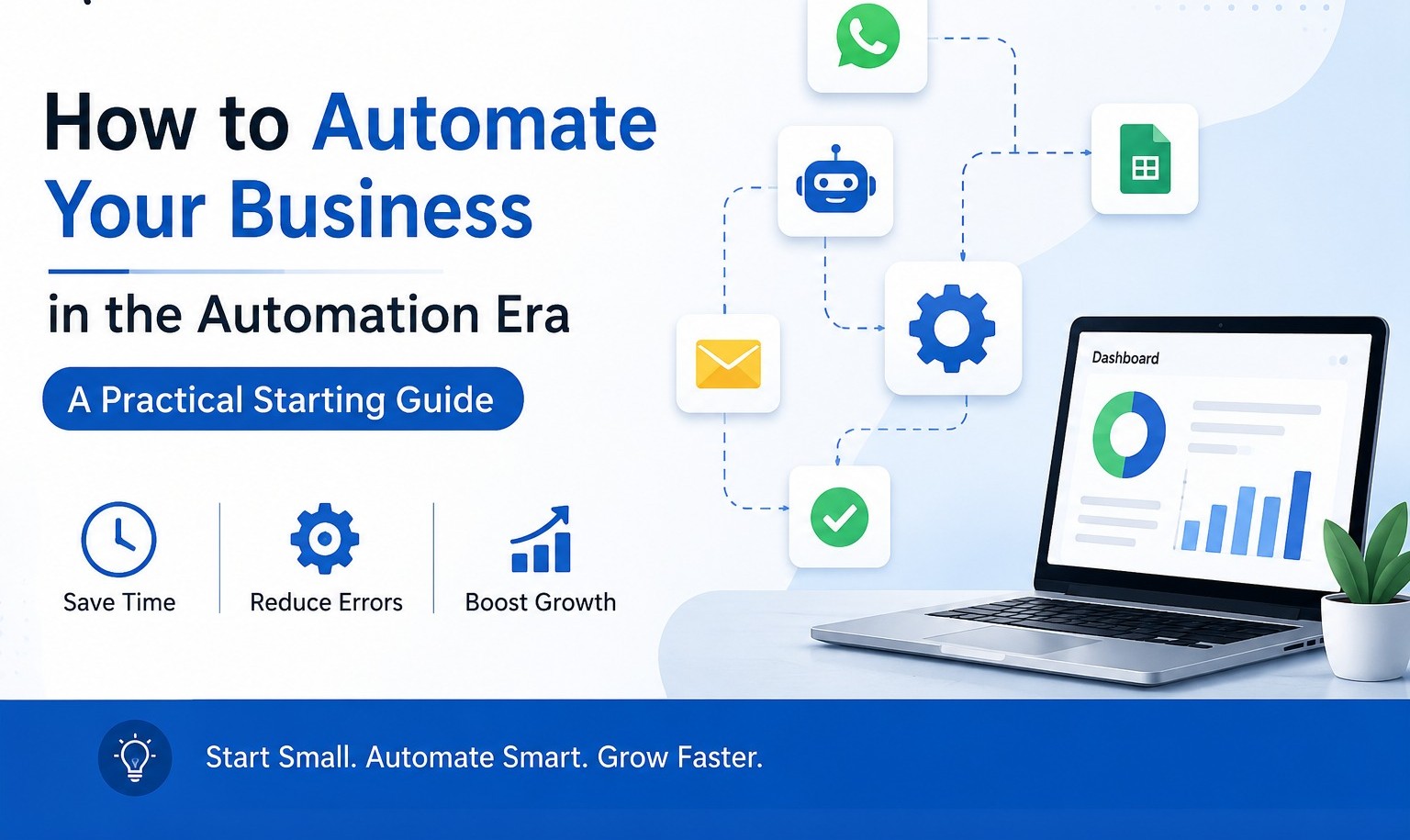
How to Automate Your Business in the Automation Era: A Practical Starting Guide.
"Automate your business" has become one of those phrases repeated so often it's started to lose meaning plastered across LinkedIn posts, software ads, and conference keynotes until it sounds more like a slogan than an instruction. Ask most SMB owners what it actually means for their specific business on a Monday morning, and the honest answer is usually "I'm not entirely sure where to start."
That confusion is understandable. Automation isn't one thing it's a broad category covering everything from a simple WhatsApp auto-reply to a full AI-driven demand forecasting system, and the right starting point looks completely different for a five-person trading firm than it does for a hundred-person manufacturer. This guide skips the hype and focuses on the practical question that actually matters: given where your business is today, what should you automate first, and how do you go about it without disrupting what's already working?
It's worth saying upfront: automation in 2026 doesn't require a data science team, a six-figure budget, or a complete overhaul of how your business runs. For most Indian SMBs, the highest-value automation is boringly practical it targets one specific, repetitive bottleneck and removes it cleanly, rather than attempting a sweeping digital transformation in a single leap.
Start by Finding the Real Bottleneck, Not the Trendiest Tool
The most common automation mistake isn't choosing bad software it's choosing a starting point based on what's currently trending rather than what's actually slowing the business down. A business that automates its social media posting while its order-to-delivery process remains completely manual has automated the wrong thing, however impressive the new tool looks.
A better starting question: where does your team lose the most hours to repetitive, low-judgment work every single week? Common answers across Indian SMBs include manually re-entering the same order data into two or three systems, chasing payment follow-ups one phone call at a time, answering the same handful of customer questions repeatedly over WhatsApp, and manually compiling reports from scattered spreadsheets.
Whichever of these consumes the most collective hours each week is usually the strongest candidate for a first automation project not because it's the most impressive, but because it's where the return will be felt fastest and most visibly by your team, which builds momentum for further automation down the line.
A Simple Prioritization Framework
Once you've identified a few candidate processes, weigh them against three factors to decide where to actually begin.
|
Factor |
Questions to Ask |
|
Frequency |
How often does this task happen daily, weekly, or only occasionally? |
|
Time Cost |
How many collective staff hours does it consume across a typical month? |
|
Complexity to Automate |
Does it follow a consistent, rule-based pattern, or does it require constant human judgment? |
The ideal first project scores high on frequency and time cost, but low on complexity a task that happens often, eats real hours, and follows a fairly predictable pattern. WhatsApp order confirmations, automated payment reminders, and basic report generation are classic examples that fit this profile for most Indian SMBs. Save the genuinely complex, judgment-heavy processes for later, once your team has built confidence and trust in automation through an early, visible win.
|
Avoid the "Automate Everything at Once" Trap Businesses that try to automate five processes simultaneously in their first attempt tend to end up with none of them working well, and a team that's now skeptical of the whole idea. One well-executed automation, adopted properly, does more for long-term momentum than five half-finished ones. |
Building a Realistic Automation Roadmap
With a first priority identified, the path from idea to working automation follows a consistent, manageable sequence.
Map the Current Process Exactly As It Happens
Before automating anything, document the process as your team actually performs it today including the informal workarounds and exceptions not the idealized version described in a training manual. Automation built on an inaccurate picture of the real process tends to fail the moment it meets reality.
Automate the Core, Keep a Human Checkpoint Where It Matters
Full automation isn't always the goal, especially early on. A WhatsApp order confirmation can be fully automated, while a large custom order might still warrant a human review step before it's finalized. Building in a checkpoint at genuinely important decision points keeps trust high while the automation proves itself.
Pilot Before Rolling Out Company-Wide
Run the automation on a subset of transactions or one team first, compare outcomes against the manual process, and fix issues while the stakes are still small. A pilot that runs for two to three weeks typically surfaces the majority of edge cases before they become a company-wide headache.
Measure Against a Clear Before-and-After Number
Define success in advance hours saved per week, faster response times, fewer errors so you can objectively confirm the automation delivered value rather than relying on a general impression that "things feel smoother now."
Choosing the Right Tools for Where You Are
One of the more paralyzing parts of getting started is the sheer number of automation tools available WhatsAppBusiness API platforms, workflow automation apps, AI chatbots, full ERP suites each promising to solve everything at once. Matching the tool to your actual stage of readiness matters more than picking the most powerful option available.
If You're Automating for the First Time
Start with a single-purpose tool aimed squarely at your priority bottleneck a WhatsApp automation platform for repetitive customer queries, or a simple workflow tool for payment reminders. Avoid platforms that bundle a dozen features you don't need yet; the added complexity slows adoption without adding proportional value at this stage.
If You've Automated One Process Successfully
This is the point to consider whether a more integrated system connecting the automation to your existing inventory or accounting records would compound the value of what you've already built, rather than leaving your first automation as an isolated island.
If You're Automating Across Multiple Departments
At this stage, a broader platform like an ERP with built-in automation capabilities usually makes more sense than stitching together several single-purpose tools, since the coordination overhead of managing many disconnected automations starts to outweigh their individual benefits.
Common Mistakes to Avoid
• Automating a broken process instead of fixing it first automation makes a good process faster and a bad process fail faster, at scale
• Choosing tools based on features rather than fit the most feature-rich platform is often overkill for a straightforward first automation
• Skipping staff involvement in design, leading to a technically correct automation that nobody on the ground actually trusts or uses
• Treating automation as a one-time project rather than an ongoing practice that expands as the business and its needs evolve
What This Looks Like in Practice
A packaging and printing business in Vadodara was fielding the same handful of WhatsApp questions from clients dozens of times a day order status, pricing for standard sizes, turnaround times while a staff member manually typed nearly identical replies each time. Rather than jumping straight to a complex CRM overhaul, InfoTechBrains started with a focused WhatsApp automation covering exactly these repetitive queries, with a clear handoff to a human for anything outside the standard pattern.
The pilot ran for three weeks on a subset of incoming chats before expanding company-wide. Within the first month of full rollout, the business had a concrete before-and-after comparison to point to.
|
70% Of routine queries handled without staff input |
12 hrs/week Staff time freed up for higher-value work |
3 weeks From idea to full rollout |
That single, well-scoped automation became the foundation for a second project a few months later automated payment reminders because the team now trusted that automation, done properly, made their work easier rather than adding a new layer of complexity to manage. That sequence, small proven win followed by the next one, is a far more reliable path through the automation era than trying to leap straight to a fully AI-driven operation in one attempt. The businesses that get the most value from automation over the next few years won't necessarily be the ones that moved fastest they'll be the ones that built each step on a foundation their team actually trusted.
|
Ready to Start Automating Without the Guesswork? InfoTechBrains helps Indian SMBs identify the right first automation, build a realistic roadmap, and implement it without disrupting daily operations. Call / WhatsApp: +91 84594 18970 Visit: https://infotechbrains.com/ |
About the author
InfoTechBrains Team
Technology expert focused on software architecture, automation, and digital transformation.
View profile & all posts →