How AI Automation Is Transforming Businesses in 2026
How AI automationis reshaping businesses in 2026.
AI AUTOMATION & INTEGRATION
How AI Automation Is Transforming Businesses in 2026
The shift from manual operations to intelligent, AI-powered workflows is no longer a future ambition — it is happening right now, across every industry.
This guide breaks down what AI automation actually is, the measurable benefits it delivers, which industries are leading adoption, and where the real-world use cases are generating ROI right now.
|
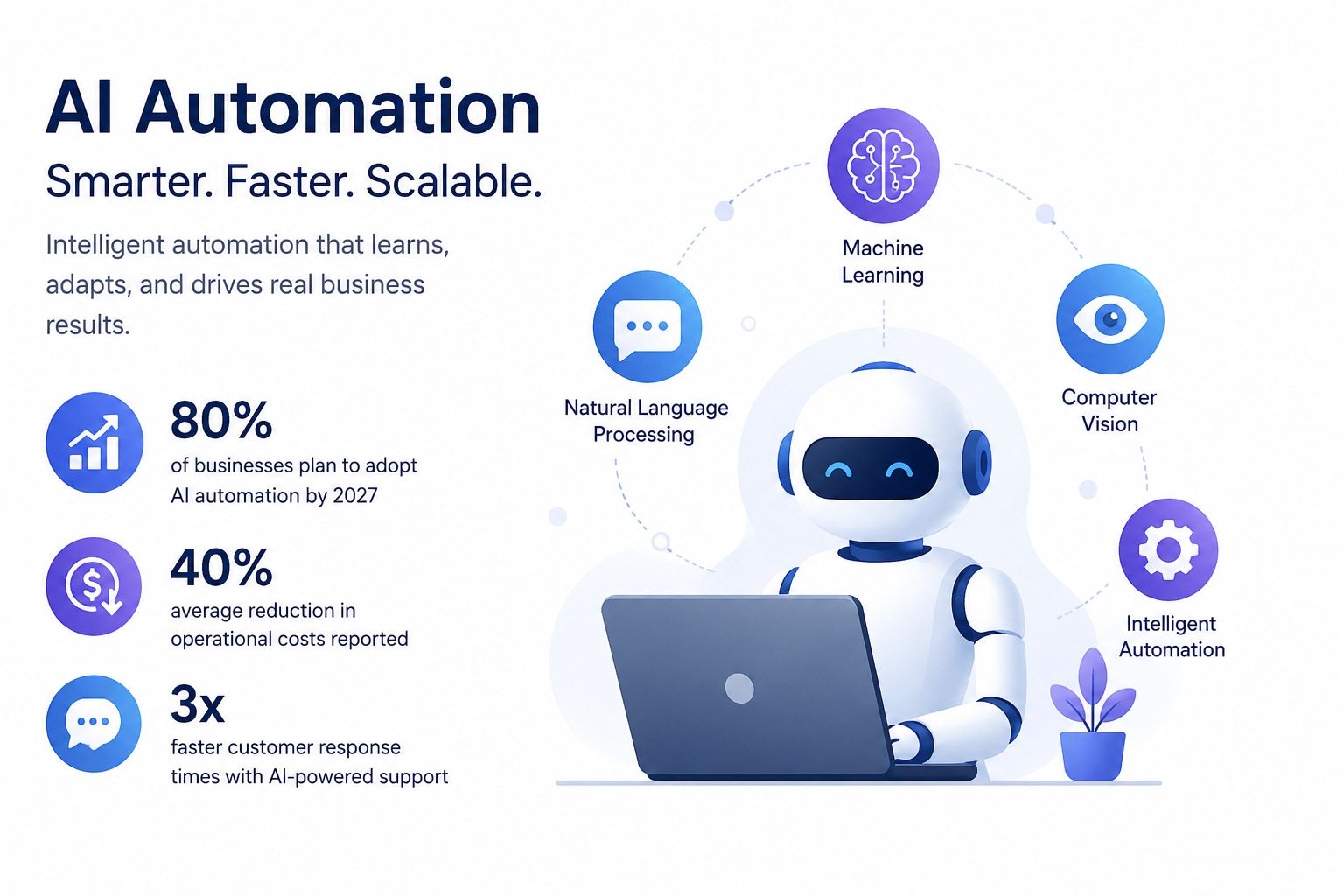
80% of businesses plan to adopt AI automation by 2027 |
40% average reduction in operational costs reported |
3x faster customer response times with AI-powered support |
What Is AI Automation?
AI automation refers to the use of artificial intelligence technologies — including machine learning, natural language processing, computer vision, and generative AI — to perform tasks that previously required human effort. Unlike traditional automation, which follows fixed rules, AI automation can handle ambiguity, process unstructured data, and improve its own performance over time.
Think of the difference this way:
|
|
Traditional Automation |
AI Automation |
|
Rules |
Rigid, pre-defined |
Adaptive, self-learning |
|
Data |
Structured only |
Structured + unstructured |
|
Decision-making |
Binary (if/else) |
Probabilistic, contextual |
|
Improvement |
Manual updates required |
Learns from new data automatically |
|
Best for |
Repetitive, predictable tasks |
Complex, variable workflows |
In practice, AI automation encompasses everything from a chatbot that resolves customer queries without human intervention, to a predictive system that flags inventory shortages before they cause production delays.
The Business Benefits of AI Automation
The appeal of AI automation is not theoretical. Organisations implementing it are reporting concrete, measurable gains across three primary dimensions:
1. Operational Efficiency
Manual processes are slow by nature. Every form that needs a human to fill it, every email that needs a person to read and route it, every report that requires someone to compile it — these tasks add up. AI automation compresses task completion times dramatically. What takes a human team an hour can often be executed by an AI system in seconds.
2. Cost Reduction
Labour is typically the largest line item in a business's operating budget. AI automation does not replace people wholesale, but it does allow teams to handle significantly higher volumes of work without adding headcount. For a business processing 500 customer support tickets per day, automating 70% of resolutions means a fraction of the staffing costs — while human agents focus on the 30% of cases that genuinely require nuanced judgement.
3. Consistency and Accuracy
Humans make errors, particularly on repetitive tasks. AI systems, once correctly configured, apply the same logic every single time. For data entry, compliance checks, invoice processing, and similar workflows, this consistency translates directly into reduced error rates and the downstream costs of fixing mistakes.
|
Key insight: The ROI on AI automation compounds over time. The system learns, the error rate drops further, and the same infrastructure handles growing volumes without proportional cost increases. |
4. Scalability Without Proportional Hiring
A human support team that handles 1,000 enquiries per day cannot handle 10,000 without roughly ten times the people. An AI-powered system can scale with workload far more fluidly. This elasticity is especially valuable for businesses with seasonal demand spikes — think e-commerce during sale periods or tax software firms during filing season.
5. Richer Customer Experiences
AI automation enables personalisation at scale. Recommendation engines, proactive outreach triggered by customer behaviour, and instant responses to enquiries — none of these are feasible with manual processes at any meaningful volume. Customers increasingly expect immediate, relevant interactions, and AI is what makes that possible.
Industries Using AI Automation in 2026
AI automation is sector-agnostic in principle, but some industries have moved faster and further than others. Here is where adoption is most advanced:
Retail and E-commerce
• Inventory forecasting based on historical sales, seasonal trends, and real-time demand signals
• Personalised product recommendations delivered via website, email, and WhatsApp
• Automated order confirmation, shipping updates, and post-purchase follow-up flows
• Dynamic pricing engines that adjust in real time based on competitor data and demand
Financial Services
• Fraud detection models that flag anomalous transactions in milliseconds
• Automated loan underwriting and credit scoring
• AI-driven customer onboarding with document verification and KYC compliance
• Intelligent invoice processing and accounts payable automation
Healthcare
• Appointment scheduling and rescheduling via AI chatbots
• Automated patient intake and symptom triage
• Medical imaging analysis to support diagnostic workflows
• Claims processing and insurance verification
Manufacturing
• Predictive maintenance using IoT sensor data to prevent equipment failures before they occur
• Quality control via computer vision systems on production lines
• Supply chain optimisation with real-time inventory visibility
• AI-assisted procurement with spend analytics and supplier risk scoring
Professional Services
• Contract analysis and review with NLP-based clause extraction
• Client onboarding automation reducing administrative burden
• AI-powered research assistants for legal, consulting, and advisory firms
• Automated reporting and dashboard generation from raw data
Real-World Use Cases: Where AI Automation Delivers Results
Abstract benefits become real when you look at specific use cases. The following three represent some of the highest-impact applications in 2026:
AI Chatbots for Customer Support
Modern AI chatbots bear little resemblance to the scripted, frustrating systems of five years ago. Built on large language models, today's chatbots understand intent rather than just keywords. They can handle multi-turn conversations, access real-time data from CRM and order management systems, and escalate to human agents when a situation genuinely requires it.
For a mid-sized e-commerce business, deploying an AI chatbot typically results in:
• 60–80% of routine enquiries resolved without human involvement
• Average response time reduced from hours to seconds
• Support available 24/7 across time zones without overnight staffing costs
• Human agents freed to focus on complex, high-value interactions
WhatsApp Automation
WhatsApp has become a primary business communication channel across Asia, the Middle East, Africa, and Latin America — and increasingly in Western markets. With WhatsApp Business API, companies can build automated messaging flows that engage customers where they already are.
Common WhatsApp automation flows that drive measurable results include:
• Order confirmations and real-time delivery tracking updates
• Abandoned cart recovery messages with personalised product reminders
• Lead qualification sequences that collect prospect information automatically
• Post-purchase feedback collection and review requests
• Appointment reminders with one-tap confirm or reschedule options
|
WhatsApp messages see average open rates of 90%+ compared to 20–25% for email — making it the highest-engagement channel available for automated business communication. |
AI-Powered Lead Management
For businesses with active sales pipelines, lead management is one of the most time-consuming and inconsistent manual processes. AI automation transforms this by:
• Scoring leads automatically based on behaviour, firmographics, and engagement signals
• Routing high-intent leads to the right sales representative instantly
• Triggering personalised follow-up sequences based on where a lead is in the funnel
• Surfacing insights about which lead sources convert best and why
The result is a sales team that spends more time having high-value conversations and less time triaging inboxes and manually updating CRM records.
Challenges and How to Solve Them
Honest guidance on AI automation must acknowledge the real obstacles businesses encounter. Here are the most common challenges and how organisations are successfully navigating them:
Challenge 1: Data Quality and Availability
AI systems are only as good as the data they are trained on. Many businesses discover that their historical data is inconsistent, incomplete, or siloed across disconnected systems.
Solution: Begin with a data audit before implementing automation. Identify your highest-quality datasets and build initial use cases around them. Invest in data hygiene as a prerequisite, not an afterthought.
Challenge 2: Change Management and Employee Resistance
Automation initiatives frequently stall not because of technology limitations but because of human ones. Employees may fear job displacement, or simply resist changing established workflows.
Solution: Frame automation as augmentation, not replacement. Involve frontline teams in identifying the manual tasks they find most tedious — these are often your best automation candidates, and involving staff in selection builds buy-in. Be transparent about how roles will evolve.
Challenge 3: Integration Complexity
Plugging AI tools into existing systems — ERPs, CRMs, communication platforms — requires careful technical planning. Integration failures are a leading cause of automation project delays.
Solution: Prioritise vendors with robust API ecosystems and pre-built integrations with the tools your business already uses. Define integration requirements before selecting any AI platform.
Challenge 4: Governance, Compliance, and AI Ethics
As AI systems make or influence more decisions, questions of accountability, bias, and regulatory compliance become critical. In regulated industries, this is not optional.
Solution: Establish clear AI governance policies early. Document how automated systems make decisions, build in human review for high-stakes outputs, and conduct regular audits of AI outputs for bias or error patterns.
Future Trends: What Is Coming Next
The AI automation landscape is evolving rapidly. These are the trends that will define the next two to three years:
Agentic AI Systems
The next frontier is AI agents that do not just respond to inputs but autonomously plan and execute multi-step tasks. An AI agent might be given the goal of resolving a customer complaint and independently pull the order history, check shipping status, draft a response, and process a refund — without any human direction at each step. Early deployments are already live in 2026, and adoption will accelerate.
Multimodal AI in Operations
AI systems are increasingly able to process not just text but images, audio, and video simultaneously. For manufacturing quality control, insurance claims assessment, or construction site monitoring, this opens use cases that were not possible with text-only AI.
Hyper-Personalisation at Scale
As AI models become more capable and customer data richer, businesses will be able to deliver genuinely individualised experiences — not just 'customers like you also bought' but communications, pricing, and product offerings tailored to the specific individual's history, preferences, and current context.
Democratisation of AI Tools
No-code and low-code AI platforms are making automation accessible to businesses that cannot afford dedicated data science teams. SMBs that previously lacked the technical resources to implement AI are increasingly able to deploy meaningful automation through user-friendly platforms with pre-built templates and workflows.
The Bottom Line
AI automation is not a single technology or a one-time project. It is a strategic capability that compounds in value as it is adopted more broadly across a business's operations. The companies getting ahead in 2026 are not necessarily the ones with the largest AI budgets — they are the ones that identified the right starting points, implemented thoughtfully, and built internal momentum.
The shift from manual to
intelligent operations is underway. The question is not whether to participate,
but how quickly to start.
|
Ready to explore where AI automation could have the biggest impact in your business? The practical starting point is almost always a workflow audit — mapping your highest-volume, most repetitive manual processes to identify where automation delivers the fastest return. |
About InfoTechBrains
InfoTechBrains is a technology partner helping businesses implement AI automation, ERP systems, WhatsApp Business API solutions, and custom software. ISO 9001:2015 certified, with a track record of delivering measurable operational improvements across retail, manufacturing, solar, and professional services.
About the author

Aman Gupta
Founder & CEO at InfoTechBrains, helping SMEs scale and reduce manual work with AI, automation and custom software.
View LinkedIn ProfileView profile & all posts →