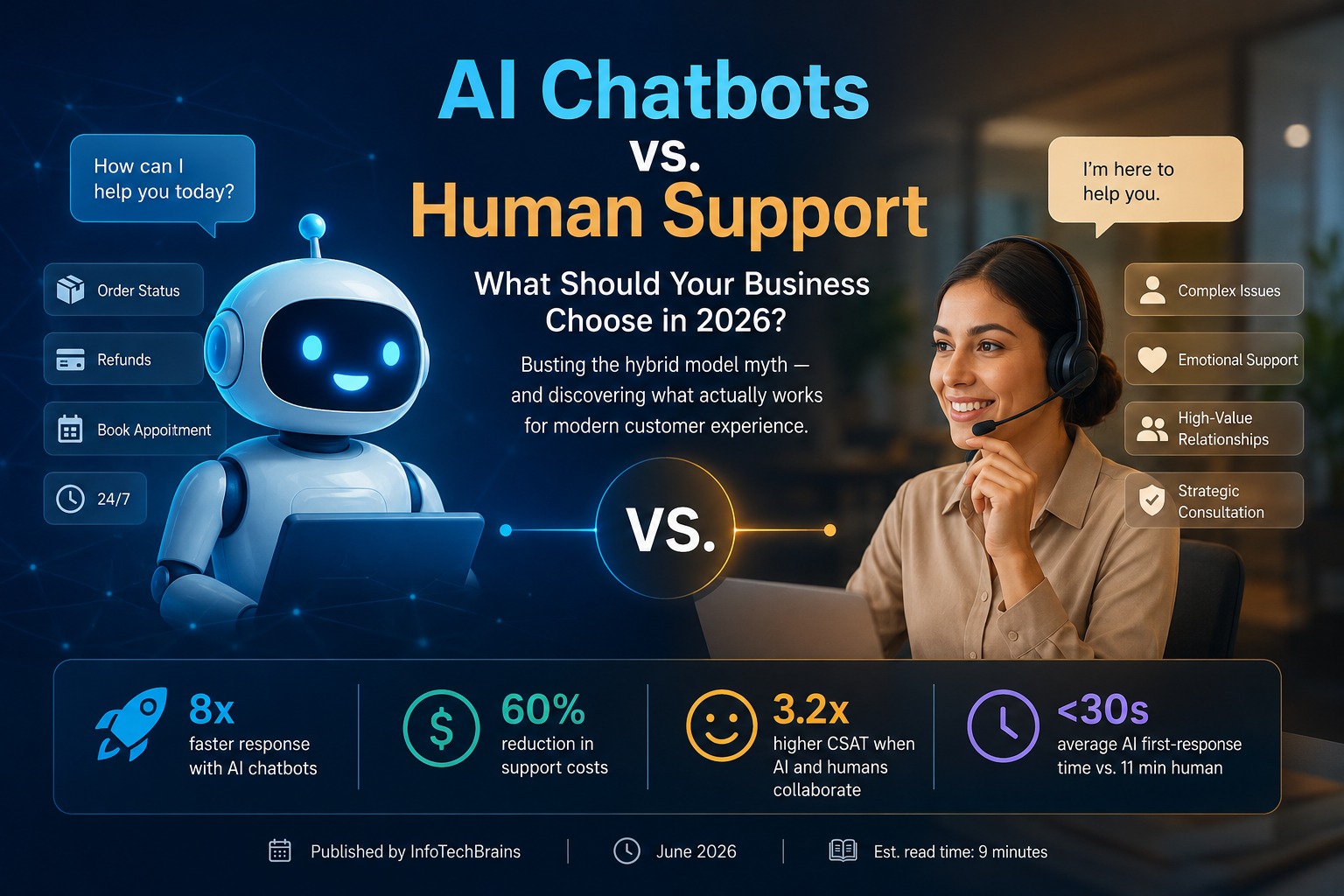
AI Chatbots vs. Human Support: What Should Your Business Choose in 2026?
Discover the key differences between AI chatbots and human support in 2026. Learn which option boosts customer satisfaction, reduces costs, and enhances efficiency for your business. Make an informed decision with expert insights on integrating AI and human support to optimize customer service.
AI AUTOMATION & INTEGRATION
AI Chatbots vs. Human Support: What Should Your Business Choose in 2026?
Busting the hybrid model myth and discovering what actually works for modern customer experience.
Published by InfoTechBrains | June 2026 | Est. read time: 9 minutes
Walk into almost any business discussion about customer support in 2026 and you will hear the same phrase repeated like a mantra: 'We use a hybrid model.' It sounds balanced, reasonable, and modern. But in practice, most hybrid models are neither well-designed nor particularly effective. They are often a patchwork of legacy human teams bolted together with a chatbot that handles FAQ pages and little else.
The question is no longer whether AI chatbots are good enough. They clearly are. The real question is: where should AI do the work, where should humans do the work, and how do you build the handoff so customers never feel the seam?
This article gives you a clear-eyed framework for that decision backed by real data, real case studies, and practical implementation steps you can act on this quarter.
The 2026 Customer Support Landscape: By the Numbers
|
72% of customers prefer self-service for simple issues |
8x faster average response time with AI chatbots |
60% reduction in support costs after AI deployment |
|
89% of customers abandon a brand after poor support |
3.2x higher CSAT when AI and humans collaborate |
<30s average AI first-response time vs. 11 min human |
Section 1: The Real Limitations of Human-Only Support
Human support teams are extraordinary at empathy, judgment, and navigating ambiguous situations. But they have structural limitations that no amount of hiring can solve.
The Scale Problem
A customer service agent can handle roughly 6–8 concurrent chats or one phone call at a time. When ticket volume spikes — during a sale, a product launch, or an outage human teams simply cannot scale on demand. Companies either overstaff (expensive) or understaff (catastrophic for customer experience).
The Cost Problem
The true cost of a customer support agent is not just their salary. Factor in recruitment, onboarding (typically 4–6 weeks), management overhead, benefits, attrition (average 45% annual turnover in support roles), and ongoing training — and the real cost per agent is often 1.4–1.8x their base salary.
The Consistency Problem
Human agents vary. One agent gives a discount; another does not. One correctly escalates a billing issue; another resolves it incorrectly. This inconsistency is not a people problem it is a systems problem. And it costs businesses more in rework, escalations, and lost customers than most realize.
The 24/7 Problem
Customers in 2026 do not operate on business hours. A prospect in Mumbai comparing your SaaS pricing at 11 PM does not want to wait until your support team arrives in the morning. The businesses winning on customer experience are available everywhere, all the time.
|
The Hidden Cost of Human-Only Support • Average onboarding time for a new support agent: 4–6 weeks • Annual attrition in customer support roles: 40–50% • Cost of a mishandled support ticket (rework + escalation): 4–7x the original ticket cost • Percentage of tier-1 queries that require human judgment: approximately 18–22% |
Section 2: What AI Chatbots Actually Solve
Modern AI chatbots particularly those built on large language models and integrated with your CRM, ERP, and knowledge base are not the rigid decision-tree bots of 2018. They understand context, handle multi-turn conversations, and can take actions like checking order status, issuing refunds below a threshold, or scheduling callbacks.
Instant Response at Any Volume
A well-configured AI chatbot responds in under 30 seconds at 3 AM on Christmas Day just as readily as at 10 AM on a Monday. It can serve 10,000 simultaneous conversations without degradation. This alone eliminates the single biggest driver of customer frustration: waiting.
Tier-1 Resolution at Scale
Across industries, 60–80% of incoming support tickets are repetitive tier-1 queries: order status, password resets, business hours, return policies, invoice copies, appointment rescheduling. AI chatbots can resolve these entirely, without human involvement, with high accuracy.
Lead Qualification and Handoff
On the sales side, AI chatbots qualify inbound leads 24/7 collecting industry, company size, use case, and budget — then either route to a salesperson during business hours or schedule a call. This means your sales team wakes up to pre-qualified meetings rather than cold leads.
Consistent, Compliant Responses
Every response follows the same policy. Discounts are only offered when authorised. Escalations happen at the right thresholds. Product information is always current. For regulated industries like finance, insurance, and healthcare, this consistency is not just operationally valuable it is a compliance requirement.
AI Chatbot Capabilities: What's Possible in 2026
|
Capability |
Basic Chatbot (2020) |
AI Chatbot (2026) |
|
Natural Language Understanding |
Keyword matching |
Contextual, multi-turn dialogue |
|
Query Types Handled |
FAQs only |
Complex, multi-step queries |
|
CRM / ERP Integration |
None |
Real-time data access & actions |
|
Sentiment Detection |
No |
Yes — escalates on frustration signals |
|
Language Support |
1–2 languages |
50+ languages simultaneously |
|
Learning Over Time |
Static rules |
Continuous improvement from interactions |
|
Handoff to Human |
Abrupt, loses context |
Seamless, with full conversation summary |
Section 3: When You Still Need Humans
This is where the hybrid model conversation gets honest. AI chatbots are exceptional at the repeatable and the predictable. Humans are irreplaceable for the complex, the emotional, and the high-stakes.
Emotionally Charged Situations
A customer whose father just passed away calling to cancel a subscription needs a human. An enterprise client threatening to churn after a major outage needs a senior relationship manager not a bot. AI should recognize these moments through sentiment analysis and route immediately.
High-Value, High-Complexity Sales
Enterprise software deals worth hundreds of thousands of rupees or dollars require human relationship-building, negotiation, and the ability to read unspoken cues. AI can prepare the groundwork qualification, discovery questionnaires, scheduling but the close belongs to a human.
Judgment Calls Outside Policy
When a customer's situation is genuinely unusual and falls outside your standard policy, a human manager with discretion to make exceptions is essential. AI follows rules; humans can bend them wisely.
Regulatory and Legal Matters
Complaints involving potential legal liability, data breaches, harassment, or regulatory non-compliance require human judgment, documentation, and often legal review. These should never be handled by AI.
|
The 80/20 Rule for Support Routing • ~80% of tickets: repetitive, tier-1, AI-resolvable (order status, FAQs, basic troubleshooting) • ~15% of tickets: complex but structured — AI-assisted, human-reviewed • ~5% of tickets: high-emotion, high-stakes, exception-based — human-only • Misrouting any category is expensive: AI on emotional tickets = churn; humans on FAQs = cost bleed |
Section 4: Case Studies What the Data Shows
Case Study A: D2C E-commerce Brand (800 Daily Tickets)
A direct-to-consumer brand in the fashion space was handling 800 support tickets per day with a team of 12 agents. Average first response time was 4.5 hours. CSAT was 3.2 out of 5. After deploying an AI chatbot integrated with their order management system and WhatsApp Business API:
• First response time dropped to under 45 seconds
• AI resolved 71% of tickets without human involvement
• Human agents focused exclusively on returns, complaints, and VIP customers
• CSAT improved to 4.4 out of 5 within 60 days
• Support team headcount was maintained agents were reskilled to handle complex cases
Case Study B: B2B SaaS Company (150 Enterprise Clients)
A mid-market SaaS company with 150 enterprise clients was struggling with technical support SLAs. Tier-1 queries (password resets, billing, basic feature questions) were consuming 60% of their senior support engineers' time. After implementing an AI support layer:
• Tier-1 ticket resolution moved entirely to AI saving 22 hours of engineer time per week
• Escalation accuracy improved: AI categorized and prioritised tickets before human review
• SLA breach rate dropped from 18% to 3%
• Engineers refocused on tier-2 and tier-3 technical issues, improving resolution quality
Section 5: Implementation Roadmap From Decision to Deployment
The most common failure mode in AI chatbot implementation is trying to automate everything at once. The businesses that succeed start narrow, prove value, and expand systematically.
Phase 1: Audit and Categorise (Weeks 1–2)
Pull the last 3 months of support tickets. Categorise every ticket type by volume and complexity. You are looking for the high-volume, low-complexity queries that are consuming disproportionate human time. These are your AI targets.
• Map your top 20 ticket types by volume
• Tag each as AI-resolvable, AI-assisted, or human-required
• Identify the data sources AI will need (order system, knowledge base, CRM)
Phase 2: Build and Connect (Weeks 3–6)
Deploy your AI chatbot on your highest-traffic channel first typically your website or WhatsApp. Connect it to the data sources identified in Phase 1. Build conversation flows for your top 5 ticket types only.
• Configure integration with CRM and order management
• Set escalation triggers: sentiment thresholds, specific keywords, query types
• Define clear handoff protocol AI passes full conversation history to human agent
Phase 3: Train and Tune (Weeks 7–10)
Monitor every conversation. Where does the AI fail? Where does it succeed? Use this data to improve conversation flows and add new ticket types. Human agents should review AI-resolved tickets daily in the first month.
Phase 4: Scale and Optimise (Month 3 Onwards)
Once your resolution rate stabilises above 65% and CSAT holds, expand to additional channels and ticket types. At this stage, revisit team structure your human agents should be handling only the tickets that genuinely require them.
|
Phase |
Timeline |
Key Action |
Success Metric |
|
1 — Audit |
Weeks 1–2 |
Ticket categorisation |
Top 20 ticket types mapped |
|
2 — Build |
Weeks 3–6 |
Deploy & integrate chatbot |
5 flows live on 1 channel |
|
3 — Tune |
Weeks 7–10 |
Review & improve daily |
Resolution rate >55% |
|
4 — Scale |
Month 3+ |
Expand channels & types |
Resolution rate >70%, CSAT maintained |
Bonus: Busting 4 Common Hybrid Model Myths
The Bottom Line
|
The Myth |
The Reality |
|
AI chatbots make customers feel ignored |
With proper escalation design, customers feel served faster and reach humans sooner for complex issues |
|
You need to choose either AI or humans |
The most effective model is intentional layering, not a binary choice |
|
Chatbots only work for large businesses |
SMBs see some of the highest ROI smaller teams, greater proportional cost savings |
|
Implementation takes 6+ months |
Focused deployment on top 5 ticket types can go live in 3–4 weeks with the right partner |
The question 'AI chatbots or human support?' is the wrong question. The right question is: 'Which interactions should AI own, which should humans own, and how do we make the transition invisible to the customer?'
Businesses that get this right in 2026 will not just reduce support costs they will create a genuinely superior customer experience that drives retention, referrals, and revenue. The hybrid model is not a myth. A poorly designed hybrid is.
The framework is straightforward: automate the repeatable, empower humans for the irreplaceable, and design every handoff with the customer in mind. Start with your top 5 ticket types. Prove the ROI. Expand from there.
|
Ready to Design Your AI + Human Support Model? • InfoTechBrains helps businesses across retail, manufacturing, and professional services deploy AI-powered customer support solutions from chatbot configuration to CRM integration and WhatsApp Business API setup. • Book a free 30-minute support audit: infotechbrains.in/contact |
InfoTechBrains | ISO 9001:2015 Certified | AI Automation & Integration Series | Article 2 of 6 | infotechbrains.in
About the author

Aman Gupta
Founder & CEO at InfoTechBrains, helping SMEs scale and reduce manual work with AI, automation and custom software.
View LinkedIn ProfileView profile & all posts →