Why Solar Companies Need a Specialized ERP.
Generic ERP systems aren't built for the unique needs of solar businesses. A specialized solar ERP streamlines project management, inventory, installations, and service in one platform, helping companies improve efficiency and scale with ease.
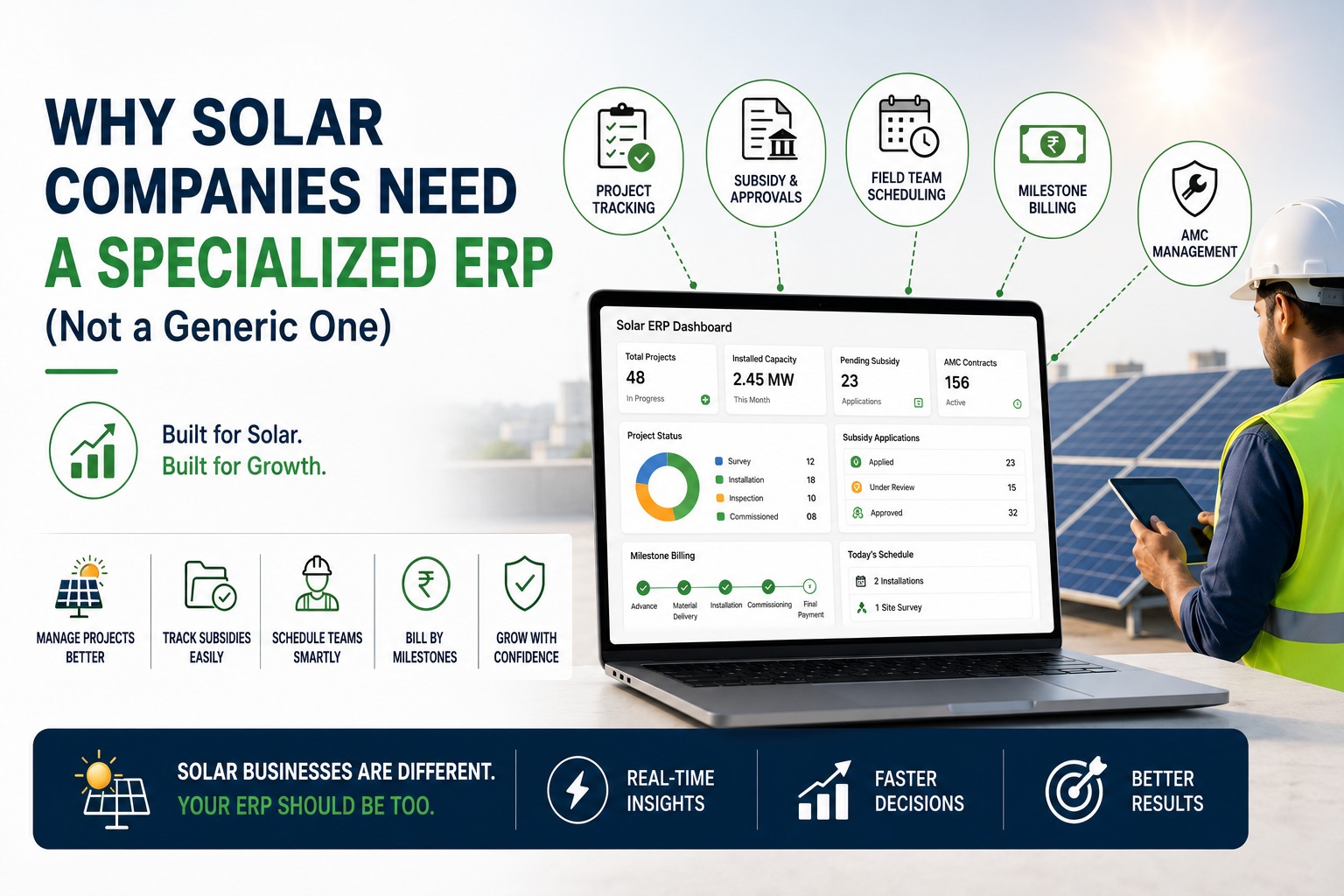
Why Solar Companies Need a Specialized ERP (Not a Generic One)
Solar installation companies occupy a strange middle ground in the world of business software. They're part manufacturer-distributor, tracking panels, inverters, and mounting structures like any hardware business. They're part project contractor, managing multi-week site installations like a construction firm. And they're part government-liaison, navigating subsidy applications and net-metering approvals that have nothing to do with either of those worlds.
No generic ERP was built with that specific combination in mind. Most solar businesses in India end up running some hybrid of an inventory tool, a project tracker, and a folder full of subsidy paperwork none of it talking to the others. This article looks at what actually makes solar operations different, where generic ERP quietly fails to keep up, and what a system built for this industry actually needs to do.
This isn't a small-scale inconvenience either. India's solar sector spanning residential rooftop, commercial, and utility-scale installers has grown fast enough that many companies are scaling their project volume well ahead of their operational systems, which is exactly when the cracks in generic software start to show most visibly.
Unique Challenges in Solar Operations
Solar businesses face a combination of operational pressures that rarely appear together in any other single industry, which is exactly why generic software struggles to serve them well.
Every Project Is Its Own Mini-Timeline
Unlike a retailer selling off a fixed shelf of stock, a solar company is running dozens of parallel, multi-stage projects at once each with its own site survey date, material delivery schedule, installation window, and inspection date. A single missed step on one project doesn't just delay that customer; it can cascade into scheduling conflicts across the whole installation calendar.
Weather and Site Conditions Aren't Optional Variables.
Installation schedules routinely shift because of weather, roof access issues, or site readiness delays that are entirely outside the company's control. A system that assumes a fixed, predictable timeline the way most generic project or order-tracking tools do breaks down quickly against this reality.
Government Subsidy and Net-Metering Paperwork.
Nearly every residential and many commercial solar installations in India involve subsidy applications, DISCOM approvals, and net-metering registration each with its own document requirements, submission stages, and approval timelines that can stretch for weeks. This paperwork trail is as central to closing a project as the physical installation itself, yet it has no natural home in a typical inventory or CRM tool.
Multi-Stakeholder Coordination.
A single project touches the sales team, a site survey engineer, a procurement team sourcing panels and inverters, an installation crew, a documentation team handling subsidy filings, and eventually an AMC team for ongoing maintenance. Keeping all of them working from the same accurate project status is a coordination challenge most generic systems were never designed to solve. When one stakeholder's update doesn't automatically reach the others, small delays at any single stage tend to ripple forward, showing up later as a missed installation date or a customer left wondering why nobody can tell them their subsidy status.
Revenue That Doesn't Look Like Typical Sales
A solar project's revenue often unlocks in stages advance payment, delivery-linked payment, installation-linked payment, and a final payment tied to subsidy disbursement or commissioning. Standard sales and invoicing modules, built around a single transaction moment, don't naturally accommodate this staged, milestone-driven billing structure.
| The Core Mismatch Generic ERP assumes a business either sells products from stock or delivers services on a schedule. Solar companies do both simultaneously, on a project timeline that's partly outside their control a combination most software simply wasn't built to represent |
What Generic ERP Misses
When a solar business tries to force-fit its operations into standard ERP modules, specific gaps show up almost immediately and they tend to be the same gaps, regardless of which generic platform is used.
| Solar-Specific Need |
What Generic ERP Typically Offers |
The Resulting Gap |
| Project-stage tracking |
Generic order status
(pending/shipped/delivered) |
No visibility into survey,
approval, or installation stages |
| Subsidy/net-metering documents |
Basic file attachment fields |
No structured tracking of
approval stages or deadlines |
| Milestone-based billing |
Single invoice per sales order |
Manual workarounds for staged
payments |
| Field team scheduling |
No field-service scheduling
logic |
Coordination happens over
phone calls and WhatsApp |
| AMC and maintenance cycles |
No recurring service-visit
tracking |
AMC renewals tracked manually,
often missed |
The consequence isn't a single dramatic failure it's the same pattern seen with disconnected systems generally: a spreadsheet tracking subsidy status here, a WhatsApp group coordinating field teams there, a separate reminder system for AMC renewals, all running alongside an ERP that technically exists but doesn't reflect how the business actually operates.
This gap tends to widen, not shrink, as a solar business grows. A company running ten installations a month can just about hold subsidy status and field scheduling together through sheer manual effort and a founder who remembers most of the details. At fifty or a hundred installations a month, that same manual coordination becomes the primary bottleneck limiting how fast the business can actually grow not demand, not installation capacity, but the sheer difficulty of keeping every project's paperwork and schedule straight.
Features Solar Businesses Actually Need
A genuinely useful Solar ERP doesn't try to be everything it focuses on the handful of capabilities that map directly onto how solar projects actually move from inquiry to commissioning.
End-to-End Project Lifecycle Tracking
A single project record that follows the job from lead to site survey, material procurement, installation, inspection, and commissioning with every stakeholder seeing the same current status, instead of five different people holding five different pieces of the picture.
Structured Subsidy and Approval Workflows
Built-in tracking for subsidy application stages, required documents, DISCOM submission dates, and approval status turning what's often an anxious, manual follow-up process into a visible pipeline with clear next steps and deadlines.
Milestone-Based Billing
Invoicing tied to project milestones advance, material delivery, installation completion, commissioning rather than a single transaction point, matching how solar projects actually generate revenue.
Field Team and Installation Scheduling
A scheduling view that accounts for crew availability, material readiness, and site conditions, making it easy to reschedule around weather or delays without losing track of the broader installation calendar.
AMC and Maintenance Management
Automated tracking of AMC contract renewals and scheduled maintenance visits, so recurring service revenue isn't left to memory or manual reminders a capability covered in more depth in our dedicated guide to managing AMC schedules.
| InfoTechBrains Approach
We build Solar ERP systems around the actual project lifecycle solar businesses run lead to installation to AMC layered onto the same reliable financial and inventory core every business needs, so nothing falls into a spreadsheet gap. |
What This Looks Like in Practice A residential and commercial solar installer in Jodhpur came to InfoTechBrains after months of tracking subsidy applications across a shared spreadsheet that frequently fell out of date, leading to missed DISCOM follow-ups and frustrated customers waiting on net-metering approval with no clear status update.
We implemented a Solar ERP with structured subsidy workflow tracking and milestone-based billing tied directly to project stages. Within the first quarter, the business had a live view of every subsidy application's status, automatic reminders before DISCOM deadlines, and billing that triggered automatically as each installation milestone was reached.
| 45%
Fewer missed DISCOM follow-ups |
3 weeks Average reduction in subsidy approval delays |
100% Projects with live, accurate status tracking |
The broader lesson for solar businesses is straightforward: the parts of your operation that feel the most chaotic subsidy paperwork, field scheduling, staged billing aren't chaotic because they're inherently unmanageable. They're chaotic because the software managing everything else in the business was never built to hold them in the first place.
Choosing a specialized Solar ERP isn't about adding complexity to your operations it's the opposite. It's about giving the complexity that already exists in solar project delivery a proper home, instead of scattering it across spreadsheets, phone calls, and individual memory. The businesses that make this shift early tend to find that growth stops feeling like a scheduling and paperwork crisis, and starts feeling like what it should be: more projects, delivered with the same reliability as the first one.
| Running a Solar Business on a Generic ERP?
InfoTechBrains builds Solar ERP systems
designed around field installations, subsidy paperwork, and AMC cycles the
way solar businesses actually operate.
Call / WhatsApp: +91 84594 18970 Visit: https://infotechbrains.com/ |
About the author

Aman Gupta
Founder & CEO at InfoTechBrains, helping SMEs scale and reduce manual work with AI, automation and custom software.
View LinkedIn ProfileView profile & all posts →