Social Media Marketing Services We Offer (and Why They Work)
This blog post breaks down our core social media marketing services and explains the data-driven strategies that turn casual scrollers into loyal customers.
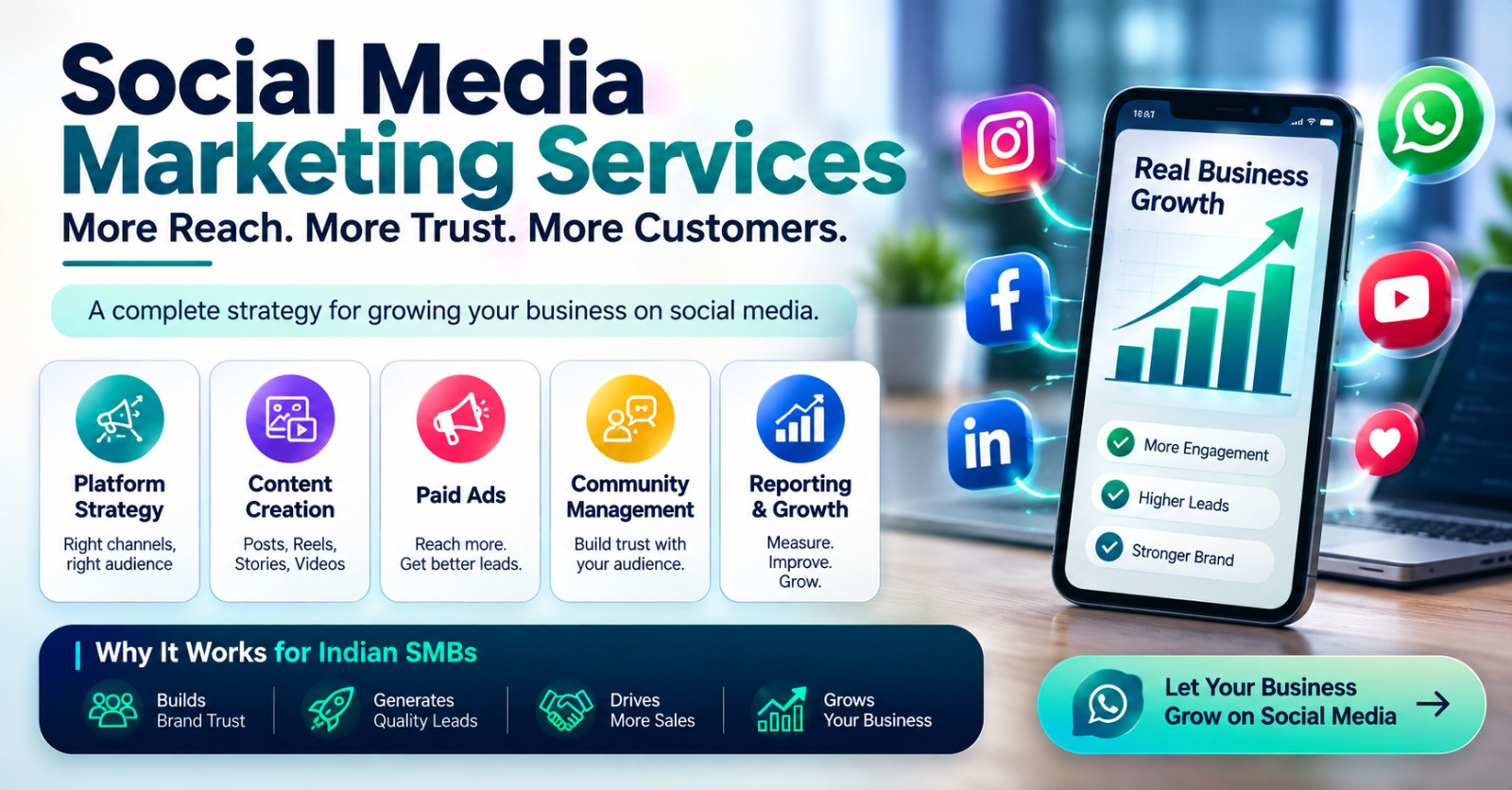
Social Media Marketing Services
We Offer (and Why They Work)
Most Indian SMBs have a social media presence of some kind an Instagram page with sporadic posts, a Facebook business account nobody checks regularly, maybe a LinkedIn page that hasn't been updated since it was created. Having a presence and having a strategy are two entirely different things, and the gap between them is exactly where most businesses lose the value social media could genuinely deliver, often without realizing a strategy was ever the missing piece.
Social media marketing services, done properly, aren't about posting more often or chasing follower counts. They're about using these platforms deliberately to generate leads, build trust with prospective customers, and support the rest of your sales and marketing effort with a clear line between activity and business outcome. This guide breaks down exactly what comprehensive social media marketing services should include, why each component actually works, and what a results-focused approach looks like for a growing Indian business.
This distinction matters more now than it did even a few years ago. Platform algorithms have grown more sophisticated at filtering low-value, inconsistent content out of feeds, which means the gap between businesses doing social media strategically and those posting sporadically has widened considerably. A half-hearted effort in 2026 is increasingly invisible, while a genuinely strategic one compounds in reach and trust month over month.
Why Social Media Marketing Matters for Indian SMBs in 2026
Social platforms have become a primary research destination for both B2C and B2B buyers before they ever contact a business directly. A prospective customer discovering your business through a Google search or a referral will very often check your Instagram or LinkedIn presence before picking up the phone using it as an informal trust signal, the way a shopper might once have judged a storefront by its window display.
For B2B and manufacturing businesses in particular, this shift is easy to underestimate. Owners sometimes assume social media matters only for consumer-facing brands selling directly to individuals, but a distributor, manufacturer, or service provider with an inactive or poorly maintained social presence quietly signals inattention to detail to exactly the kind of buyer doing careful due diligence before signing a contract worth lakhs or crores of rupees.
The businesses winning on social media in 2026 aren't necessarily the ones posting most frequently they're the ones whose content, targeting, and engagement strategy is built around a clear understanding of who their buyer actually is and what convinces that buyer to take the next step.
There's also a compounding trust effect worth naming directly. A prospective buyer who sees consistent, professional activity over months forms a very different impression than one who finds a page with a burst of posts from a year ago and silence since. The second scenario doesn't just fail to help it can actively raise doubts about whether a business is still operating normally, which is a real cost most owners don't anticipate when they let a social presence go stale.
The Core Services That Make Up Social Media Marketing
"Social media marketing" is really an umbrella covering several distinct disciplines, each contributing meaningfully to the overall result. A partner offering only one or two of these in isolation is offering a partial solution, however well they execute that narrow piece.
Platform Strategy and Audience Research
Before any content gets created, a proper strategy identifies which platforms your actual customers use, what kind of content they respond to, and what competitors in your space are doing well or poorly. A manufacturing B2B business and a D2C fashion brand need almost entirely different platform priorities, posting cadences, and tones treating every business the same way is the single most common mistake in generic social media packages.
Content Creation
This covers the actual posts graphics, short-form video, written captions, and increasingly, behind-the-scenes and process-driven content that builds trust by showing how a business actually operates. For manufacturing and B2B businesses especially, content showing real production processes, team expertise, and client outcomes tends to outperform generic stock-image posts by a wide margin.
Good content creation also means matching format to platform rather than repurposing the exact same asset everywhere. A polished product photo that performs well on Instagram often falls flat as a LinkedIn post, where a short written insight or a client result tends to generate far more meaningful engagement from a professional audience.
Paid Social Advertising
Organic reach on most platforms has declined steadily for years, making paid promotion an increasingly necessary complement to organic content rather than an optional extra. Effective paid social advertising requires careful audience targeting, budget management, and continuous testing of creative and messaging treated as a discipline in its own right, not an afterthought bolted onto organic posting.
The businesses that get real value from paid social treat it as an ongoing experiment rather than a set-and-forget budget line testing different audiences, creative formats, and messaging angles, then reallocating spend toward whatever is actually converting. A campaign left untouched for months typically underperforms one that's actively monitored and refined weekly.
Community Management and Engagement
Responding to comments, messages, and reviews in a timely, on-brand way is where many businesses quietly fail, leaving inquiries unanswered for days or ignoring negative feedback entirely. Prompt, thoughtful engagement is often what actually converts a social media follower into a real inquiry or sale the content gets attention, but the engagement is what builds the relationship.
Analytics and Reporting
Genuine social media marketing services track performance against business outcomes leads generated, website traffic driven, inquiries received not just vanity metrics like likes and follower counts. A monthly report should tell you clearly whether the investment is working, in language tied to your business goals rather than platform jargon.
Why a Structured Approach Actually Works
The mechanism behind effective social media marketing isn't mysterious, but it does require patience and consistency that many businesses underestimate when they start.
|
Mechanism |
How It Drives Business Results |
|
Consistent visibility |
Repeated, relevant exposure builds familiarity, making a business the first one a prospect thinks of when a need arises |
|
Social proof |
Client testimonials, case studies, and visible engagement signal credibility to prospects doing due diligence |
|
Targeted paid reach |
Precise audience targeting puts content in front of people genuinely likely to need the product or service |
|
Direct engagement |
Prompt responses to inquiries and comments convert passive interest into active conversations |
|
Content-driven SEO |
Active social profiles and shared content support broader search visibility and brand searches |
None of these mechanisms deliver results from a single post or a single week of activity. Social media marketing compounds over months early activity builds the audience and content library that later campaigns draw on, which is exactly why businesses that start and stop repeatedly rarely see the same results as those who commit to a sustained, structured effort. This is one of the hardest truths for owners to accept early on, because the first month or two of a genuinely good strategy can look outwardly similar to the first month of a mediocre one the difference only becomes obvious once the compounding effects of consistency and refinement start to show in the numbers.
|
Why Posting Alone Isn't a Strategy A business posting consistently without a clear audience strategy, paid amplification, or engagement plan is doing the hardest, least effective version of social media marketing all of the effort, with none of the compounding advantages that come from doing it as a connected system rather than a checklist item. |
Platform-by-Platform: What Actually Works
Generic "social media marketing" advice tends to treat all platforms identically, but each major platform has a genuinely different audience behavior, content format, and business use case. A strategy that doesn't account for these differences ends up diluted across every platform rather than effective on any of them.
Instagram remains the strongest platform for visually driven businesses retail, hospitality, D2C brands, and increasingly, manufacturers showcasing production processes and finished products. Reels and short-form video consistently outperform static images for reach, while Stories offer a lower-pressure format for behind-the-scenes content and quick engagement with existing followers.
Facebook's organic reach has declined significantly over the years, but it remains valuable for two specific things: community building through groups, and highly targeted paid advertising, particularly for reaching a slightly older demographic than Instagram typically captures. For local and regional businesses, Facebook's location-based ad targeting remains genuinely effective.
For B2B businesses manufacturers, service providers, software companies LinkedIn is often the single highest-value platform, reaching decision-makers directly in a professional context. Content that performs well here tends to be more substantive: case studies, industry insights, and genuine expertise, rather than the polished, high-production content that works on Instagram.
YouTube
Often overlooked by SMBs, YouTube functions as both a social platform and a search engine, making it valuable for businesses with genuinely useful how-to, explainer, or product-demonstration content. Video content here has a far longer shelf life than posts on other platforms, continuing to generate views and leads months or years after publication.
While not a traditional "social media" platform, WhatsApp Business functions as a critical extension of social media marketing in the Indian market specifically the natural next step once a prospect engages with a post or ad, allowing direct, immediate conversation that converts interest into an actual sale far more often than a generic contact form.
|
Fewer Platforms, Done Well Most Indian SMBs are better served by doing two or three platforms genuinely well than spreading thin, mediocre effort across five or six. Platform selection should follow directly from where your specific customers actually spend their attention, not from a generic "be everywhere" instinct. |
What Social Media Marketing Services Typically Cost in India
Pricing varies considerably based on scope, platform count, content volume, and whether paid advertising budget is managed as part of the engagement. These ranges reflect typical 2026 market positioning for Indian SMB-focused social media services, excluding the actual ad spend budget itself, which is always kept separate from the management fee for transparency.
|
Service Tier |
What's Typically Included |
Approx. Monthly Cost (INR) |
|
Starter |
1-2 platforms, basic content calendar, minimal paid support |
₹15,000-30,000 |
|
Growth |
2-3 platforms, regular content + Reels/video, active paid campaigns, monthly reporting |
₹30,000-70,000 |
|
Comprehensive |
3+ platforms, dedicated content production, advanced targeting, community management, detailed analytics |
₹70,000-1,50,000+ |
Ad spend budget sits on top of these management fees entirely a business running paid campaigns should expect to allocate a separate budget for the actual advertising, typically starting from a modest test budget and scaling up once specific campaigns prove effective. Providers who bundle ad spend into a flat "all-inclusive" fee without transparency on how much is actually being spent on ads versus management deserve extra scrutiny, since this structure can obscure whether your budget is being used efficiently.
Common Mistakes Businesses Make Without a Proper Partner
• Posting inconsistently, then abandoning the effort after a few weeks of limited visible results, before the compounding effects of consistent activity have had time to build
• Treating every platform identically instead of tailoring content format and tone to how each platform's audience actually behaves
• Focusing on follower count and likes instead of tracking actual leads, inquiries, or sales attributable to social activity
• Ignoring paid promotion entirely, relying solely on organic reach that has become increasingly limited on most major platforms
• Letting comments, messages, and reviews go unanswered for days, quietly damaging the trust that social media is meant to build
• Running social media as a side task for an already-stretched employee rather than treating it as a dedicated function with its own strategy and accountability
What to Look for in a Social Media Marketing Partner
Whether working with InfoTechBrains or evaluating any provider, a few questions consistently separate a results-focused partner from one selling generic packages built for volume rather than genuine results.
• Do they ask about your specific business goals and target customer before proposing a content calendar, or do they jump straight to a generic package?
• Can they show real examples of measurable business results not just visually appealing posts for businesses similar to yours?
• Do they include paid advertising strategy as a core part of the service, or treat it as a separate, optional add-on?
• How do they report results, and do those reports tie back to business outcomes you actually care about?
• Who specifically manages your account day to day, and how quickly do they respond to comments, messages, and time-sensitive opportunities?
What This Looks Like in Practice
A B2B industrial equipment supplier in Gurugram had maintained a LinkedIn page for over a year with sporadic, generic posts and almost no engagement, generating essentially zero leads despite the time invested. Their assumption, common among B2B manufacturers, was that social media simply didn't work for their kind of business a conclusion that felt reasonable given a year of effort with nothing to show for it.
InfoTechBrains rebuilt their approach around a clear audience strategy targeting procurement managers and plant heads at mid-sized manufacturing companies with content shifted toward real production capability videos, client case studies, and specific problem-solution posts addressing common procurement pain points, supported by targeted LinkedIn advertising toward the defined audience. Community management was also formalized for the first time, with a defined response-time commitment for any inbound comment or message rather than the previous ad hoc approach.
|
340% Increase in qualified profile engagement |
18 Sales inquiries generated in first quarter |
4 months To reach consistent monthly lead flow |
The turnaround wasn't about posting more it was about posting with a clear audience and purpose in mind, backed by paid reach targeted precisely at the buyers who actually make purchasing decisions in their industry. The business owner's own reflection was candid: he'd assumed social media "didn't work" for B2B industrial sales, when the real issue had simply been an unfocused, unmeasured approach with no strategy behind it.
The broader lesson holds across almost every Indian SMB sector, B2B or B2C: social media marketing works reliably when it's treated as a structured discipline strategy, content, paid reach, engagement, and reporting working together toward defined business outcomes rather than a task delegated informally to whoever has a few spare hours each week. Businesses that make this shift consistently outperform those still treating social media as an afterthought, regardless of how technical, traditional, or B2B their industry might seem on the surface. The platforms themselves haven't changed the fundamentals of good marketing clear audience understanding, consistent value delivery, and honest measurement they've simply made the cost of skipping those fundamentals higher and more visible than it used to be.
|
Ready for Social Media That Actually Drives Business? InfoTechBrains runs social media marketing for Indian SMBs with the same transparent, results-first approach we bring to ERP and automation projects. Call / WhatsApp: +91 84594 18970 Visit: https://infotechbrains.com/ |
About the author
InfoTechBrains Team
Technology expert focused on software architecture, automation, and digital transformation.
View profile & all posts →