Machine Learning for Small Businesses: Myths vs. Reality
Machine learning is an accessible tool rather than a luxury for tech giants. It quietly automates tedious workflows, personalizes customer experiences, and optimizes daily operations.
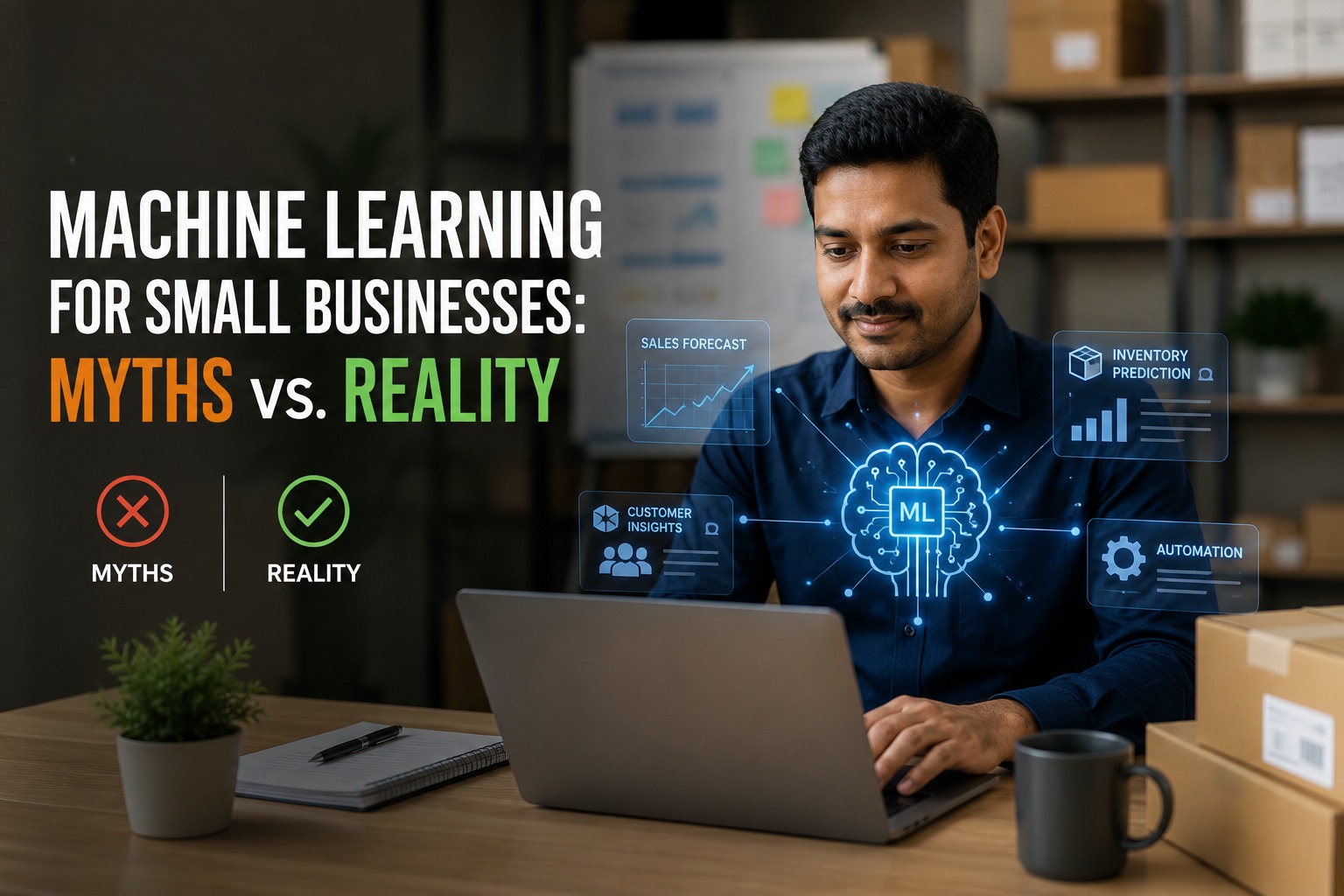
Machine Learning for Small Businesses:
Myths vs. Reality
Ask a small business owner in Ludhiana, Coimbatore, or Nashik what "machine learning" means, and you'll usually get one of two reactions: either a shrug ("that's for Google and Amazon, not us") or a slightly panicked look ("do I need to hire engineers now?"). Both reactions are understandable and both are based on myths that have been repeated so often they've started to feel like facts.
The truth is far less intimidating. Machine learning (ML) has quietly become accessible, affordable, and genuinely useful for Indian SMBs from a two-person garment export business in Tiruppur to a 15-person solar installer in Pune. You don't need a PhD, a six-figure budget, or an in-house data team to benefit from it. You need clarity on what ML actually does, and a partner who can implement it without the jargon.
This article separates the myths from the reality, so you can make an informed decision about whether and how ML fits into your growth plan for 2026.
Common Misconceptions About Machine Learning
Most hesitation around ML doesn't come from a bad experience it comes from no experience, filled in with assumptions picked up from tech news written for enterprise audiences. Let's address the five myths we hear most often from SMB owners across India.
Myth 1: "ML Is Only for Big Companies with Big Budgets"
This was true a decade ago, when building a predictive model required a dedicated data science team and expensive infrastructure. Today, cloud-based ML tools and pre-trained models have collapsed that cost curve. A small retail chain can now use demand-forecasting tools that cost a few thousand rupees a month not the lakhs it once required to build similar capability in-house.
Myth 2: "I Need a Data Science Team to Use ML"
Most SMBs don't build ML models from scratch they use ML that's already embedded inside tools they adopt: WhatsApp automation platforms that learn response patterns, ERP systems that flag anomalies, inventory tools that predict stockouts. The skill you actually need is knowing which off-the-shelf ML capability solves your specific bottleneck, which is exactly where an implementation partner adds value.
Myth 3: "ML Requires Huge Amounts of Data We Don't Have"
Large enterprises train models on millions of data points, but most practical SMB use cases like predicting which customers are likely to churn, or flagging unusual expense patterns work effectively with a few hundred to a few thousand historical records. Two to three years of sales, inventory, or customer interaction data is often more than enough to get started.
Myth 4: "ML Will Replace My Team"
In SMB deployments, ML overwhelmingly augments rather than replaces. It handles repetitive pattern-recognition work flagging a likely-to-default customer, predicting next month's raw material needs so your team can spend time on relationship-building, negotiation, and judgment calls that still require a human.
Myth 5: "It's Too Risky and Unproven for a Small Business"
Ironically, small businesses often see faster, more measurable ROI from ML than large enterprises, simply because the use cases are narrower and the baseline processes being replaced are more manual. A single well-targeted use case — better demand forecasting, smarter lead scoring — can pay for itself within a few months.
|
Reality Check You don't need to "do machine learning." You need to solve two or three specific business problems and increasingly, the tools that solve them happen to use ML under the hood. The technology is the means, not the goal. |
What's Actually Achievable on a Budget
For Indian SMBs working with realistic budgets, certain ML-powered capabilities offer the best return without requiring custom model development. Here's where the technology is mature, affordable, and genuinely useful today.
|
Use Case |
What It Does |
Typical SMB Fit |
|
Demand & Inventory Forecasting |
Predicts stock needs from historical sales patterns and seasonality |
Retail, distribution, manufacturing |
|
Lead Scoring |
Ranks incoming leads by likelihood to convert |
B2B services, solar, real estate |
|
Customer Churn Prediction |
Flags customers likely to stop ordering or renewing |
Subscription, AMC-based, services |
|
WhatsApp/Chatbot Intent Detection |
Understands customer queries to route or auto-respond |
E-commerce, support-heavy SMBs |
|
Anomaly Detection in Expenses |
Flags unusual transactions or billing errors |
Finance-heavy operations, ERP users |
A Realistic Case Study
A mid-sized electrical components distributor in Rajkot came to InfoTechBrains with a familiar problem: overstocking slow-moving items while frequently running out of fast-moving ones, tying up working capital and frustrating repeat customers. Rather than building a custom ML platform, we layered a demand-forecasting module onto their existing ERP, trained on two years of sales history.
|
23% Reduction in dead stock |
31% Fewer stockout incidents |
4 months Time to break even |
No data scientists were hired. No custom algorithm was built from scratch. The forecasting engine was configured, connected to existing sales data, and tuned over a few weeks a pattern that holds true for most SMB ML deployments.
What to Budget Realistically
• Entry-level ML add-ons (chatbot intent detection, basic forecasting): a few thousand rupees per month as part of a broader automation or ERP subscription
• Mid-tier deployments (churn prediction, lead scoring integrated with CRM): a modest one-time setup fee plus monthly usage
• Custom-trained models for niche use cases: higher one-time investment, justified only when off-the-shelf tools can't solve the specific problem
Getting Started Without a Data Science Team
You don't need to hire anyone new to begin using ML in your business. Here's a practical, low-risk path that Indian SMBs can follow.
Step 1: Identify One Painful, Repetitive Decision
Look for a decision your team makes repeatedly using gut feel or spreadsheets — how much stock to reorder, which leads to call first, which customers might churn. This is your starting use case. Resist the urge to solve everything at once.
Step 2: Check What's Already Built Into Your Existing Tools
Before considering a custom build, check whether your ERP, CRM, or WhatsApp automation platform already offers a forecasting, scoring, or anomaly-detection module. Many SMBs are already paying for ML capability they haven't switched on.
Step 3: Start With Clean, Available Data
You don't need perfect data — you need consistent data. A few years of sales records, inventory logs, or customer interaction history, even in spreadsheets, is usually enough for an implementation partner to build a working first version.
Step 4: Pilot on One Process, Measure, Then Expand
Run the ML-powered tool alongside your existing process for four to eight weeks. Compare predictions against actual outcomes. Once the pilot proves out, expand to adjacent processes rather than attempting a company-wide rollout on day one.
Step 5: Partner With Someone Who Handles the Technical Layer
This is where most SMBs get stuck not because ML is hard to use, but because choosing, configuring, and integrating the right tool takes technical judgment. An experienced automation partner can shortlist the right approach, connect it to your existing systems, and monitor performance so your team isn't left maintaining infrastructure they didn't build.
|
InfoTechBrains Approach As an ISO 9001:2015 certified technology partner, InfoTechBrains helps Indian SMBs adopt ML-powered features inside the tools they already use ERP, WhatsApp automation, and customer support with clear documentation, structured rollout, and no dependency on an in-house data science team. |
|
Ready to Explore What ML Can Actually Do for Your Business? InfoTechBrains helps Indian SMBs adopt practical, budget-friendly AI and ML solutions no data science team required. Let's talk about what's realistic for your business. Call / WhatsApp: +91 84594 18970 Visit: https://infotechbrains.com/ |
About the author

Aman Gupta
Founder & CEO at InfoTechBrains, helping SMEs scale and reduce manual work with AI, automation and custom software.
View LinkedIn ProfileView profile & all posts →