Industry-Specific ERP: Why One-Size-Fits-All Doesn't Work
Discover why industry-specific ERP outperforms generic ERP for manufacturing, education, and healthcare with tailored modules that improve efficiency and compliance.
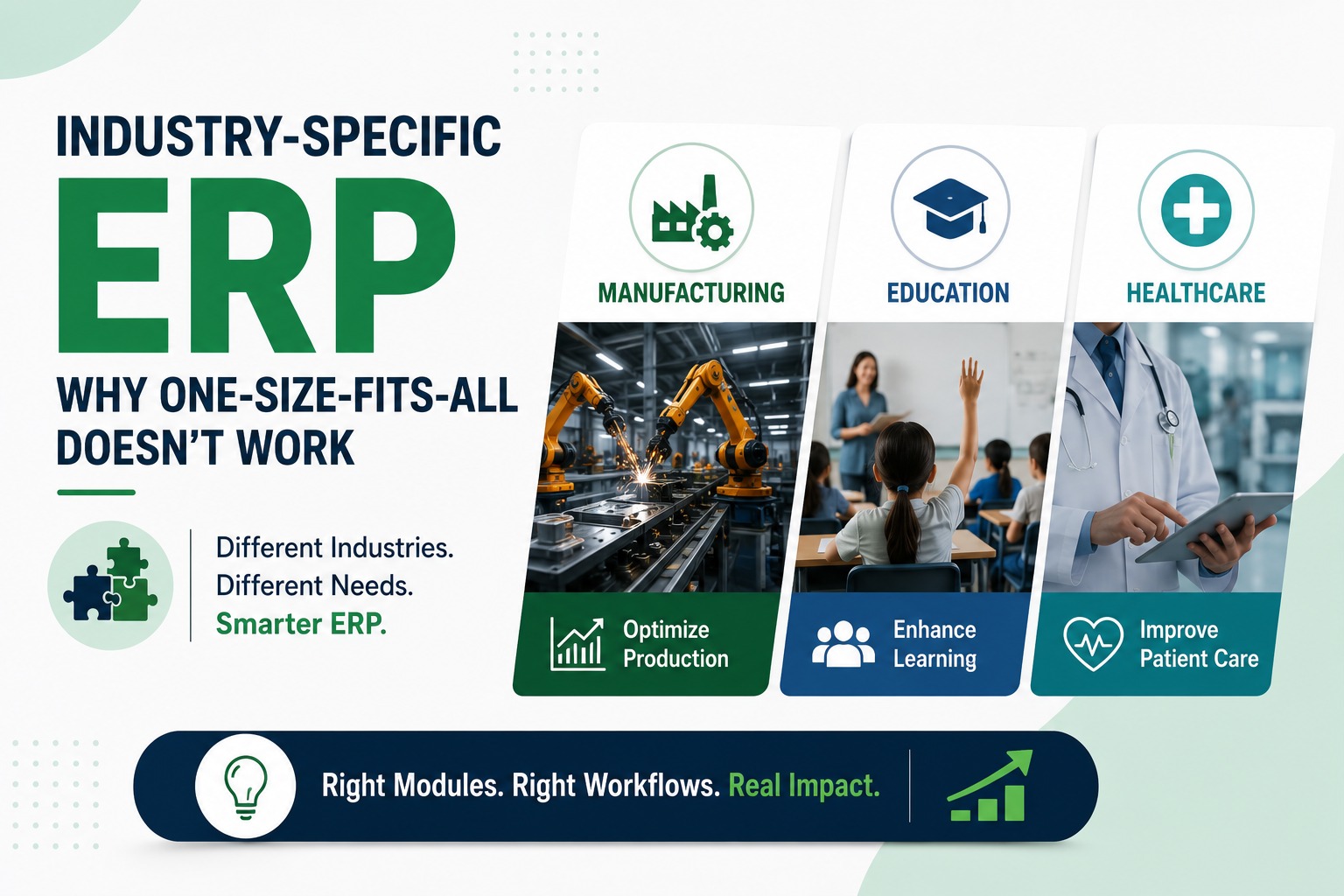
Industry-Specific ERP:Why One-Size-Fits-All Doesn't Work
There's a persistent myth in enterprise software that a good ERP is a good ERP, regardless of industry that the core functions of tracking orders, managing inventory, and running reports are essentially the same everywhere, with only minor cosmetic differences between sectors. Anyone who has actually tried to run a manufacturing unit, a school, or a diagnostic lab on a generic, one-size-fits-all ERP knows this isn't true.
A factory doesn't manage "records" the way a school manages "records." A hospital doesn't track "inventory" the way a distributor tracks "inventory." The underlying software concepts might rhyme, but the actual workflows, compliance requirements, and daily pressures are different enough that generic ERP tends to force businesses into awkward workarounds — or worse, into abandoning modules they paid for because they simply don't fit.
This article breaks down exactly where generic ERP falls short, how needs genuinely differ across manufacturing, education, and healthcare, and what industry-specific modules actually look like in practice.
Generic ERP Limitations:
Generic ERP platforms are built to serve the broadest possible customer base, which means their core design decisions optimize for "works reasonably well everywhere" rather than "works excellently for your specific industry." That trade-off shows up in a few consistent ways.
Terminology and Workflow Mismatch:
A generic ERP's "product" field doesn't distinguish between a finished good, a work-in-progress batch, and a raw material the way a manufacturer needs it to. A generic "customer" record doesn't capture the parent-student-guardian relationship an educational institution needs, or the patient-referring-doctor relationship a healthcare provider needs. These aren't cosmetic gaps they force staff to misuse fields or maintain workarounds outside the system.
Compliance Blind Spots:
Every industry carries its own regulatory and documentation burden batch traceability in manufacturing, attendance and academic record-keeping in education, patient data handling and clinical documentation in healthcare. Generic ERP rarely bakes these in natively, leaving businesses to bolt on separate compliance tools or track them manually alongside the ERP.
The risk here isn't just inconvenience it's exposure. A manufacturer that can't produce clean batch traceability during an OEM audit risks losing a contract. A healthcare provider with inconsistent patient data handling risks regulatory penalties. These aren't edge cases; they're routine operational realities that a generic system simply wasn't designed to anticipate.
Reporting That Misses What Actually Matters:
Out-of-the-box reports in generic ERP tend to focus on universal metrics revenue, basic inventory counts, generic sales pipelines. They rarely surface the metrics that matter most within a specific industry, like machine downtime in manufacturing, fee collection rates in education, or bed occupancy in healthcare, without significant custom report-building.
Forced Workarounds That Erode ROI:
When the software doesn't fit, teams inevitably build workarounds a parallel spreadsheet here, a separate app there quietly recreating the exact data silos that ERP was supposed to eliminate in the first place. The result is a business paying for an ERP license while still doing meaningful parts of its operations outside the system.
This is often the most expensive form of ERP failure, precisely because it's invisible on paper. The system is technically "live," the subscription is being paid, and leadership may genuinely believe the rollout succeeded while on the ground, staff have quietly rebuilt the same fragmented, disconnected workflow the ERP was meant to replace, just with an extra piece of software layered awkwardly on top.
The Core Problem:
Generic ERP isn't badly built software it's software built for an average business that doesn't actually exist. The moment your operations have any real specificity, that averaging starts working against you rather than for you.
Manufacturing vs. Education vs. Healthcare Needs
To see why one-size-fits-all fails so consistently, it helps to look at how differently three common sectors actually need their systems to behave.
| Need |
Manufacturing |
Education |
Healthcare |
| Core Record Type |
Production batch / BOM |
Student / academic record |
Patient / clinical record |
| Critical Tracking |
Raw material to finished
goods, machine uptime |
Attendance, fee collection,
exam results |
Appointments, treatment
history, inventory of medicines |
| Compliance Focus |
Quality certifications, batch
traceability |
Academic regulatory reporting,
safety records |
Patient data privacy, clinical
documentation |
| Key Bottleneck |
Production scheduling and
downtime |
Admissions cycles, fee
follow-up |
Appointment scheduling,
bed/resource allocation |
| High-Value Report |
OEE (overall equipment
effectiveness) |
Fee collection aging report |
Occupancy and resource
utilization |
A manufacturing business in Nagpur producing auto components cares deeply about tracking a part through multiple production stages, tool wear, and vendor-supplied components concerns a school or hospital would never need to model. An educational institution in Vadodara, meanwhile, revolves around academic calendars, fee cycles, and parent communication concepts that don't map onto a factory floor at all. A diagnostic and healthcare provider in Kochi has entirely different priorities again: appointment scheduling, medicine inventory with expiry tracking, and strict patient data confidentiality.
Running any of these three on the same generic ERP template means at least two of them are working against significant friction bending their actual operations to fit fields, workflows, and reports that were never designed with their industry in mind. Over time, this friction doesn't stay constant it compounds as the business grows, adds locations, or takes on more complex clients who expect industry-standard documentation and reporting.
Custom Module Examples
Industry-specific ERP doesn't mean rebuilding software from zero it means layering the right specialized modules onto a solid ERP core. Here's what that looks like in practice across these three sectors.
Manufacturing: Production and Quality Modules
• Bill of Materials (BOM) management that tracks raw material consumption per finished unit
• Machine and tool maintenance scheduling tied to production output, flagging wear before it causes downtime
• Batch traceability that auto-generates documentation required by OEM or export clients
• Multi-stage work-order tracking that shows exactly where a product is in the production pipeline
Education: Academic and Administrative Modules
• Admissions pipeline tracking from inquiry to enrollment, with automated follow-up reminders
• Fee management with structured installment tracking and aging reports for overdue payments
• Attendance and academic performance tracking linked directly to parent communication
• Timetable and resource (classroom, lab, faculty) scheduling that avoids conflicts automatically
Healthcare: Clinical and Patient Management Modules
• Appointment scheduling integrated with doctor availability and resource/room allocation
• Medicine and consumables inventory with expiry-date tracking and automatic reorder alerts
• Patient history and treatment records with appropriate access controls for data privacy
• Billing and insurance claim tracking specific to healthcare reimbursement workflows
InfoTechBrains Approach
We build on a proven ERP core covering finance, inventory, and reporting fundamentals every business needs and then layer industry-specific modules on top, so you get the reliability of a mature foundation with the fit of a system designed around your sector.
A Practical Example
A precision auto-components manufacturer in Nagpur initially adopted a generic ERP recommended widely across industries. Within months, their production team had reverted to a separate spreadsheet to track batch-wise raw material consumption, because the generic "inventory" module simply couldn't represent multi-stage manufacturing accurately.
InfoTechBrains rebuilt their ERP around a manufacturing-specific core — proper BOM tracking, stage-wise work orders, and automated batch documentation for their OEM clients. Within the first quarter, the parallel spreadsheet was retired entirely, documentation errors for OEM audits dropped sharply, and the production manager finally had a single, trustworthy view of material consumption across every batch.
| 100%
Elimination of parallel tracking spreadsheets |
40% Faster OEM audit documentation prep |
1 Quarter
Time to fully retire old workarounds |
The lesson holds regardless of which industry you're in: an ERP that speaks your industry's language not a generic approximation of it is what actually gets adopted, trusted, and used to its full potential by your team.
How to Evaluate Whether Your ERP Fits Your Industry
A useful test: ask your team, across sales, operations, and finance, to name the one report or workflow they still maintain outside the ERP "just to be safe." If every department has an answer, that's a strong signal the current system is generic where it needed to be specific. The fix isn't always a full replacement often it's identifying the two or three industry-specific modules that would eliminate those remaining workarounds entirely.
Generic ERP Not Fitting Your Industry? InfoTechBrains builds ERP systems with industry-specific modules designed around how your sector actually operates not a generic template you have to work around. Call / WhatsApp: +91 84594 18970 Visit: https://infotechbrains.com/ |
About the author

Aman Gupta
Founder & CEO at InfoTechBrains, helping SMEs scale and reduce manual work with AI, automation and custom software.
View LinkedIn ProfileView profile & all posts →