How to Choose a Mobile App Development Company in India
To choose a mobile app development company in India, you must define your app goals, review past work, and check technical skills. Look at their portfolio, verify client reviews on independent sites, and discuss post-launch support.
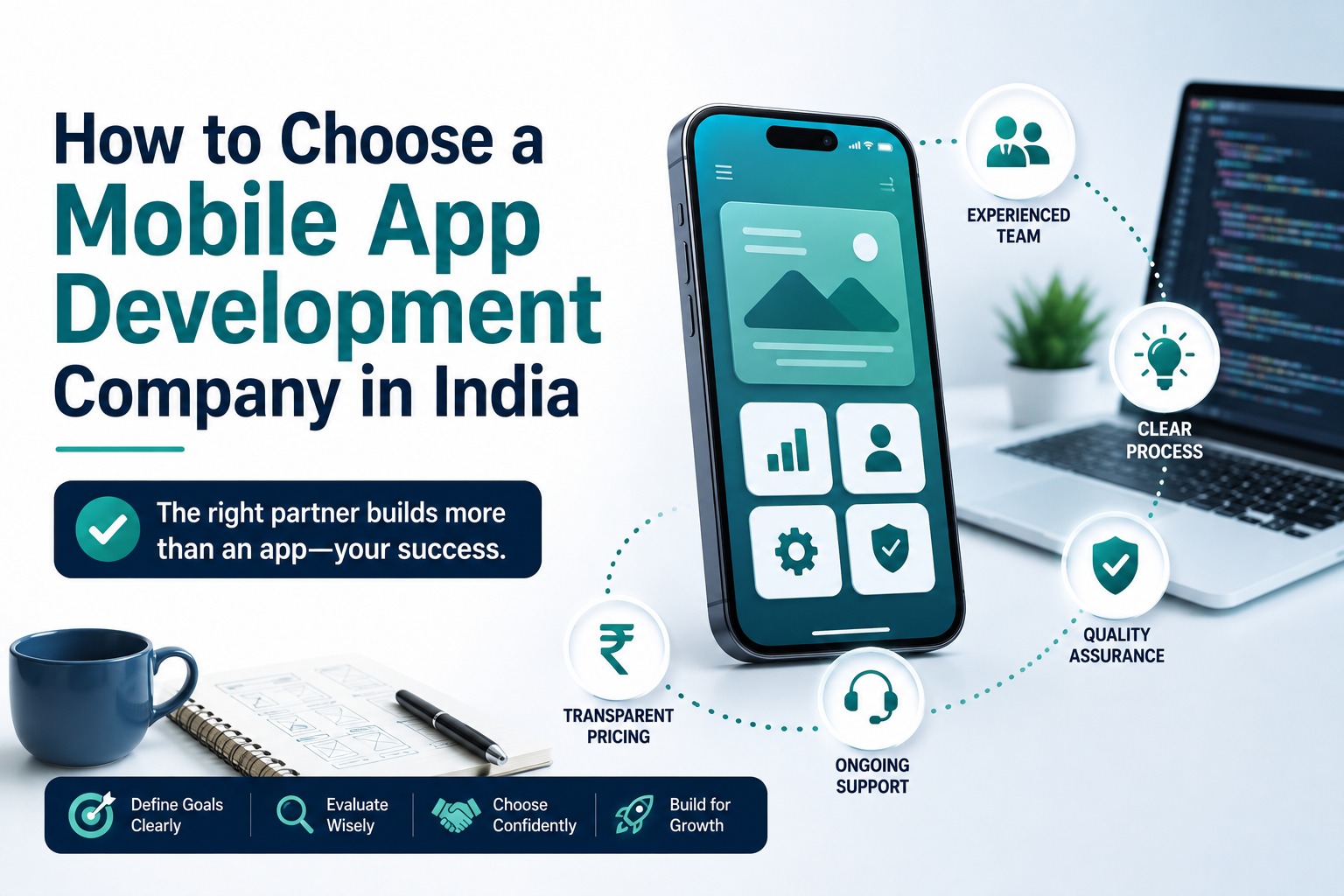
How to Choose a Mobile App
Development Company in India
Every business that decides to build a mobile app eventually hits the same wall: a Google search for "mobile app development company in India" returns thousands of results, most claiming years of experience, an in-house team of experts, and client satisfaction that borders on suspiciously perfect. Somewhere behind that marketing language, a small number of these companies will actually deliver a working, well-built app on time and within budget and a larger number will deliver something late, over budget, or quietly abandoned halfway through.
The difference rarely comes down to talent alone. It comes down to process, communication discipline, technical honesty, and a business model that aligns the development company's incentives with actually finishing your project well. This guide walks through everything a business owner in India needs to evaluate before signing a contract the types of development partners available, the criteria that actually predict project success, red flags experienced clients learn to spot, realistic pricing expectations, and the questions worth asking in your very first call.
Why This Decision Matters More Than It Seems
A mobile app is rarely a one-time purchase the way a website sometimes can be. It's the beginning of an ongoing relationship updates, bug fixes, new features, platform compatibility as iOS and Android evolve, and scaling as your user base grows. Choosing the wrong partner doesn't just risk a bad first version; it risks being stuck with a codebase nobody else wants to touch, forcing an expensive rebuild months or years down the line.
This is especially true in India's app development market, which has grown large and varied enough that quality varies enormously even among companies charging similar rates. Two agencies quoting nearly identical prices can differ dramatically in the actual engineering discipline, documentation practices, and long-term thinking that goes into the final product differences that are invisible in a sales pitch but become extremely visible six months after launch, when you need to add a feature or fix something the original code wasn't built to handle.
Types of Mobile App Development Partners
Before evaluating individual companies, it helps to understand the broad categories of partners available, since each comes with a genuinely different risk and cost profile.
Freelance Developers
Individual freelancers offer the lowest cost and often direct, fast communication, since you're dealing with the person actually writing the code. The risk is concentration a single point of failure if that person becomes unavailable, and often limited capacity to handle both design and complex backend work simultaneously without bringing in additional freelancers, which reintroduces coordination overhead.
Boutique Development Agencies
Small, focused teams typically five to twenty five people that specialize in mobile app development specifically, rather than treating it as one service among dozens. Boutique agencies often provide a strong balance of accountability, technical depth, and reasonable cost, though capacity can be limited if your project needs to move faster than their current team size allows.
Large IT Services Companies
Bigger, more established firms offer greater capacity and often more mature project management processes, but frequently at a higher cost and with less founder-level attention on any single project your app may be one of dozens the account team is juggling simultaneously, and you may work primarily with account managers rather than the engineers actually writing your code.
Offshore and Outsourced Teams
Some businesses work with development teams outside India entirely, or use Indian companies that in turn outsource parts of the work further. This can reduce cost but often adds communication friction, time zone challenges, and a longer chain of accountability if something goes wrong.
Key Criteria to Evaluate a Mobile App Development Company
Once you've identified a shortlist, evaluate each option against the specific factors that actually predict whether a project succeeds not just the ones that make for an impressive sales pitch.
Portfolio Relevance, Not Just Portfolio Size
A long list of past apps matters less than whether any of them resemble what you're building — similar complexity, similar industry, similar scale of user base. Ask specifically about a project close to yours in scope, and request to actually use the finished app rather than just viewing screenshots, since a polished screenshot says little about real-world performance, load times, or how the app handles edge cases.
Technical Stack and Platform Expertise
Modern mobile development generally falls into native development building separately for iOS (Swift) and Android (Kotlin) or cross-platform development using frameworks like React Native or Flutter that share a single codebase across both platforms. Neither approach is universally "better"; the right choice depends on your app's complexity, performance requirements, and budget. A development company should be able to explain clearly why they're recommending one approach over the other for your specific case, rather than defaulting to whichever technology their existing team happens to know best.
|
Approach |
Best For |
Trade-off |
|
Native (Swift/Kotlin) |
Performance-heavy apps, deep device feature integration |
Higher cost, two separate codebases to maintain |
|
Cross-Platform (React Native/Flutter) |
Faster launch, moderate complexity apps, tighter budgets |
Occasional platform-specific limitations for advanced features |
|
Progressive Web App |
Content-focused apps, minimal budget, fast iteration |
Limited access to native device capabilities |
Communication and Project Management Process
Ask exactly how the company manages projects which tools they use for task tracking, how often you'll receive updates, and whether you'll have a single point of contact or need to chase different people for different questions. A company that struggles to clearly explain its own process during the sales conversation is unlikely to suddenly become organized once your contract is signed and their attention shifts elsewhere.
Post-Launch Support and Maintenance
An app's real work begins after launch bug fixes discovered through real user behavior, OS updates that require compatibility changes, and new feature requests as your business evolves. Clarify upfront what post-launch support is included, for how long, and what ongoing maintenance costs once the initial warranty period ends. Companies that focus entirely on the build phase and go quiet on support terms are worth extra scrutiny.
Pricing Transparency
A trustworthy development partner breaks down pricing by phase or feature, rather than offering a single opaque number with no visibility into what's actually included. Ask specifically what happens if requirements change mid-project a common and often reasonable occurrence and how that's priced, since vague answers here often turn into disputed invoices later.
Team Structure and Who You'll Actually Work With
Ask who specifically will be assigned to your project, and whether that team remains consistent throughout development or gets reshuffled onto other client work partway through. High team turnover mid-project is one of the most common, and most disruptive, causes of delay and quality inconsistency in app development.
How a Well-Run App Development Project Actually Unfolds
Beyond evaluating a company on paper, it helps to understand what a properly structured app development engagement should look like in practice, so you can recognize whether a prospective partner's proposed process matches this or skips important steps entirely.
Phase 1: Discovery and Requirements Definition
A serious development partner starts by understanding your business goals, target users, and core functionality needs before writing a single line of code or even a design mockup. This phase should produce a clear, written scope document not a vague verbal agreement outlining exactly what will be built, in what order, and what's explicitly out of scope for the initial version.
Be wary of companies eager to skip straight to a price quote without this discovery step. A quote given before requirements are properly understood is, at best, a rough estimate likely to shift significantly once real scoping begins and at worst, a lowball number designed purely to win the contract before renegotiating later.
Phase 2: UI/UX Design
Wireframes and visual designs should be reviewed and approved before development begins, giving you a clear picture of the app's flow and appearance while changes are still cheap to make. Catching a design issue at this stage costs a revision; catching the same issue after development is underway often costs a rebuild.
Phase 3: Development in Iterative Sprints
Rather than disappearing for months and reappearing with a finished product, a well-run team works in shorter iterative cycles commonly two-week sprints with regular demos showing genuine progress. This structure catches misunderstandings early, when they're a quick correction, rather than at the end, when they require reworking substantial portions of the app.
Phase 4: Quality Assurance and Testing
Dedicated testing across multiple devices, screen sizes, and real-world network conditions should happen throughout development, not as a rushed final step before launch. Ask specifically whether a company has dedicated QA resources or relies solely on developers testing their own code, since the latter tends to miss the kinds of issues real users encounter first.
Phase 5: Launch and App Store Submission
Submitting to the Apple App Store and Google Play Store involves specific technical and content requirements, and rejected submissions are common even for well-built apps if store guidelines aren't followed precisely. A partner with genuine launch experience will have a clear checklist for this stage rather than treating it as an afterthought once development wraps up.
Phase 6: Post-Launch Monitoring and Iteration
The weeks immediately following launch typically surface issues that testing couldn't fully anticipate real user behavior at real scale often reveals problems no QA process catches in advance. Active monitoring during this window, with a fast response plan for anything critical, distinguishes a partner genuinely invested in your app's success from one that considers the relationship finished at launch.
|
A Process You Can Actually Follow You don't need to understand the technical details of every phase to evaluate whether a company follows this structure. What matters is whether they can clearly explain their process in plain language, and whether that explanation matches what actually happens once the contract is signed ask past clients this specific question if possible. |
Red Flags to Watch For
• Pricing that's dramatically lower than every other quote you've received, with no clear explanation of what's being cut to hit that number
• Reluctance to provide references or working examples of apps they've actually built and shipped, not just design mockups
• No clear answer on who owns the source code and intellectual property once the project is complete this should always default to you, the client
• Vague or evasive answers about post-launch support, maintenance costs, or what happens if a critical bug appears after launch
• Pressure to sign quickly without adequate time to review the contract, scope document, or technical proposal in detail
• An unwillingness to start with a smaller pilot phase or detailed scoping document before committing to the full project cost upfront
Questions to Ask Before Signing
• Can you walk me through a project similar in scope to mine, including what went wrong and how it was resolved?
• Who exactly will be working on my project, and will that team stay consistent through the entire build?
• What does your post-launch support include, and what happens once that period ends?
• How do you handle scope changes or new feature requests that come up mid-project?
• Will I own the full source code and design files once the project is complete?
• What does your typical project timeline look like, and what specifically could extend it?
Realistic Cost Expectations in India
Mobile app development costs in India vary enormously based on complexity, platform choice, and the type of partner you choose. These ranges reflect typical 2026 market positioning for Indian development companies, though individual quotes will vary based on your specific requirements.
|
App Complexity |
Typical Feature Set |
Approx. Cost Range (INR) |
|
Simple/MVP |
Basic screens, simple data storage, minimal integrations |
₹2-6 lakh |
|
Moderate |
User accounts, payment integration, push notifications, API integrations |
₹6-15 lakh |
|
Complex |
Real-time features, multiple third-party integrations, advanced backend logic |
₹15-40 lakh+ |
|
Enterprise-grade |
Custom infrastructure, high scalability needs, advanced security requirements |
₹40 lakh and above |
These figures cover the initial build only. Budget separately for post-launch maintenance typically 15 to 20 percent of the original build cost annually app store fees, and ongoing hosting or backend infrastructure costs that continue regardless of which development company you choose.
|
The Cheapest Quote Is Rarely the Cheapest App A significantly underpriced quote usually means shortcuts somewhere less testing, thinner documentation, junior developers with limited supervision, or a codebase that will need substantial rework the moment you want to add a meaningful new feature. Price your evaluation around total cost of ownership over two to three years, not just the initial build invoice. |
What This Looks Like in Practice
A growing e-commerce retailer in Kochi had already been through one failed app development attempt a low-cost freelancer built an initial version that worked in early testing but collapsed under real user load within weeks of launch, with no documentation left behind to help a new team understand or fix the underlying code.
When they approached InfoTechBrains, the first step wasn't jumping straight into a rebuild. It was a structured scoping phase auditing what existed, documenting what could be salvaged, and building a clear, phased proposal with transparent pricing broken down by feature, rather than a single lump sum.
The rebuild used a cross-platform approach given the retailer's moderate complexity needs and tighter timeline, with a consistent three-person team assigned for the full project duration and weekly progress reviews the client could actually follow without needing to interpret technical jargon.
|
12 weeks From scoping to full relaunch |
99.8% Uptime in first 3 months post-launch |
Full Source code and design file ownership transferred |
The retailer's founder later described the biggest difference not as raw coding skill the first freelancer had genuinely been capable but as process: clear documentation, a stable team, transparent pricing for the inevitable mid-project changes, and a support plan that didn't quietly disappear the moment the app went live. That combination, more than any single technical decision, is what separates a mobile app development company worth hiring from one that simply looks capable in a sales pitch.
For any Indian business approaching this decision, the underlying lesson holds regardless of industry or app complexity: evaluate the company's process, communication discipline, and long-term support commitment with the same seriousness you'd apply to evaluating their technical portfolio. The apps that succeed long-term are rarely the ones built fastest or cheapest they're the ones built by a team that treated the relationship as something ongoing from day one, not a single transaction that ends the moment the app reaches the store. Take the time upfront to ask the harder questions, request real references, and read the contract terms around ownership and support carefully that time investment is consistently smaller than the cost of discovering these answers the hard way, months into a project that's already gone sideways.
|
Evaluating App Development Partners Right Now? InfoTechBrains builds native and cross-platform mobile apps for Indian businesses, with transparent pricing and direct access to the team building your product. Call / WhatsApp: +91 84594 18970 Visit: https://infotechbrains.com/ |
About the author
InfoTechBrains Team
Technology expert focused on software architecture, automation, and digital transformation.
View profile & all posts →