How Business Automation Increases Sales.
Business automation does more than save time it helps increase sales by streamlining lead management, speeding up customer responses, personalizing follow-ups, and reducing missed opportunities. Discover how the right automation strategy can boost conversions, improve customer experience, and drive sustainable business growth.
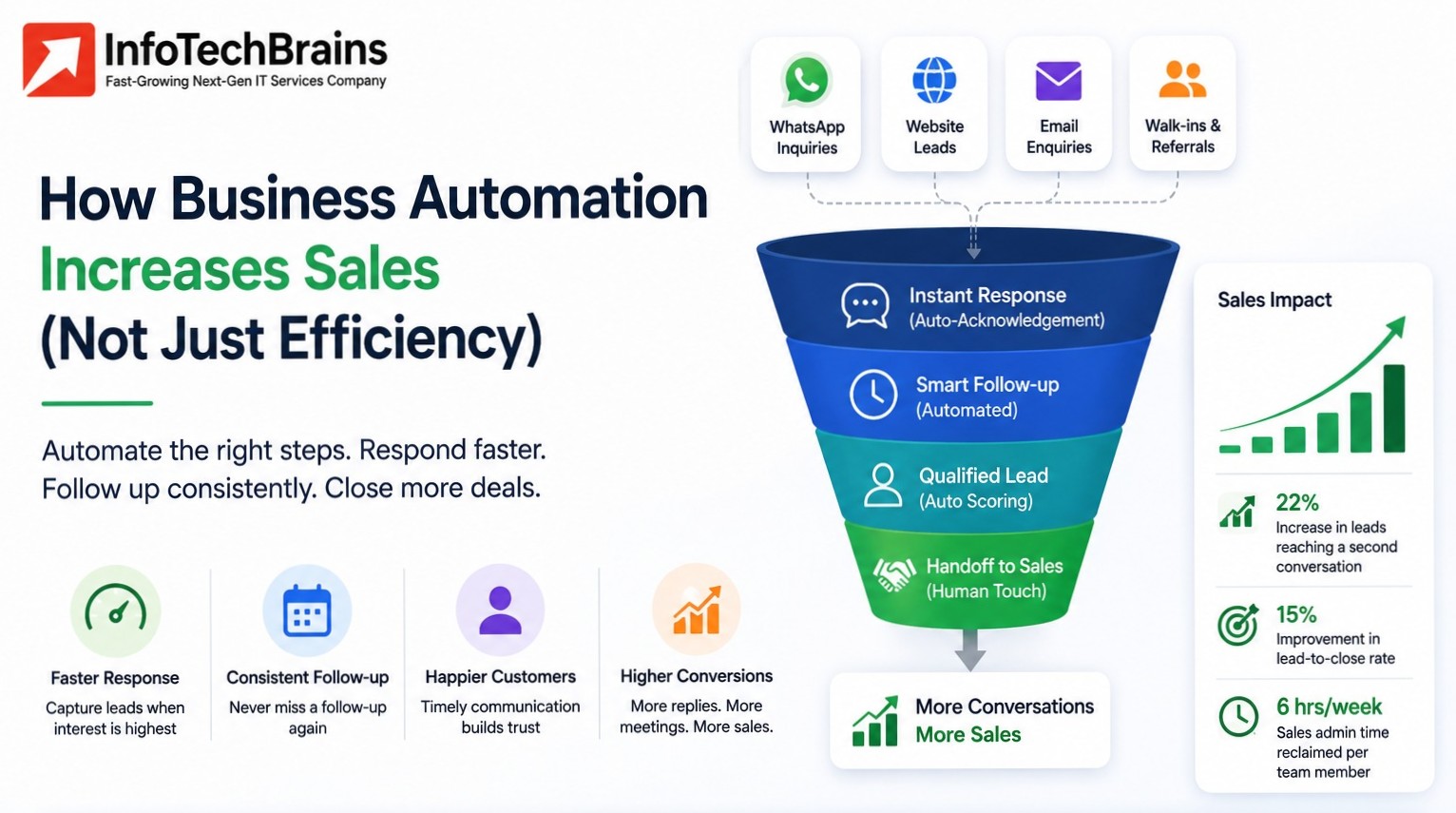
How Business Automation Increases Sales (Not Just Efficiency)
Most conversations about business automation focus on efficiency fewer manual tasks, less admin work, more hours in the day. All true, and all valuable. But for a business owner staring at a sales target, the more pressing question is usually simpler: will this actually help me sell more? The honest answer is yes just not always through the mechanism people expect.
Automation rarely increases sales by replacing your sales team or writing cleverer pitches. It increases sales by fixing the quiet, unglamorous leaks in your sales process the lead that didn't get called back fast enough, the follow-up that got forgotten in the noise of a busy week, the existing customer who never heard about a relevant new product because nobody had time to reach out. This article walks through exactly where those leaks happen and how automation closes them.
It's a distinction worth sitting with, because it changes how you should think about return on investment. Efficiency-focused automation saves money by reducing hours worked. Sales-focused automation makes money by capturing revenue that was already achievable but was slipping through gaps in timing, memory, and bandwidth. For most growing Indian SMBs, that second category delivers a faster, more visible return because the upside shows up directly on the sales report, not buried in a reduced overhead line.
The Hidden Leaks in a Manual Sales Process
Before looking at solutions, it's worth being specific about where manual sales processes actually lose revenue because the losses rarely show up as a single dramatic failure. They show up as a slow, steady drip.
Slow Response to New Leads
A lead that comes in through a website form, a WhatsApp inquiry, or a walk-in often has a narrow window of genuine interest. If your team responds within minutes, conversion odds are meaningfully higher than if the same lead waits hours or, worse, a full day because the person handling inquiries was busy with something else.
Inconsistent Follow-Up
Most sales aren't won on the first conversation. They're won on the third or fourth follow-up the one that happens only if someone remembers to make it. In a manual process, follow-up consistency depends entirely on individual discipline, which means it's the first thing to slip when a salesperson gets busy or distracted by more urgent-feeling tasks.
Existing Customers Left Unattended
New leads get the attention; existing customers, who are statistically far easier to sell to again, often don't. Without a system prompting timely check-ins, cross-sell opportunities, or renewal conversations, that easier revenue simply goes uncollected.
Sales Time Consumed by Admin, Not Selling
Every hour a salesperson spends manually updating a spreadsheet, chasing internal approvals, or typing out the same quote template from scratch is an hour not spent actually talking to a prospect. In many Indian SMBs, sales staff spend a surprisingly large share of their week on this kind of low-value administrative work.
This particular leak is easy to underestimate because it doesn't feel like lost revenue in the moment it feels like normal, necessary work. But a salesperson who spends ten hours a week on data entry and quote formatting has effectively lost a quarter of their selling capacity to tasks that add no value a customer would ever notice or care about.
|
The Real Cost of These Leaks None of these leaks look dramatic individually a slightly delayed reply here, a missed follow-up there. But across a full sales pipeline over a full year, they routinely account for a meaningful share of deals that should have closed but quietly didn't. |
What makes these leaks particularly frustrating is that they're entirely avoidable none of them stem from a weak product, uncompetitive pricing, or a genuinely lost sale to a better competitor. They're process failures, not market failures, which is precisely why automation is such an effective fix: it targets the process, leaving the parts of selling that actually require human skill and relationship-building untouched.
Where Automation Actually Moves the Sales Needle
Each of the leaks above has a fairly direct automation fix none of which require replacing your sales team's judgment, only removing the parts of the job that never needed a human in the first place.
|
Sales Leak |
Automation Fix |
Typical Impact |
|
Slow lead response |
Instant auto-acknowledgment + immediate task assignment to a salesperson |
Higher contact and conversion rates on fresh leads |
|
Inconsistent follow-up |
Scheduled follow-up sequences that trigger automatically until a lead responds or converts |
Fewer leads silently going cold |
|
Neglected existing customers |
Automated check-in and cross-sell reminders based on purchase history |
Incremental revenue from an already-warm audience |
|
Admin-heavy sales process |
Auto-generated quotes, automatic CRM updates from WhatsApp or email |
More actual selling hours per salesperson per week |
The common thread across all four fixes is speed and consistency automation doesn't out-persuade a good salesperson, but it makes sure that every lead gets the fast, reliable follow-up that a good salesperson would give if they had unlimited time and perfect memory, which of course nobody does. That gap between what a great salesperson would do with unlimited bandwidth and what actually happens under real-world time pressure is exactly the gap automation is built to close.
Building an Automated Funnel Without Losing the Human Touch
The businesses that get the most out of sales automation are careful about where they draw the line between automated and human-handled. Automating the wrong step can make a sales process feel impersonal exactly when a prospect needed reassurance from a real person and that misstep can cost a deal automation was supposed to help win.
Automate the Repetitive, Time-Sensitive Steps
Initial acknowledgment, basic qualifying questions, scheduling a call, sending standard pricing information these are ideal candidates for automation because speed matters more than personal nuance at this stage.
Keep Humans at the Judgment Points
Negotiating final pricing, handling objections, and closing a significant deal still benefit enormously from a real conversation. Automation should hand a warm, well-qualified lead to a salesperson at the right moment, not attempt to replace that conversation entirely.
Make the Handoff Feel Seamless
A prospect shouldn't be able to tell exactly where the automated interaction ended and the human one began. This usually means the salesperson picking up the conversation has full context what was asked, what was already answered rather than starting from zero and asking the prospect to repeat themselves.
|
InfoTechBrains Approach We design sales automation around this handoff point specifically fast, consistent automation for the repetitive early stages, with a clean, well-informed transition to your sales team exactly when a human conversation adds the most value. |
Case Study: Automation That Closed More Deals
A B2B industrial equipment distributor in Pune was generating a healthy volume of inbound leads through their website and trade show contacts, but their sales team, stretched thin across both new leads and existing accounts, was struggling to follow up consistently. An internal review found that nearly a third of leads received no second follow-up at all after the first contact attempt failed to connect.
InfoTechBrains implemented an automated lead response and follow-up sequence instant acknowledgment on inquiry, a structured four-touch follow-up sequence over two weeks if a lead went quiet, and automatic CRM logging so the sales team always had accurate, current context on every prospect.
|
22% Increase in leads reaching a second conversation |
15% Improvement in overall lead-to-close rate |
6 hrs/week Sales admin time reclaimed per team member |
The sales manager's own assessment captured it well: the team hadn't gotten better at selling they'd simply stopped losing deals to silence. Automation didn't replace a single conversation that mattered; it made sure far fewer of those conversations failed to happen in the first place, which turned out to be worth more to the bottom line than any new sales technique the team could have learned. For a business already investing time and marketing spend to generate leads in the first place, that alone makes automated follow-up one of the highest-return additions available not because it's flashy, but because it stops revenue that was already earned from quietly slipping away.
|
Ready to Turn Automation Into More Closed Deals? InfoTechBrains helps Indian SMBs automate the sales follow-up, lead response, and admin work that's currently costing them closed deals. Call / WhatsApp: +91 84594 18970 Visit: https://infotechbrains.com/ |
About the author
InfoTechBrains Team
Technology expert focused on software architecture, automation, and digital transformation.
View profile & all posts →