Custom CRM Software Development: When You Need One
Custom CRM software development means building a tailored customer relationship management system from scratch to match unique business workflows, security rules, and internal integrations, rather than forcing your operations to fit rigid off-the-shelf software templates.
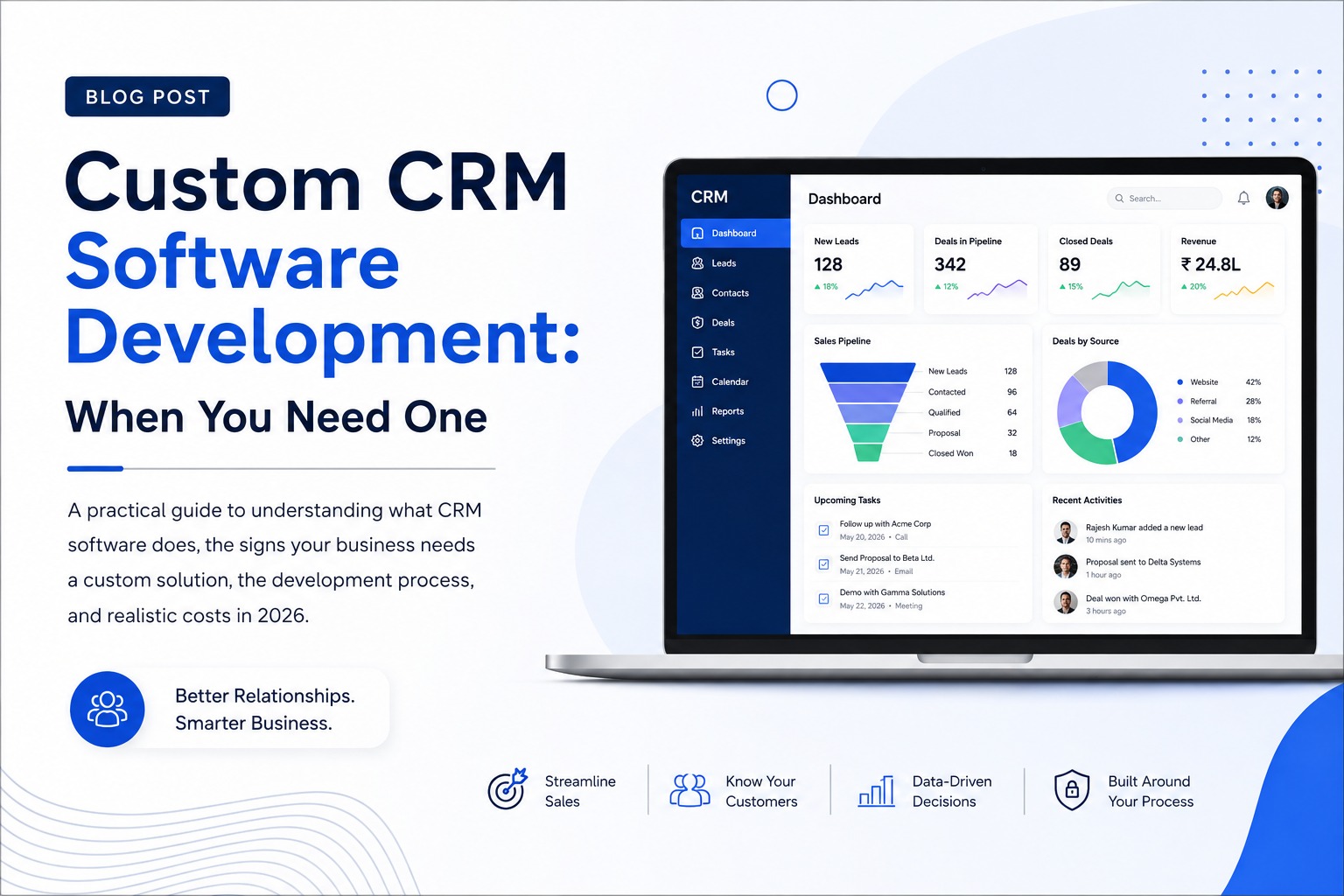
Custom CRM Software Development:
When You Need One
CRM has become one of those terms every growing business knows it needs, without always being entirely sure what it actually means in practice. For some businesses, an off-the-shelf CRM platform configured with a bit of setup and a few custom fields genuinely covers everything they need for years. For others, that same off-the-shelf platform becomes a source of constant friction almost from day one, forcing a sales or service process into a shape it was never designed to hold.
The difference between these two outcomes rarely comes down to the quality of the platform. It comes down to whether the business's actual sales and customer relationship process fits what a generic CRM assumes and when it doesn't, custom CRM development becomes a genuinely better long-term investment than continuing to force-fit a mismatched tool. This guide walks through what CRM software actually does, the clearest signs it's time to consider a custom build, what that process actually involves, and what it realistically costs for an Indian business making this evaluation in 2026.
This is a decision worth getting right the first time, because switching CRM platforms after a business has invested years of customer data, workflow habits, and team training into one system is genuinely disruptive and costly to undo. Understanding upfront whether your business is a natural fit for an off-the-shelf platform or a strong candidate for a custom build saves the far more expensive cost of migrating away from a mismatched choice later, once switching costs have compounded.
What CRM Software Actually Does
At its core, a CRM (Customer Relationship Management) system centralizes every interaction a business has with a lead or customer inquiries, calls, meetings, quotes, purchases, and support requests into one shared, structured record, rather than scattered across individual salespeople's memory, personal notebooks, and disconnected spreadsheets that only the person who created them can fully interpret.
Beyond simple record-keeping, a properly used CRM drives specific business outcomes: it ensures leads get followed up consistently rather than falling through cracks, gives managers visibility into what's actually happening across the sales pipeline, and preserves institutional knowledge about a customer relationship even if the salesperson who originally built it leaves the company.
A well-implemented CRM also changes how a business makes decisions. Instead of relying on a salesperson's memory or gut feel about which deals are likely to close this month, a manager can see actual pipeline data how many deals are at each stage, how long deals typically take to move from one stage to the next, and which specific deals have gone quiet and need attention urgently. This visibility is often the single biggest operational shift a CRM introduces, more impactful day to day than any individual feature the platform offers.
Off-the-Shelf CRM vs. Custom CRM Development
Popular off-the-shelf CRM platforms are built to serve an extremely broad range of businesses, which means their default structure leads, contacts, deals, a standard pipeline of stages reflects a generalized, average sales process rather than any specific business's actual workflow.
For businesses whose sales process genuinely resembles that generalized structure, this works well. A straightforward B2B sales cycle inquiry, qualification, proposal, close maps cleanly onto what nearly every off-the-shelf CRM offers out of the box, often with minimal configuration required beyond basic setup and field naming.
The mismatch appears when a business's actual process diverges meaningfully from that generic structure multi-party approval chains, industry-specific compliance documentation tied to each deal, a sales cycle that branches differently depending on product line, or integration needs with existing systems that off-the-shelf platforms handle only through expensive, fragile third-party connectors that frequently break with routine platform updates.
This mismatch tends to surface gradually rather than immediately. A business often adopts an off-the-shelf CRM, finds it works reasonably well for the first several months, and only later notices the accumulation of small workarounds a supplementary spreadsheet here, a manual cross-check there that quietly signal the platform never quite fit as well as it initially appeared to during the sales demo and early onboarding period.
|
Factor |
Off-the-Shelf CRM |
Custom CRM Development |
|
Setup Speed |
Fast live within days to a few weeks |
Slower weeks to a few months depending on complexity |
|
Cost Structure |
Lower upfront, ongoing per-user subscription |
Higher upfront, no per-user licensing over time |
|
Process Fit |
You adapt your workflow to the platform |
The platform is built around your actual workflow |
|
Industry-Specific Needs |
Often requires workarounds or paid add-ons |
Built in natively from the start |
|
Scalability of Customization |
Limited by the vendor's platform architecture |
Extended as your business and needs evolve |
|
Best Fit For |
Standard sales processes, tight budgets, fast timelines |
Complex or industry-specific workflows, long-term scale |
Signs You Need Custom CRM Development
Beyond the general off-the-shelf versus custom framing above, a few specific, concrete signals reliably indicate that a business has reached the point where custom development is worth serious evaluation rather than continued patchwork adjustment.
• Your sales or service process has multiple approval stages, branching logic, or industry-specific steps that a generic pipeline can't accurately represent
• Your team maintains parallel spreadsheets alongside the CRM to track information the platform simply has no field or module for
• You've paid for multiple third-party add-ons or integrations trying to patch gaps in your CRM's native functionality, and the costs keep climbing
• Per-user licensing costs have grown disproportionately as your team has expanded, with the pricing model no longer making sense at your current scale
• Your business has genuinely unique compliance, documentation, or industry-specific tracking needs that off-the-shelf platforms weren't designed to handle natively
• You need deep, reliable integration with an existing ERP, inventory, or industry-specific system that off-the-shelf CRM connectors handle poorly or unreliably
• Your management team routinely has to manually reinterpret or rebuild standard reports before they're useful in an actual decision-making meeting
|
The Workaround Test If your team has built more workarounds around your CRM than the CRM itself has native features to support your process, that's a strong signal the platform has stopped fitting your business the same warning sign that shows up across spreadsheets, ERP, and any other business-critical software stretched past its intended purpose. Count the workarounds honestly; the number itself is often more revealing than any single complaint about the platform. |
What Custom CRM Development Actually Involves
Custom CRM development doesn't necessarily mean building every feature from zero. In practice, the most cost-effective custom builds start from proven, standard CRM concepts and add genuine customization only where a business's process meaningfully diverges from the norm.
Process Mapping
Before any development begins, your actual sales or service process gets documented in detail every stage, every decision point, every piece of information that needs to be captured along the way. This step alone often reveals inconsistencies in how different team members currently handle the same process.
This discovery step is frequently the most valuable part of the entire engagement, independent of the software that eventually gets built. Businesses routinely discover, through this mapping exercise, that different salespeople have been quietly handling the same stage of the sales process in meaningfully different ways for years a discrepancy nobody had previously had reason to formally document, question, or reconcile across the team.
Custom Pipeline and Field Design
Rather than adapting your process to a generic "lead, deal, won/lost" structure, the CRM's pipeline stages, required fields, and branching logic are built to mirror your actual process including industry-specific documentation or approval steps a generic platform wouldn't natively support.
This might mean a pipeline that branches differently depending on deal size, requiring additional approval stages above a certain value, or one that tracks industry-specific compliance documents as a required field before a deal can progress structural flexibility that off-the-shelf platforms typically only offer through complex, expensive configuration, if they offer it at all.
Integration With Existing Systems
A custom CRM can be built with deep, reliable integration into your existing ERP, inventory, or industry-specific tools from the outset, rather than relying on brittle third-party connectors that break with every platform update.
This integration depth matters more than it might initially seem. A CRM that can automatically pull real-time inventory availability, past order history, or account payment status directly into a sales conversation gives your team meaningfully more context and considerably more credibility with the customer than one requiring a salesperson to manually check three separate systems before answering even a simple customer question about order status.
Reporting Built Around Your Actual Metrics
Rather than generic sales reports that may not reflect what actually matters to your business, custom CRM reporting can surface the specific metrics your management team cares about metrics an off-the-shelf platform's standard reports were never designed to capture.
For a business with a genuinely unusual sales cycle, this often means the difference between reports that require manual reinterpretation before every management meeting and reports that can be reviewed directly, exactly as generated, because they were built from the outset around the specific, concrete questions leadership actually needs answered week to week.
You Don't Always Need to Choose Extremes
The decision between off-the-shelf and fully custom CRM isn't always binary. A growing number of businesses find real value in a hybrid approach starting with a proven off-the-shelf platform's core structure for standard functions like contact management and basic pipeline tracking, then layering custom-built modules on top specifically for the parts of their process that genuinely diverge from the norm. This middle path deserves serious consideration before committing to either extreme.
This hybrid path can meaningfully reduce both cost and risk compared to a fully custom build from scratch, while still solving the specific structural mismatches that make a pure off-the-shelf approach frustrating. It works best when the divergence from standard CRM logic is contained to one or two specific areas a particular approval workflow, a specific compliance requirement rather than touching nearly every part of how the business actually operates day to day.
How to Evaluate Whether You're a Good Candidate for This Hybrid Path
Ask specifically which parts of your current CRM frustrate your team the most, and whether those frustrations cluster around one or two specific processes, or are spread broadly across nearly everything the platform touches. A narrow cluster of frustration usually suggests a hybrid approach; broad, pervasive mismatch across most of your workflow usually points toward a fully custom build being the more sustainable long-term choice.
This evaluation is worth doing formally rather than relying on a general impression, since the answer directly shapes both cost and timeline. A hybrid build addressing one clearly defined pain point can often be scoped and delivered considerably faster, and at lower cost, than a fully custom system provided the underlying mismatch really is contained rather than symptomatic of a deeper, more pervasive process fit problem across the entire sales operation.
What Custom CRM Development Realistically Costs
Costs vary considerably based on complexity, integration needs, and how far the build diverges from standard CRM concepts. These ranges reflect typical 2026 positioning for Indian businesses evaluating custom CRM development.
|
Project Scope |
Typical Features |
Approx. Cost Range (INR) |
|
Focused Custom Build |
Custom pipeline, a handful of specific integrations, core reporting |
₹3-8 lakh |
|
Mid-Complexity Build |
Multi-stage approval workflows, several system integrations, custom reporting dashboards |
₹8-20 lakh |
|
Enterprise-Grade Build |
Complex branching logic, deep ERP/industry-system integration, advanced analytics |
₹20 lakh and above |
It's worth comparing these figures against the real, cumulative cost of an off-the-shelf platform over the same multi-year period per-user licensing fees, paid add-ons purchased to patch functionality gaps, and the internal staff time spent maintaining parallel spreadsheets for whatever the CRM can't handle natively. For a growing sales team, that cumulative cost frequently exceeds what a well-scoped custom build would have cost outright, particularly once the business has grown past the size where per-user pricing was originally attractive and reasonable.
What This Looks Like in Practice
A commercial real estate brokerage in Visakhapatnam had been running their client and deal pipeline through a popular off-the-shelf CRM for two years, paying escalating per-user fees as their team grew while still maintaining a separate spreadsheet to track the multi-party approval chains and site-visit documentation their specific business required information the CRM's generic "deal" structure had no proper place for.
The brokerage had actually tried several rounds of customization within the existing platform before considering a custom build adding custom fields, experimenting with third-party add-ons for document tracking, and asking their existing CRM vendor's support team for workarounds. Each attempt provided partial relief but never fully resolved the underlying structural mismatch, since the platform's core pipeline logic simply wasn't built to represent a real estate deal's genuinely branching, multi-party approval process from the ground up.
InfoTechBrains built a custom CRM around their actual deal lifecycle from initial inquiry through site visits, multi-party negotiations, and final documentation with each stage capturing exactly the information their process actually required, and deep integration with their existing accounting system that the previous CRM's generic connector had never handled reliably.
The build process began with two weeks of process mapping across their sales team, which surfaced meaningful inconsistencies in how different agents handled site-visit documentation inconsistencies that had been quietly causing compliance gaps nobody had previously connected directly to their CRM's structural limitations, having instead attributed the issue to individual agent carelessness rather than a genuine systems problem.
|
100% Elimination of the parallel tracking spreadsheet |
45% Lower total cost vs. continued per-user CRM licensing over 3 years |
7 weeks From process mapping to go-live |
The 45% figure specifically accounted for the previous platform's escalating per-user fees, the third-party add-ons purchased over two years trying to patch functionality gaps, and an estimate of internal staff time spent maintaining the parallel spreadsheet a fuller accounting than simply comparing one software subscription price against another, and one the brokerage's finance team hadn't fully tallied until undertaking this evaluation directly.
The brokerage's managing partner summarized the shift simply: for the first time, the system reflected how deals in their business actually moved from inquiry to close, rather than forcing every deal into a generic pipeline that had never quite matched their reality. The broader lesson for any growing business evaluating this decision: off-the-shelf CRM is a genuinely strong starting point for most businesses, but recognizing when your process has outgrown it rather than continuing to force-fit a mismatched tool indefinitely is what separates businesses getting real value from their CRM investment from those quietly maintaining a shadow spreadsheet alongside a system that was supposed to replace it entirely. That recognition, more than any specific feature or price point, is ultimately what determines whether a CRM investment pays off.
|
Outgrown What Off-the-Shelf CRM Can Offer? InfoTechBrains builds custom CRM systems around your actual sales process — not a generic pipeline you have to adapt your business to fit. Call / WhatsApp: +91 84594 18970 Visit: https://infotechbrains.com/ |
About the author
InfoTechBrains Team
Technology expert focused on software architecture, automation, and digital transformation.
View profile & all posts →