Custom App Development Company vs. Freelancers: Pros & Cons
Choosing between a custom app development company and a freelancer depends on your budget, project size, and how much ongoing support you need.
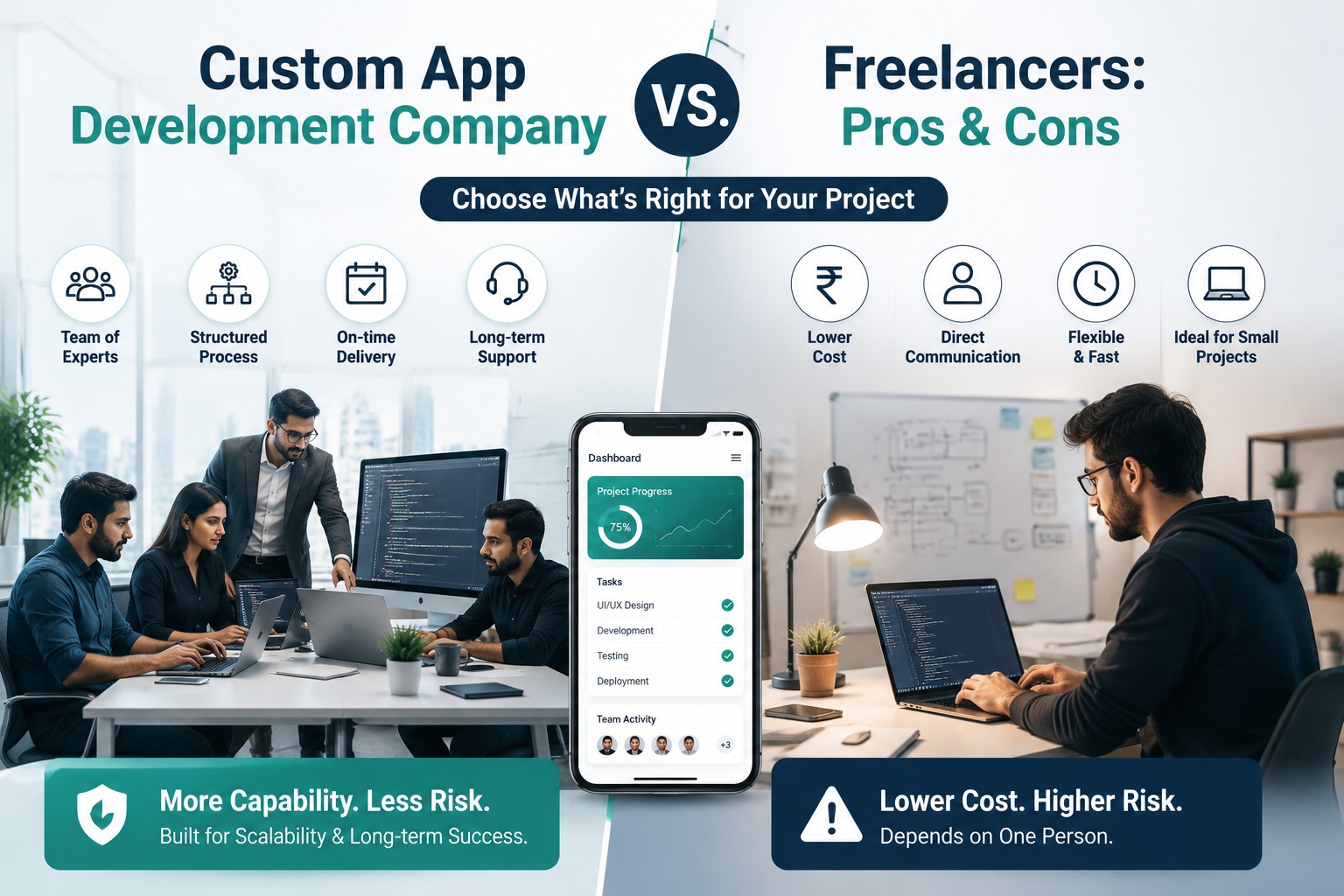
Custom App Development Company
vs. Freelancers: Pros & Cons
Every business planning a custom app faces the same early fork in the road: hire a freelancer, who typically offers a lower price and direct one-on-one communication, or hire a development company, which typically costs more but brings a broader team, more structured process, and greater accountability. Neither option is universally right for every situation, and most of the generic advice available online "always hire an agency" or "freelancers are cheaper and just as good" oversimplifies a decision that genuinely depends on your specific project, budget, and risk tolerance.
This guide breaks down the real trade-offs between these two paths honestly, including where each option tends to fail businesses that chose it for the wrong reasons, so you can make this decision based on your actual project rather than generic advice that doesn't account for your specific situation.
It's worth stating upfront that this comparison deliberately avoids declaring a universal winner, because the honest answer genuinely depends on factors specific to your project. A business searching for a simple, one-size-fits-all recommendation may find that frustrating but that same instinct to reach for a quick, generic answer is often exactly what leads businesses to a mismatched choice they later regret.
The Core Trade-off: Cost vs. Capability and Risk
At the heart of this decision is a simple trade-off that most comparisons skip over in favor of listing generic pros and cons: freelancers generally offer lower cost and more direct communication, in exchange for concentrated risk and limited capacity. Development companies offer broader capability and reduced risk, in exchange for higher cost and sometimes less direct access to the people actually doing the work day to day.
Understanding this trade-off clearly rather than treating one option as simply "better" is what allows you to match the right choice to your specific project's complexity, timeline, and tolerance for things going wrong along the way, instead of relying on a generic rule of thumb that doesn't actually fit your situation.
Freelancers: The Real Pros and Cons
Where Freelancers Genuinely Excel
• Lower cost, often 30-50% less than an equivalent development company quote for a similar scope
• Direct communication with the person actually writing your code, with no account manager layer in between
• Greater flexibility and willingness to accommodate unconventional project structures or tight, informal budgets
• Often faster initial response and quicker project kickoff, since there's no internal sales or onboarding process to navigate
Where Freelancers Create Real Risk
• Single point of failure illness, a competing project, or simply disappearing mid-project can leave you stranded with an incomplete app and no clear path forward
• Limited capacity for projects requiring multiple specialized skills simultaneously a freelancer strong in backend development may be genuinely weak in UI design, or vice versa
• Inconsistent documentation practices, since freelancers working alone often keep critical project knowledge in their own head rather than in shared, accessible documentation
• No institutional backup if a freelancer becomes unavailable, finding someone else to pick up an unfamiliar, undocumented codebase is often more expensive than starting over
• Limited long-term support capacity, since a freelancer's availability for post-launch maintenance depends entirely on their personal schedule and other client commitments
Development Companies: The Real Pros and Cons
Where Development Companies Genuinely Excel
• Team redundancy if one team member is unavailable, others can step in without the project stalling entirely
• Broader skill coverage under one roof design, frontend, backend, and QA specialists working together rather than one person stretched across every discipline
• More structured project management, documentation practices, and formal contracts that provide clearer recourse if something goes wrong
• Greater capacity to scale a project up if requirements grow mid-development, without needing to onboard an entirely new person
• More reliable long-term post-launch support, backed by an organization rather than a single individual's ongoing availability
Where Development Companies Fall Short
• Higher cost, reflecting the overhead of a larger team, project management structure, and business operations
• Communication sometimes filtered through account managers rather than direct access to the engineers actually building your app
• Larger companies in particular may allocate less senior attention to smaller projects, prioritizing higher-value clients internally
• Slower initial kickoff in some cases, due to more formal sales, contracting, and onboarding processes
Side-by-Side Comparison
|
Factor |
Freelancer |
Development Company |
|
Typical Cost |
Lower, often 30-50% less |
Higher, reflecting team and process overhead |
|
Risk of Project Stalling |
Higher single point of failure |
Lower team redundancy |
|
Skill Breadth |
Limited to individual's expertise |
Broader, multiple specialists available |
|
Communication |
Direct with the actual builder |
Often through an account manager or lead |
|
Documentation Quality |
Varies widely by individual habits |
Generally more structured and consistent |
|
Long-Term Support Reliability |
Dependent on individual availability |
Backed by the organization, more consistent |
|
Best Fit |
Small, simple, well-defined projects |
Complex, business-critical, or scaling projects |
|
Neither Option Is Inherently Safer A skilled, experienced freelancer with a proven track record can genuinely outperform a poorly run development company, and a disorganized development company can create just as much risk as a freelancer disappearing mid-project. Evaluate the specific person or team in front of you, not just the category they fall into. |
How to Vet Either Option Properly
Regardless of which path you lean toward, the actual quality of the individual freelancer or specific development company matters more than the category itself. A few vetting practices apply usefully to both, and skipping them is a common thread across most of the regret stories businesses share after a project goes sideways.
Review Actual Working Products, Not Just Portfolios
Screenshots and case study write-ups can flatter any level of work. Ask to actually use a live app the freelancer or company has built download it, click through it, notice how it performs under real conditions rather than a curated demo environment.
Ask About Availability and Capacity Honestly
For freelancers specifically, ask directly how many other projects they're currently juggling and what their realistic weekly capacity looks like for your work. For companies, ask which specific team members will be assigned and whether that team is currently stretched across many simultaneous client projects.
Request a Small Paid Trial Before the Full Commitment
Whether working with a freelancer or a company, a small, paid initial task a single feature, a focused piece of design work reveals communication style, code quality, and reliability far more reliably than any conversation or portfolio review, at a fraction of the risk of committing to the full project upfront.
Clarify Ownership and Handoff Terms Explicitly
Regardless of path, confirm in writing that you'll own the full source code, design files, and any account credentials once the engagement ends. This matters especially with freelancers, where informal arrangements sometimes leave ownership terms vague until a dispute forces the question.
Which Option Actually Fits Your Project
• A simple app with a narrow, well-defined feature set and a tight budget: a skilled, well-vetted freelancer is often a genuinely reasonable choice
• An app central to your core business operations, where downtime or delay has real financial consequences: a development company's redundancy and structured process is usually worth the added cost
• A project requiring multiple specialized skills simultaneously — complex backend architecture, polished design, and rigorous QA: a development company's team breadth typically outperforms a single freelancer trying to cover every discipline
• A fast, low-stakes prototype meant purely to validate an idea before further investment: a freelancer's speed and lower cost often makes more sense for this specific, limited purpose
• An app expected to scale significantly in complexity or user base over the next one to two years: a development company's capacity to grow with the project reduces the risk of needing to switch partners mid-scale
The Hybrid Approach Some Businesses Use
It's worth noting that this decision isn't always strictly binary. Some businesses successfully use a hybrid approach engaging a development company for the initial architecture, design system, and complex backend work, then bringing in a freelancer for smaller, ongoing feature additions once the core foundation is solid and well-documented.
This approach can work well specifically because the riskiest, most foundational work the parts where a mistake is expensive to correct later benefits most from a structured team's discipline, while smaller incremental additions on top of a well-documented foundation are lower-risk work a capable freelancer can handle more affordably. The key requirement for this hybrid approach to work is genuinely thorough documentation from the initial build, since a freelancer picking up work later depends entirely on being able to understand the existing codebase without the original team's help.
Businesses considering this hybrid path should discuss it openly with their initial development partner before the project begins, since documentation practices and code structure decisions made early on directly determine how easily a different developer can pick up the work later. A development company aware from the outset that a freelancer might extend the app down the line will typically structure the codebase more modularly than one assuming it will handle every future change itself.
Common Regret Patterns Worth Learning From
Beyond the general pros and cons, a few specific regret patterns show up repeatedly among businesses that later wished they'd chosen differently patterns worth understanding before making your own decision.
Choosing a Freelancer Purely on Price
Businesses that select a freelancer based primarily on being the cheapest option, without carefully vetting past work and communication style, disproportionately end up among those describing a stalled or abandoned project. Price alone is a poor predictor of reliability, and the cheapest freelancer quote often reflects underestimating the actual project scope rather than genuine efficiency.
This pattern tends to compound in a predictable way: a low quote wins the contract, the freelancer realizes partway through that the actual work required exceeds what they budgeted time for at that price, and the project either stalls, gets rushed toward a lower-quality finish, or accumulates scope disputes as the freelancer pushes back on work they now consider outside the original agreement leaving the client caught in the middle of a disagreement that a clearer initial scope document might have prevented entirely.
Choosing a Large Company for a Small Project
Conversely, businesses with a small, simple app sometimes engage a large development company more suited to enterprise-scale projects, ending up paying enterprise-level overhead for a project that never needed that level of process and structure. Matching the scale of your partner to the scale of your actual project matters in both directions.
This mismatch often shows up as unnecessary process overhead extended discovery phases, multiple layers of sign-off, and account management costs applied to a project simple enough that a smaller, more agile team could have delivered the same result faster and at a fraction of the cost, without meaningfully sacrificing quality.
Skipping Reference Checks Regardless of Path
Whether hiring a freelancer or a company, skipping the step of actually speaking with past clients not just reading testimonials on a website is one of the most consistent predictors of a project going wrong. A five-minute reference call routinely surfaces information no portfolio or pitch ever will.
The specific questions matter here too. Rather than a generic "were you happy with the work," ask a past client what actually went wrong at any point during the project and how it was resolved. Every real project has some friction along the way a reference who claims a perfectly smooth process with zero issues is often less useful, and less credible, than one willing to describe a real problem and how the freelancer or company actually handled it.
Underestimating Post-Launch Needs at the Outset
A final regret pattern worth naming: businesses that evaluate freelancers and companies purely on their ability to build the initial version, without seriously weighing who will realistically handle bug fixes, OS updates, and feature additions a year down the line. An app is rarely a finished product at launch it's the start of an ongoing need, and the partner best suited to the initial build isn't always the one best positioned for years of reliable follow-up support.
What This Looks Like in Practice
A small but fast-growing fitness studio chain in Mysore initially hired a freelancer to build a class-booking app, drawn by a quote roughly half of what development companies were proposing. Six weeks in, the freelancer took on a larger competing project and communication slowed to occasional, delayed responses, leaving the studio with a partially built app and no clear timeline for completion.
The studio had done a reasonable amount of diligence before hiring reviewing the freelancer's portfolio and speaking briefly by phone but hadn't asked specifically about current workload or requested a small paid trial task before committing to the full project. In hindsight, the owner acknowledged that a more thorough vetting process, even with the same freelancer, might have surfaced the capacity risk before it became a real problem.
When they approached InfoTechBrains, the first step was an honest audit of the existing codebase, which turned out to be salvageable but poorly documented usable as a foundation, but requiring real investment to understand before building further. Rather than starting over, InfoTechBrains completed the build using a small, dedicated team, formally documenting the codebase along the way so future changes wouldn't face the same fragility.
|
7 weeks To complete the stalled build from where it stood |
100% Codebase now fully documented |
3-person Dedicated team assigned for project continuity |
The studio owner's own reflection was candid: the original freelancer hadn't been a bad developer the code that existed was genuinely reasonable but a single person juggling multiple clients simply couldn't guarantee the continuity a business-critical booking app needed. The lesson wasn't "never hire a freelancer"; it was that the choice should have matched the actual stakes of the project from the start, rather than being driven by the lowest quote alone. A booking app tied directly to daily revenue, he later reflected, was exactly the kind of business-critical project that warranted the redundancy a larger team provides, even at a higher upfront cost.
For any business facing this decision, the honest answer is rarely a universal rule in either direction. A freelancer and a development company are simply different tools suited to different situations the real mistake isn't choosing one over the other, it's choosing without honestly weighing your project's complexity, business criticality, and tolerance for things going wrong against what each option genuinely offers. Take the time to vet the specific person or team in front of you, request a small trial where possible, and match the scale of your partner to the actual scale of your project that discipline matters more to the outcome than which category you ultimately choose.
|
Weighing a Development Company Against a Freelancer? InfoTechBrains offers the accountability and technical depth of a full development company, with the direct communication and transparency businesses value in a smaller team. Call / WhatsApp: +91 84594 18970 Visit: https://infotechbrains.com/ |
About the author
InfoTechBrains Team
Technology expert focused on software architecture, automation, and digital transformation.
View profile & all posts →