Best ERP Software for Small Manufacturing Businesses in India (2026 Guide)
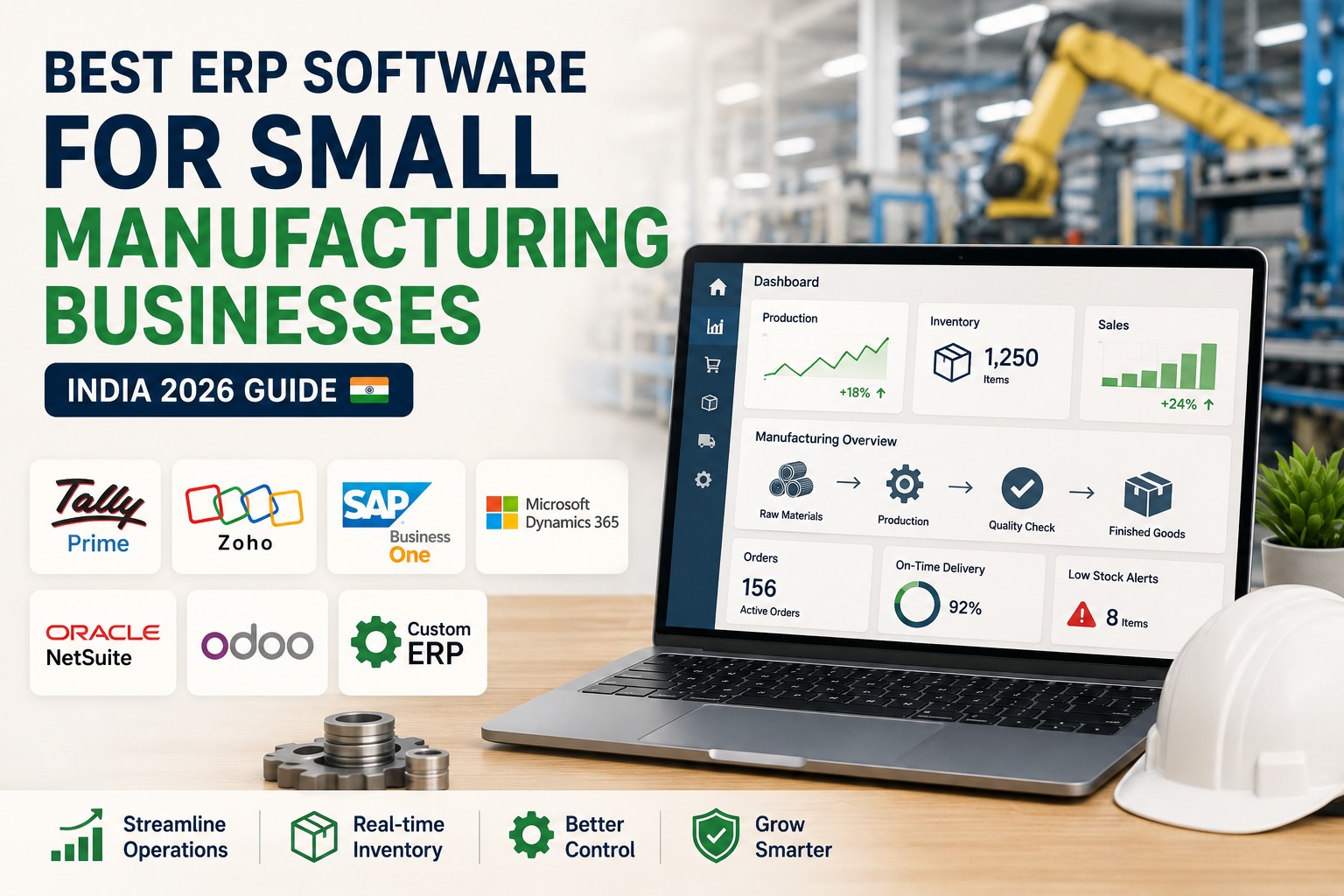
Best ERP Software for Small
Manufacturing Businesses in India (2026 Guide)
Small manufacturing businesses across India today are past the point of asking whether they need an ERP system most owners already know spreadsheets and disconnected tools can't keep up with production schedules, multi-stage inventory, and GST-compliant invoicing forever. The harder question is which ERP actually fits a business at their specific size, budget, and industry, out of a crowded field of platforms all claiming to be the right choice for every type of manufacturer.
This guide walks through the leading ERP options available to Indian manufacturing SMEs in 2026, what each one is genuinely good at, where each tends to fall short for manufacturing-specific needs, and how to think through the decision itself rather than just picking the most heavily advertised name.
One thing worth stating upfront: there is no single "best" ERP for manufacturing in India. Every platform covered here is a genuinely capable piece of software used successfully by real manufacturing businesses. The right choice depends entirely on your production complexity, budget, existing tech stack, and how far you're planning to scale which is exactly why this guide compares them honestly rather than crowning a single winner.
Why ERP Selection Matters More for Manufacturers
Manufacturing has requirements that many other business types simply don't multi-stage production tracking, bill-of-materials management, raw material to finished goods conversion, batch traceability, and often OEM-driven documentation standards. A generic accounting or inventory tool can look perfectly capable in a demo and still fall apart once it meets a real, multi-stage production floor.
This is exactly why the "bestERP" answer isn't universal. A garment exporter, an auto-components manufacturer, and a packaging unit can each have very different needs even though all three are technically "manufacturers." The right approach is understanding what each major platform is built to handle well, then matching that against your specific production process.
It's also worth being realistic about cost beyond the sticker price. Implementation time, staff training, data migration, and ongoing customization all add to the real cost of any ERP sometimes significantly more than the software license itself. A platform that looks cheaper upfront can end up more expensive over two or three years if it requires constant workarounds for your specific manufacturing process, so comparing sticker price alone is one of the most common mistakes manufacturers make during evaluation.
Leading ERP Options for Indian Manufacturing SMEs
Here's an honest look at where each major platform tends to fit best, based on how Indian manufacturing businesses are actually using them in 2026.
|
Platform |
Best Suited For |
Key Strength |
|
TallyPrime |
Small manufacturers needing strong GST compliance and accounting |
Deep alignment with Indian tax and invoicing requirements |
|
Zoho ERP/Books suite |
Growing SMEs wanting lower-complexity cloud deployment |
Fast implementation, AI-driven features, strong Indian business focus |
|
SAP Business One |
Mid-sized manufacturers needing tighter operational control |
Modular structure that scales as the business grows |
|
Microsoft Dynamics 365 Business Central |
Manufacturers already using Microsoft's ecosystem |
Strong workflow automation and supply chain visibility |
|
Oracle NetSuite |
Multi-location manufacturers needing deep financial visibility |
Cloud-first architecture built for expansion across regions |
|
Odoo |
Budget-conscious SMEs wanting broad functionality |
Free/low-cost entry point with a wide range of modules |
|
Manufacturers with workflows generic platforms don't fit |
Built around your exact production process, no workarounds needed |
TallyPrime
TallyPrime remains one of the most widely used platforms among Indian manufacturers and SMEs, largely because it was built around Indian business requirements from the ground up. GST handling, invoicing, banking, and payroll all sit within a single, familiar interface, making it a comfortable entry point for businesses transitioning off pure accounting software.
Zoho's ERP Suite
Zoho has expanded aggressively into ERP territory, with a strong focus on Indian retail, distribution, and manufacturing businesses. Its cloud-based deployment tends to mean lower implementation complexity than traditional enterprise platforms, and its growing set of AI-driven features make it a reasonable option for businesses wanting modern capability without an enterprise-level budget.
SAP Business One
SAP Business One is aimed at small and mid-sized manufacturers needing stronger operational control across finance, inventory, procurement, and production than entry-level tools typically offer. Its modular structure allows functionality to be added as a business scales, making it a common choice for manufacturers planning meaningful growth over the next several years.
Microsoft Dynamics 365 Business Central
For manufacturers already operating inside the Microsoft ecosystem, Dynamics 365 offers workflow monitoring, automated alerts, and production visibility across the supply chain, integrating naturally with tools like Excel and Outlook that staff may already be comfortable using daily.
Oracle NetSuite
NetSuite is a cloud-first platform aimed at businesses needing deeper financial visibility and multi-location management, and tends to suit manufacturers expanding across regions or managing more complex operational structures than a single-site business would need.
Odoo
Odoo offers a genuinely broad, low-cost entry point into ERP functionality, covering everything from inventory to HR to project management within one ecosystem. It's a common starting point for budget-conscious SMEs, though manufacturing-specific depth often requires additional configuration or paid modules as needs grow more specific.
|
Where All Six Tend to Hit a Wall Every platform above is a genuinely solid piece of software. But all of them are built to serve a broad range of industries, which means manufacturing-specific needs batch traceability tied to OEM documentation, multi-stage BOM tracking, tooling maintenance schedules often require workarounds, paid add-ons, or configuration that eats into the timeline and budget these platforms were chosen to save. |
How to Choose the Right One for Your Business
Rather than starting from "which is the best ERP," a more useful starting question is where your specific production process sits on a spectrum from standard to highly specific.
• If your production process is fairly standard single-stage manufacturing, straightforward inventory, no unusual compliance requirements a platform like TallyPrime, Zoho, or Odoo will likely serve you well with minimal customization
• If you're scaling toward multi-location operations or need deeper financial consolidation across sites, SAP Business One or Oracle NetSuite are worth serious evaluation
• If you're already committed to the Microsoft ecosystem for other tools, Dynamics 365 Business Central offers the smoothest integration path
• If your production process involves multi-stage BOMs, OEM-specific traceability, tooling maintenance schedules, or other manufacturing-specific complexity that doesn't map cleanly onto any of the above, a custom-built ERP is usually the more cost-effective path over the medium term, even though it carries a higher upfront investment
What This Looks Like in Practice
An auto-ancillary manufacturer in Aurangabad had implemented a well-known off-the-shelf ERP recommended widely across manufacturing forums, expecting it to handle their multi-stage component production out of the box. Within a few months, their production team had reverted to a parallel spreadsheet to track batch-wise material consumption, because the platform's inventory module couldn't represent their specific multi-stage process without extensive, ongoing customization that kept adding to their subscription and consulting costs.
InfoTechBrains evaluated their existing setup and, rather than recommending a switch to yet another off-the-shelf platform, built a custom ERP layer around a manufacturing-specific core proper BOM tracking, stage-wise work orders, and automated batch documentation for their OEM clients. This approach preserved the parts of their existing system that worked well, while replacing only the specific modules that had been causing ongoing friction.
|
100% Elimination of parallel tracking spreadsheets |
30% Lower ongoing cost vs. customizing the generic platform |
6 weeks From evaluation to working implementation |
The lesson for manufacturing SMEs evaluating ERP options in 2026 is straightforward: the "best" ERP isn't a single named product it's whichever platform, standard or custom, actually fits how your specific production process runs, without asking your team to work around software limitations for years to come. Getting an honest, vendor-neutral evaluation before committing is usually worth far more than following whichever platform ranks highest on a generic "best of" list. Whether that evaluation points you toward TallyPrime, Zoho, SAP Business One, or a custom-built system, the goal is the same: software that adapts to your factory, not a factory quietly adapting itself around software limitations.
|
Not Sure Which ERP Actually Fits Your Manufacturing Unit? InfoTechBrains helps Indian manufacturers evaluate off-the-shelf options and, where needed, build custom ERP systems suited to their specific production processes. Call / WhatsApp: +91 84594 18970 Visit: https://infotechbrains.com/ |
About the author
InfoTechBrains Team
Technology expert focused on software architecture, automation, and digital transformation.
View profile & all posts →